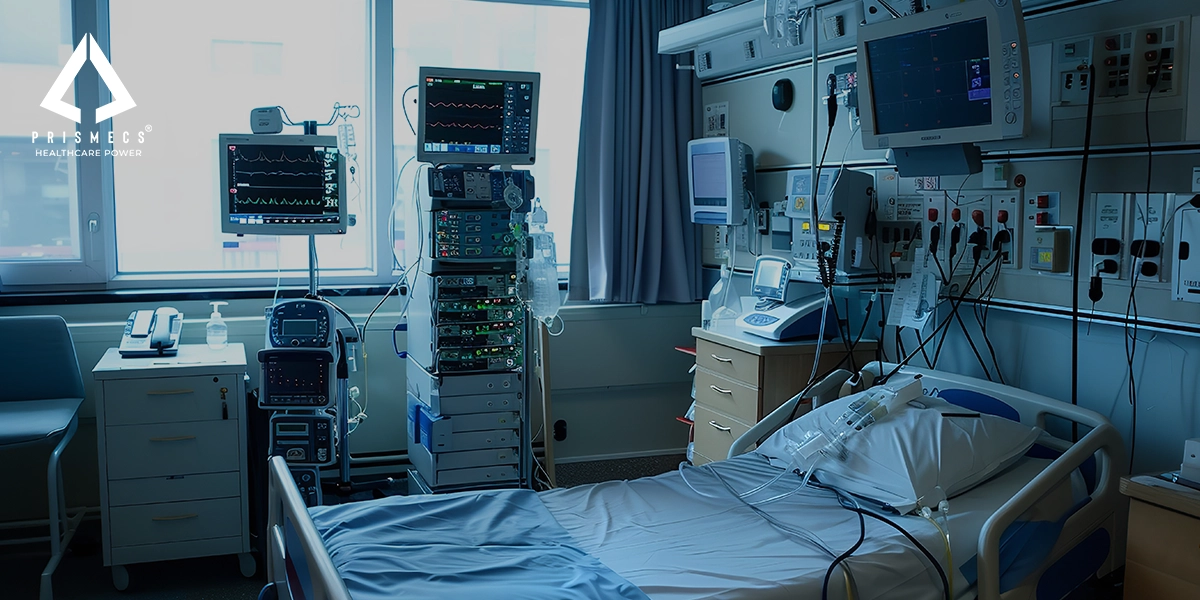
Imagine life-saving surgery in progress; an emergency patient is being stabilized in the ICU, or a complex diagnostic imaging procedure is underway in a busy medical lab. Now, picture the lights flickering, machines shutting off, and equipment that’s essential for these critical moments going down.
In the healthcare sector, where every second counts, a power outage can have catastrophic consequences. When you’re dealing with human lives, downtime is simply not an option. That’s where uninterruptible power supply (UPS) systems for medical equipment come into play.
An uninterruptible power supply (UPS) for medical equipment is not a battery backup accessory. In a healthcare environment, it is a transfer-stability layer between utility power, emergency generators, automatic transfer switches, and patient-critical equipment that cannot tolerate voltage dips, frequency instability, or even brief interruptions.
Why UPS Protection Goes Beyond Generator Backup
A hospital backup generator is built for sustained emergency power. A UPS is built for immediate power continuity. These are two different problems.
During a utility outage, a generator must detect power loss, start, stabilize, and transfer load through the ATS. The Joint Commission requires generators to provide emergency power within 10 seconds from a cold start. For many loads, 10 seconds is acceptable. For active ICU monitors, infusion pumps, and imaging systems mid-procedure, it is not.
Generator capacity answers the question of duration. UPS coverage answers the question of continuity and power quality.
A UPS also conditions power during disturbances that never become full outages: voltage sag, transient spikes, frequency drift, switching events, and harmonics. These events are invisible to most loads but can reset sensitive electronics, trigger nuisance alarms, corrupt data, or interrupt active clinical procedures.
Critical Equipment That Requires UPS Coverage

Not every load in a healthcare facility needs the same UPS strategy. Classification should be based on patient risk, transfer tolerance, device sensitivity, and operational consequence if power is lost.
ICU and Critical Care
Bedside monitors, ventilators, infusion pumps, syringe pumps, central monitoring stations, nurse call systems, and respiratory therapy devices should be prioritized. A transfer of disturbance in an ICU can cause device alarms, display resets, pump interruptions, or communication loss before clinical staff can respond. UPS coverage maintains uninterrupted operation until generator power stabilizes.
For ICU areas, UPS selection must address load criticality, inrush behavior, medical-grade isolation, branch-circuit design, battery runtime, bypass capability, and maintenance access.
Imaging Systems and Diagnostic Suites
MRI, CT, PET/CT, cath lab, fluoroscopy, and radiology workstations carry a different risk profile. A power event during imaging can interrupt a scan, corrupt image data, force repeat procedures, or trigger equipment recovery delays that affect patient throughput.
UPS coverage in imaging environments is not necessarily about backing up the entire scanner load. The priority is protecting control electronics, PACS/RIS connectivity, image reconstruction systems, chillers, and safe shutdown pathways. Separate the scanning load, control load, cooling load, and IT load then define which components need no-break power, which need short ride-through, and which can tolerate a generator transfer.
Laboratories, Blood Bank, and Pharmacy
Clinical laboratories depend on analyzers, centrifuges, incubators, reagent storage, biosafety cabinets, freezers, and sample tracking systems. Power interruption can stop active test runs, invalidate samples, and disrupt chain-of-custody data.
UPS planning for labs should target three outcomes: protect active testing, preserve data integrity, and maintain storage conditions until emergency power is stable. Blood bank refrigeration and pharmacy cold storage require particular attention to controllers, monitoring systems, alarms, and access systems.
UPS, Generator, ATS, and EPSS: How the Layers Work Together
A healthcare UPS must be engineered as part of the broader emergency power architecture. Each layer has a defined role:
Layer | Primary Role | What It Protects |
UPS | Immediate no-break power and power conditioning | Sensitive electronics, monitors, clinical IT, short transfer events |
Generator | Sustained emergency power | Extended outage operation, essential facility loads |
ATS / Switchgear | Coordinated source transfer | Safe transition between utility and emergency power |
EPSS Documentation | System readiness verification | Testing records, commissioning evidence, audit compliance |
BESS / Hybrid (optional) | Load smoothing and resilience | Load stability, emissions strategy, flexible backup capacity |
The UPS and generator layers must be coordinated. A UPS that trips during generator transfer, or a generator that sees poor load characteristics from an unconditioned UPS output, can create failures at exactly the moment the system is designed to prevent.
NFPA defines the healthcare essential electrical system as divided into branches including the life safety branch, critical branch, and equipment branch with the critical branch serving circuits important to patient care. NFPA 110 further specifies inspection, monthly exercise, and multi-year testing cycles for emergency and standby power systems.
How to Size a UPS for Medical Equipment
Nameplate totals alone are not a reliable sizing basis. A structured workflow produces more accurate results:
- Define the clinical load list - Separate ICU, imaging, lab, pharmacy, blood bank, nurse call, biomedical, and IT loads. Classify each as life-supporting, procedure-critical, data-critical, temperature-critical, or operationally important.
- Confirm actual electrical demand - Measure or verify real operating load where possible. Document kW, kVA, power factor, harmonics, inrush current, startup sequence, and load diversity.
- Define the ride-through requirement - Runtime should match the clinical risk scenario bridging a transfer event, supporting controlled shutdown, or maintaining continuity during a sustained utility disturbance.
- Coordinate with generator and ATS behavior - The UPS must tolerate the transfer sequence and generator voltage and frequency characteristics. Poor coordination causes nuisance bypass events and premature battery discharge.
- Account for maintenance and redundancy - Higher-consequence areas may require N+1 architecture, maintenance bypass, modular battery design, and integrated alarm monitoring.
- Validate environment and installation conditions - Battery life depends on temperature, ventilation, dust control, and maintenance discipline. Evaluate the physical space before procurement, especially for temporary or imaging suite deployments.
Power Quality Risks in Clinical Environments:

Medical equipment does not only fail during blackouts. Lower-profile disturbances can fault sensitive devices in ways that remain invisible to other loads on the same circuit:
Voltage sag - Can reset sensitive electronics and trigger alarms without a full outage
Transient overvoltage - Stresses power supplies, circuit boards, and device controllers
Frequency variation - Creates problems when generator output is unstable or outside the UPS input window
Harmonic distortion - Degrades power electronics and UPS efficiency
Inrush current - Overloads undersized UPS systems during startup sequences
Poor grounding and bonding - Increases equipment noise and reliability risk
Battery degradation - Reduces real ride-through time below design assumptions if not monitored
Temporary UPS and Emergency Power During Outages and Renovations
Healthcare facilities frequently need UPS support during temporary conditions: generator replacement, switchgear upgrades, imaging suite renovation, lab expansion, or emergency response windows. These scenarios require the same level of clinical rigor as permanent installations.
Temporary deployments still require cable routing, grounding, access, staging, ventilation, noise control, fuel logistics, ATS coordination, and full documentation. A temporary power package without a site-readiness plan introduces risks comparable to having no backup at all.
Prismecs Healthcare Power supports rapid-deployment temporary emergency power covering UPS coverage, generator backup, ATS coordination, commissioning, and on-call operational support with defined rental periods, transparent fees, and no unnecessary capital commitment.
Documentation and Testing Requirements
Every UPS deployment for critical medical equipment should produce a documentation package the facility team can use not just delivery paperwork. Useful records include:
- Protected equipment list and load schedule by department
- UPS sizing basis and runtime assumptions
- Battery configuration and maintenance requirements
- Single-line connection diagram
- Startup and commissioning checklist
- Transfer-event verification results
- Alarm and monitoring configuration
- Maintenance bypass procedure
- Test results and event logs
- Service contact and escalation path
- Rental term, extension conditions, and demobilization plan (for temporary equipment)
Common UPS Planning Mistakes in Healthcare
Treating all medical equipment as equal:
A lab printer, ICU ventilator, MRI control console, and blood bank freezer carry very different consequences of interruption. Load classification must precede product selection.
Sizing from nameplate data only:
Nameplate values miss inrush, power factor, and real operating profiles. Field verification reduces nuisance trips and undersizing errors.
Ignoring transfer coordination:
A UPS that performs well on utility power but reacts poorly to generator input can create failures during the exact event it was deployed to prevent.
Overlooking the battery environment:
Battery performance depends on temperature, ventilation, maintenance, and test discipline. Incorrect placement shortens service life significantly.
Missing documentation:
Without records of what was protected, how it was tested, and what assumptions were made, the deployment is difficult to defend during audits or incident reviews.
Deploying temporary equipment without site readiness:
Temporary UPS and generator systems still require grounding, access, staging, security, ventilation, and integration planning before energization.
What to Include in a UPS RFQ for Medical Facilities
A strong request for quotation gives vendors enough technical context to size and support the system correctly. At minimum, include:
- Protected equipment list by department
- Load values in kW and kVA
- Input and output voltage
- Single-phase or three-phase requirement
- Required runtime
- Generator-backed or utility-only input source
- ATS and switchgear interface requirements
- Battery type and expected service life
- Maintenance bypass configuration
- Monitoring, alerts, and remote reporting options
- Delivery location and site access constraints
- Installation, commissioning, and testing scope
- Documentation requirements
- Service response expectations
- Rental, purchase, or temporary deployment preference
At the Bottom Line
Uninterruptible power supply (UPS) systems are indispensable in healthcare facilities where downtime is not an option. From ICU units to imaging systems and laboratories, UPS solutions ensure that medical equipment remains operational, even in the face of power interruptions. By choosing the right UPS system, healthcare facilities can safeguard their equipment, improve operational continuity, and ultimately provide the highest level of care to their patients.
Plan Your UPS Coverage with Prismecs Healthcare Power
Whether you need permanent UPS infrastructure, emergency power for a generator replacement window, or temporary coverage during a renovation, Prismecs Healthcare Power can assess your critical loads, size the right package, coordinate deployment, and deliver documentation-ready power continuity support.
Contact a Prismecs Healthcare Power specialist to discuss UPS coverage, emergency response power, or a generator replacement bridge for your facility.
Tags: Healthcare Power Infrastructure Medical Grade UPS Systems Emergency Power for Hospitals NFPA 99 Compliance Critical Care Power Continuity
recent posts
O&M Services
16 minutes read
Predictive Maintenance for Power Assets: How It Works, Challenges, and Real Applications
Predictive maintenance cuts power plant downtime, but only inside the P-F window. See fault signatures, honest ROI math and false alarm traps. Read th...
Renewables
17 minutes read
Renewable Energy Integration: Challenges, Technologies, and How the Grid Adapts
Renewable energy integration breaks grids built for baseload. See how inertia loss, duck curves, and storage decide reliability, with field-proven fix...
Healthcare Power
21 minutes read
Runtime Planning for Hospital Emergency Power
Your hospital emergency power passed every test, yet runtime can still fail mid-outage. See the NFPA 110 gap auditors miss and verify your real hours...
Data Centers
11 minutes read
How to Design Backup Power Systems That Never Fail
Data centers don't lose power to dead generators. They lose it to untested transfer logic. See how to design backup power systems that hold under load...