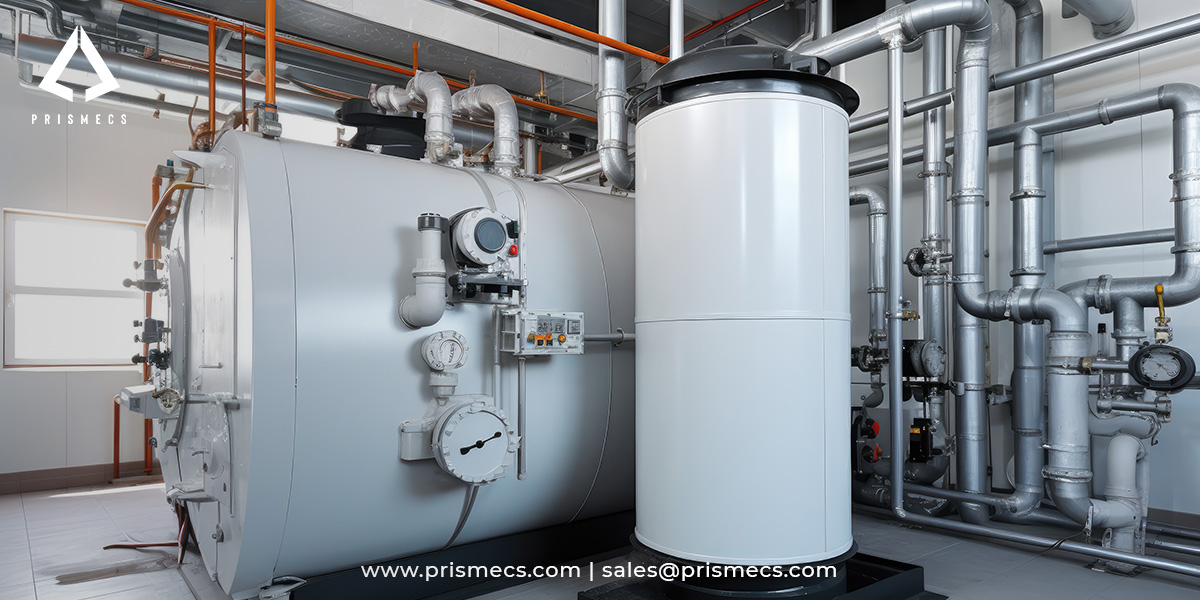
An industrial boiler's combustion system is a safety system before it is a heating system, and which code governs yours depends on one number.
At 12,500,000 Btu/hr the rules change. Below that figure your boiler falls under ASME CSD-1. At or above it, NFPA 85 applies, and the required safety devices, interlock architecture and testing regime are different.
Most operators of boilers in the middle of that range have never checked which side of the line they are on.
This guide covers the combustion system component by component, the burner management system that most component guides skip entirely, the efficiency numbers that tell you whether yours is tuned, and a verification list for a boiler you inherited rather than specified.
Scope note: this covers fired industrial and power boilers producing steam or high-temperature hot water for process and generation duty. It does not cover residential or light commercial hydronic heating, which uses different components, different codes and a different service model.
Which Code Governs Your Boiler
Two American standards divide fired boilers by heat input rating, and 12,500,000 Btu/hr is the dividing line.
ASME CSD-1, Controls and Safety Devices for Automatically Fired Boilers, applies to boilers with inputs above 400,000 Btu/hr and up to 12,500,000 Btu/hr. NFPA 85, the Boiler and Combustion Systems Hazards Code, applies at or above that figure, which the code also expresses as a heat release above 3.7 MW.
CSD-1 is currently at its 14th edition, issued on 17 November 2021 and approved by ANSI on 9 September 2021. Most US states have adopted it, though some adopt only portions.
How to confirm which applies to yours
Read the heat input rating from the boiler nameplate or the ASME data report, in Btu/hr. That single figure places you on one side of the threshold or the other. If your unit is rated in boiler horsepower or pounds of steam per hour, convert to heat input before deciding, because the codes are written against input rather than output.
Then confirm which edition your jurisdiction has adopted. Adoption lags publication and varies by state, and the authority having jurisdiction is the body that enforces it locally, typically a state boiler inspection program or an insurance inspector holding a National Board commission.
If your boiler predates the current edition
Existing installations are generally not required to retrofit to the latest edition, but three things commonly trigger reassessment: a change of fuel, a control system replacement, and any alteration to pressure-retaining parts. Insurers and jurisdictional inspectors also apply current practice at their discretion. Establish your position before you plan a retrofit, not during it.
One requirement worth knowing now
Under CSD-1 clause CE-110(a), a manually operated shutdown switch or circuit breaker must be located just outside the boiler room and marked for easy identification. It is one of the first things an inspector checks, frequently before entering the room.
The Combustion System, Component by Component
An industrial boiler's combustion system comprises the burner and fuel train, the burner management system, the furnace and heat transfer surfaces, the flue gas path, and the water side that removes the heat.
The parts list varies with boiler type and rating, and that matters more than any generic diagram. A low-pressure hot water unit may have no superheater at all, while a power boiler needs both an economizer and a superheater to reach its efficiency target. Check the parts list against the rated pressure and output of your specific unit.
The four sections that follow cover each subsystem in the order the energy moves: fuel in, heat released, heat transferred, flue gas out.
Fire-tube, water-tube and HRSG
In a fire-tube boiler, hot combustion gases pass through tubes surrounded by water. In a water-tube boiler, water passes through tubes heated by surrounding combustion gases. Fire-tube units dominate below roughly 50,000 lb/hr of steam; water-tube units cover higher pressures and capacities.
A heat recovery steam generator, or HRSG, is an unfired or supplementary-fired boiler that recovers exhaust heat from a gas turbine. It shares the water side and heat transfer surfaces described below and has no primary burner unless duct firing is fitted.
The Burner and Fuel Train
The burner meters fuel and air in the correct ratio and ignites the mixture, and the fuel train is the valve assembly that delivers fuel to it safely.
The burner is the principal device for firing oil or gas, introducing both into the furnace at controlled velocities. Its design changes with fuel, so a gas burner, an oil burner and a dual-fuel burner are different machines with different maintenance regimes.
Air delivery is as important as fuel delivery. The forced draft fan supplies combustion air into the windbox, a plenum that distributes air around the burner. The air register controls the pattern and swirl of that air entering the furnace, which shapes the flame.
The fuel train
The fuel train carries gas or oil from the supply to the burner through a sequence of safety and control devices: a manual isolation valve, a pressure regulator, high and low pressure switches, two safety shutoff valves in series, and a vent or bleed between them.
Two safety shutoff valves in series with a vent between them is the double block and bleed arrangement. If the upstream valve leaks, the vent releases the leakage rather than allowing it to accumulate in the furnace.
A valve proving system tests the integrity of the safety shutoff valves automatically before each start, pressurising the space between them and checking for decay. NFPA 85 added valve proving requirements for fuel gas trains, and it is one of the clearest indicators of whether a fuel train is current.
What to check on a burner
Fuel nozzles and tips for wear, erosion or coking. Ignitor and pilot condition. Air register and damper linkage for free movement and correct position feedback. Refractory burner throat for cracking. Diffuser or swirler condition. And the fuel train valves for external leakage and correct sequencing.
The Burner Management System
The burner management system, or BMS, is the safety instrumented function that prevents furnace explosions, and it is a different system from combustion control.
This distinction is the most important thing in this article and it is missing from most component guides. Combustion control adjusts fuel and air to meet steam demand. The BMS proves that conditions are safe before fuel is admitted and shuts fuel off when they are not. One optimises. The other protects.
NFPA 85 mandates flame safeguard systems, purge sequences, interlocks and shutdown logic for fuel-fired boilers, and BMS design must comply with its sequencing and testing requirements.
What the BMS does
Prepurge. Before ignition, the BMS forces a defined volume of air through the furnace and flue gas path to clear any accumulated fuel. Purge airflow must be proven, not assumed. Under recent CSD-1 revisions, an automatically operated stack damper must be listed, must provide for full purge airflow, and must be interlocked with the burner control.
Ignition and flame proving. The pilot is established and proven by a flame scanner before the main fuel valves open. If flame is not proven within a defined trial period, fuel is shut off and the sequence locks out.
Flame supervision. A flame scanner, typically ultraviolet or infrared, continuously confirms the presence of flame. Loss of flame trips the safety shutoff valves within a defined response time.
Interlocks. Low water, high pressure, high or low fuel pressure, loss of combustion air, high stack temperature and others each trip the fuel supply. Codes including NFPA 85, ASME CSD-1 and EN 746 require automatic burner shutdown if flame is not detected during operation.
Postpurge. After shutdown, remaining combustibles are cleared from the furnace.
The architecture requirement that catches people
Under NFPA 85, the safety interlock chain must be hardwired and independent of the PLC. The burner must drop on a physical contact opening even if the PLC is in fault or unpowered.
A software emergency stop can serve as secondary notification. It cannot be the primary safety device. The PLC's role in a trip is to log the event, not to cause it.
This is where many older retrofits fail review. A control system upgrade that migrated safety interlocks into PLC logic has made the plant less safe while appearing more modern. If your BMS and your combustion control run in the same controller with no independent hardwired chain, that is a finding.
Where a safety instrumented system approach is applied, IEC 61511 and ANSI/ISA 84 govern the functional safety lifecycle including SIL determination and proof test intervals. UL 353 and UL 834 define requirements for the limit control switches and thermal and fluid safety interlocks used in BMS shutdowns, including low-water and pressure or temperature limit devices.
Testing
Flame safety and interlock testing falls under annual testing requirements for boilers under NFPA 85, and CSD-1 sets its own testing intervals. Test records are the evidence an inspector or insurer asks for first. A device that has never been function-tested is not a safety device, it is a component.
Retrofitting a BMS
A BMS retrofit is the most common and usually the highest-value boiler controls project, because it addresses safety, compliance and reliability at once without touching pressure parts. It is also far less disruptive than replacing a boiler, since pressure-retaining components remain in service and the work is largely confined to the burner front, the fuel train and the control panel.
Scope it against the code that applies to your heat input, not against the control platform you happen to prefer.
The Furnace and Heat Transfer Surfaces
The furnace is the enclosed space where fuel burns, and it absorbs approximately 40 to 50 percent of the total heat a boiler transfers, primarily by radiation.
That radiant fraction is why furnace condition matters so much. Everything downstream works by convection as the flue gas cools, and it works on whatever heat the furnace did not already absorb.
Water walls are assemblies of riser tubes aligned to form the furnace walls. Water circulating in them absorbs radiant heat and becomes a steam and water mixture.
Refractory is the high-temperature lining that retains heat and protects the boiler structure, manufactured from ceramic or brick-like materials and often directly exposed to flame. It is not insulation. Insulation is for lower temperatures, is not flame-exposed, and is typically fiberglass or mineral wool. Confusing the two produces the wrong repair specification.
The steam drum is the cylindrical vessel at the top of a water-tube boiler that holds water and separates steam from it. Internal cyclone separators and scrubbers deliver dry steam and prevent moisture carryover to the superheater and turbine. Water treatment chemicals are dosed here because the turbulent environment aids mixing.
The mud drum sits at the bottom and collects sediment and impurities from the boiler water.
The superheater is a tubular heat exchanger in the flue gas path that raises steam temperature above saturation without raising pressure, producing drier steam for turbines. Power boilers commonly use primary and secondary superheaters, with a desuperheater between them that sprays feedwater into the steam to control final temperature.
A reheater, where fitted, returns partially expanded steam from a turbine to the boiler for reheating before it enters the next turbine stage.
What causes tube failure
The common mechanisms are overheating from scale or deposit on the water side, external erosion from ash or soot blower impingement, corrosion from low feedwater pH or oxygen ingress, and thermal fatigue from rapid cycling. Tube failure is the most frequent cause of unplanned boiler outage, and water chemistry is the most frequent root cause behind it.
The Flue Gas Path and Heat Recovery
After the furnace, the flue gas gives up its remaining heat by convection across the superheater, the economizer and the air preheater before leaving through the stack.
The economizer is a heat recovery exchanger that uses waste heat from the flue gas to preheat boiler feedwater before it enters the steam drum. It raises overall efficiency by reducing the fuel needed to bring feedwater to saturation, and it also reduces thermal shock to the drum by avoiding cold water entering a hot vessel.
As a rule of thumb, every 40°F reduction in stack temperature achieved through economizer recovery returns roughly one percent in boiler efficiency. Confirm against your own stack readings rather than assuming the figure.
The air preheater recovers further flue gas heat into the incoming combustion air, raising flame temperature and reducing fuel demand.
The induced draft fan draws flue gas through the convection passes and out of the stack. Together with the forced draft fan it sets furnace draft, the slight negative pressure that keeps combustion gases inside the boiler.
Soot blowers periodically clear ash and deposits from external tube surfaces using steam or compressed air, restoring heat transfer.
Economizer corrosion, and why stack temperature has a floor
Recovering too much heat is possible. If flue gas cools below its acid dew point, sulphuric acid condenses on economizer surfaces and attacks them. The dew point depends on fuel sulphur content, which is why oil and coal firing carries a higher minimum stack temperature than natural gas.
Do not chase stack temperature below the design minimum. The efficiency gain is small and the corrosion cost is not.
The Water Side
The water side delivers feedwater at the right quality, temperature and rate, and its safety devices are the ones that prevent the most severe boiler failures.
The deaerator removes dissolved oxygen and carbon dioxide from feedwater by heating and mechanical scrubbing, preventing oxygen pitting in the boiler and downstream piping.
The boiler feedwater pump delivers water against boiler pressure. It is a high-energy centrifugal pump and it is one of the most maintenance-sensitive machines in the plant. For maintenance strategy on feedwater pumps and similar rotating equipment, see our rotating equipment field guide.
Three-element drum level control regulates feedwater using three inputs: drum level, steam flow and feedwater flow. Using level alone is inadequate on a load-following boiler because of shrink and swell, where drum level moves in the opposite direction to the actual water inventory during rapid load changes.
The low-water cutoff is the safety device that shuts off fuel when drum level falls below a defined point. Low water is among the most dangerous boiler conditions, because a dry-fired pressure part can fail catastrophically. Most codes require two independent low-water devices on larger units.
Safety relief valves are the final protection against overpressure, sized and set under the ASME BPVC and sealed after setting. They are not adjustable in the field and any valve with a broken seal requires recertification.
Blowdown removes concentrated dissolved solids from the boiler water, either continuously from the drum or intermittently from the mud drum. Under-blowdown causes scale and carryover; over-blowdown wastes energy and treated water.
What happens on low water
The BMS trips the fuel supply, the burner shuts down and the unit locks out. Restart requires manual reset and, on any suspicion of dry firing, an internal inspection before returning to service. Never reset a low-water trip without establishing why level was lost.
Combustion Efficiency: Excess Air and Stack Oxygen
Excess air is combustion air supplied beyond the theoretical minimum needed for complete combustion, and getting it right is the single cheapest efficiency gain available on most boilers.
Too little air prevents complete combustion, producing carbon monoxide, unburned fuel and soot, and it is a safety hazard as well as a loss. Too much air carries heat out of the stack in gas that was never needed, and reduces fuel efficiency directly.
Stack oxygen is the measurable proxy. Natural gas firing typically targets around 3 percent O2 in the flue gas at high fire, corresponding to roughly 15 percent excess air. Oil firing typically runs slightly higher. Confirm the target against your burner manufacturer's data, because it varies with burner type and firing rate.
Turndown ratio is the ratio between maximum and minimum firing rates a burner can hold stable, commonly 4:1 to 10:1 depending on burner design. Higher turndown means fewer on and off cycles at low load, and every start consumes a purge cycle worth of fuel and thermal stress.
Tuning
Combustion tuning sets the fuel-air ratio across the firing range using a flue gas analyser measuring O2, CO and stack temperature. It is typically performed annually and after any burner, fuel or control change, and it routinely recovers one to three percent efficiency on a unit that has drifted.
Measuring efficiency properly
ASME PTC 4, Fired Steam Generators, is the performance test code for boiler efficiency. Where efficiency is contractual, for example after a retrofit with a guaranteed improvement, name PTC 4 and agree the method, the instrumentation and the uncertainty before the test.
Emissions Compliance
Which emissions rule applies to an industrial boiler depends on its heat input rating, its fuel and whether the facility is a major or area source of hazardous air pollutants.
Subpart DDDDD and JJJJJJ obligations commonly include tune-ups at defined intervals, one-time energy assessments and, for some units, emissions limits and monitoring. Tune-up frequency is itself a compliance obligation, not just good practice.
NOx control at the burner
Low-NOx burners and staged combustion control flame temperature and oxygen availability to suppress thermal NOx formation at source. Flue gas recirculation lowers flame temperature by diluting combustion air with recirculated flue gas. Selective catalytic reduction treats NOx after combustion and is used where burner measures alone cannot meet the limit.
Burner measures are almost always cheaper than after-treatment, which is why a low-NOx burner retrofit is frequently the first option evaluated.
Does a BMS or burner upgrade trigger a permit change
It can. A burner replacement that changes emissions characteristics, or any modification that increases heat input or emissions, may require a permit revision and in some cases triggers new source review. A like-for-like BMS replacement that does not alter combustion generally does not. Confirm with your air permitting adviser at scope definition rather than after installation.
What to Verify on an Existing Boiler
If you inherited the boiler rather than specified it, these are the checks that establish where you stand.
Repairs and alterations to pressure-retaining items are governed by the National Board Inspection Code, NBIC NB-23. An undocumented pressure part repair is both a compliance finding and an insurance exposure.
Insurance
Boiler and machinery underwriters price on inspection currency, safety device testing records and maintenance regime. In many jurisdictions the insurer also performs the jurisdictional inspection. Missing test records affect both premium and, after an incident, coverage position.
What to require from a service contractor
Demonstrated familiarity with the code that applies to your unit, technicians qualified on your specific flame safeguard platform, documented test procedures rather than a checklist, and reports that record actual readings rather than pass or fail marks. For how to structure and evaluate the wider arrangement, see our guide to choosing a power plant O&M provider and, for operating scope and procedures, plant operations and maintenance.
For planning the outage in which most of this work happens, see our outage planning guide. For procuring long-lead pressure parts, see the industrial procurement process.
How Boiler Priorities Change by Sector
The components are constant. What changes is which failure costs most.
Power generation
Water-tube boilers and HRSGs at high pressure and temperature, with superheaters, reheaters and economizers all present. Steam purity and drum level control dominate because turbine damage is the downstream consequence. Heat rate makes efficiency tuning directly financial.
Petrochemicals and refining
API 538 supplements NFPA 85 for industrial fired boilers in refinery and petrochemical service, covering waterside control, combustion control, BMS, feedwater preparation, steam purity and emissions. Process heaters follow API 556 and API 560 rather than NFPA 86. Hazardous area classification applies around the burner front.
Metals and mining
Waste heat recovery and fuel flexibility dominate, often including process off-gases with variable heating value. Variable fuel composition makes combustion control and flame stability harder, and turndown matters more.
Commercial and institutional facilities
Frequently fire-tube units in the range where CSD-1 applies. The most common findings are the missing external shutdown switch under CE-110(a), blocked combustion air louvres and overdue safety device testing.
Food and pharmaceutical
Steam purity and reliability of supply dominate, and culinary steam requirements may apply. Boiler outage planning is constrained by production campaigns rather than seasonal load.
Outside the United States
The component set and the physics are unchanged. The codes differ: EN 12952 and EN 12953 cover water-tube and shell boiler construction in Europe, EN 746 addresses industrial thermoprocessing safety, and the Pressure Equipment Directive governs equipment placed on the EU market. Confirm the local jurisdictional inspection regime, since it varies more than the design codes do.
What Prismecs Does
Prismecs delivers instrumentation and controls, operations and maintenance, and balance of plant services across industrial and power generation assets, working OEM-agnostically on equipment it did not manufacture.
Boiler and combustion work sits across three of those service lines. Burner management and combustion control fall under I&C services. Routine operation, testing and maintenance fall under O&M services. Pressure part and balance of plant scope falls under power generation asset services.
Prismecs is not a boiler manufacturer. That is the point of an OEM-agnostic service organisation: the recommendation on whether to retune, retrofit the BMS, replace the burner or replace the unit is not tied to a manufacturer's order book.
Apply this article's checks to any provider, including us. Ask which code applies to your heat input and get the Btu/hr figure back. Ask whether the safety chain in the proposed design is hardwired independent of the PLC. Ask for the flame safeguard platform their technicians are qualified on. Ask for a tuning report with readings, not a pass mark.
To request a boiler combustion and controls compliance review, send your boiler nameplate rating, fuel, control system make and model, last tuning report and current jurisdictional inspection certificate to sales@prismecs.com or call +1 (888) 774-7632. We return a code applicability assessment, a safety device gap list and a tuning and retrofit recommendation.
Frequently Asked Questions
What are the main components of an industrial boiler combustion system?
The burner and fuel train, the burner management system, the furnace and heat transfer surfaces including water walls, steam drum and superheater, the flue gas path including economizer, air preheater, induced draft fan and stack, and the water side including deaerator, feedwater pump, drum level control and low-water cutoff. The exact parts list varies with boiler type and rating, so check it against your unit's rated pressure and output.
Which code applies to my boiler, NFPA 85 or ASME CSD-1?
It depends on heat input rating. ASME CSD-1, Controls and Safety Devices for Automatically Fired Boilers, applies above 400,000 Btu/hr and up to 12,500,000 Btu/hr. NFPA 85, the Boiler and Combustion Systems Hazards Code, applies at or above 12,500,000 Btu/hr, which it also expresses as a heat release above 3.7 MW. Read the figure from the nameplate or ASME data report.
What is a burner management system and how is it different from combustion control?
A burner management system is the safety instrumented function that proves conditions are safe before fuel is admitted and shuts fuel off when they are not, covering purge, ignition, flame supervision, interlocks and postpurge. Combustion control is a separate system that adjusts fuel and air to meet steam demand. One protects and one optimises, and conflating them is the most common design error in boiler controls.
Does the BMS safety chain have to be independent of the PLC?
Yes under NFPA 85. The safety interlock chain must be hardwired and independent of the PLC, so the burner drops on a physical contact opening even if the controller is in fault or unpowered. A software emergency stop can provide secondary notification but cannot be the primary safety device. The PLC's role in a trip is to log the event, not to cause it.
What is a purge sequence and why does it matter?
Prepurge is the forced flow of a defined volume of air through the furnace and flue gas path before ignition, clearing any accumulated fuel that could ignite explosively. Purge airflow must be proven rather than assumed. Recent CSD-1 revisions require an automatically operated stack damper to be listed, to provide for full purge airflow, and to be interlocked with the burner control.
What is double block and bleed on a fuel train?
It is two safety shutoff valves in series with a vent or bleed between them. If the upstream valve leaks, the vent releases the leakage to a safe location rather than allowing fuel to accumulate in the furnace. A valve proving system tests both valves automatically before each start by pressurising the space between them and checking for pressure decay. NFPA 85 added valve proving requirements for fuel gas trains.
What excess air or stack oxygen should my boiler run at?
Natural gas firing typically targets around 3 percent oxygen in the flue gas at high fire, corresponding to roughly 15 percent excess air, with oil firing slightly higher. Too little air causes incomplete combustion, carbon monoxide and soot. Too much carries heat out of the stack in air that was never needed. Confirm the target against your burner manufacturer's data, since it varies by burner type and firing rate.
How much heat does the furnace absorb compared with the rest of the boiler?
The furnace absorbs approximately 40 to 50 percent of the total heat transferred, primarily by radiation from the flame to the water walls. Everything downstream, the superheater, economizer and air preheater, works by convection on the heat the furnace did not absorb. That radiant fraction is why furnace and refractory condition has a disproportionate effect on overall efficiency.
What does an economizer do and how much efficiency does it recover?
An economizer is a heat recovery exchanger that uses waste heat from the flue gas to preheat boiler feedwater before it enters the steam drum, reducing the fuel needed to reach saturation and limiting thermal shock to the drum. As a working rule, every 40°F reduction in stack temperature returns roughly one percent in boiler efficiency. Do not cool flue gas below its acid dew point, or economizer corrosion follows.
What is three-element drum level control?
It is feedwater regulation using three inputs: drum level, steam flow and feedwater flow. Single-element control using level alone is inadequate on a load-following boiler because of shrink and swell, where drum level briefly moves opposite to actual water inventory during rapid load changes. Three-element control anticipates demand rather than reacting to a misleading level signal.
What happens when a boiler trips on low water?
The burner management system shuts off the fuel supply, the burner shuts down and the unit locks out. Restart requires a manual reset, and where dry firing is suspected an internal inspection must be completed before returning to service. Never reset a low-water trip without first establishing why level was lost, because the second event is usually worse than the first.
What emissions rules apply to an industrial boiler?
It depends on heat input and source status. 40 CFR Part 60 Subpart Db covers new units above 100 MMBtu/hr and Subpart Dc covers 10 to 100 MMBtu/hr. 40 CFR Part 63 Subpart DDDDD, commonly called Boiler MACT, covers major sources of hazardous air pollutants, and Subpart JJJJJJ covers area sources. Obligations commonly include tune-ups at defined intervals and energy assessments.
Which test code measures boiler efficiency?
ASME PTC 4, Fired Steam Generators, is the performance test code for boiler efficiency. Where efficiency is contractual, for example after a retrofit carrying a guaranteed improvement, name PTC 4 in the contract and agree the test method, instrumentation and acceptable measurement uncertainty before the test is run. An efficiency figure produced by an unspecified method is not enforceable.
What is the difference between refractory and insulation?
Refractory is the high-temperature lining used inside the furnace, often directly exposed to flame, manufactured from ceramic or brick-like materials, and its job is to retain heat and protect the boiler structure. Insulation is for lower-temperature surfaces, is not flame-exposed, and is typically fiberglass or mineral wool. Specifying insulation where refractory is required produces rapid failure, and the terms are frequently confused.
Tags: Industrial Boiler Components Burner Management System NFPA 85 Compliance Combustion Efficiency Boiler Safety Devices
recent posts
Power Utilities
18 minutes read
Temporary and Bridge Power for Industrial Facilities: When and How to Use It
Planning bridge power past 12 months? Under EPA rules your generators may be stationary from day one. Check Tier 4, NSPS KKKKa and SPCC triggers befor...
Gas Turbines
16 minutes read
What Is a Mobile Gas Turbine Power Plant? TM2500-Class Units Explained
A mobile gas turbine power plant is a transportable power generation system designed to add electrical capacity faster than a conventional permanent p...
Power Utilities
20 minutes read
Fast-Track Power Plants Deployment: How to Reach Speed to Power in Under 12 Months
Fast-track power plant deployment can hit first power in weeks. See real TM2500 timelines from permitting to COD, proven in Oman and Taiwan. Plan your...

Gas Turbines
11 minutes read
Gas Turbine Outage Planning: Schedule, Scope Rules, and Checklist
Gas turbine outage planning starts 18 months out. Get the T-minus schedule, scope freeze rules, parts readiness gates and checklist. Talk to a Prismec...