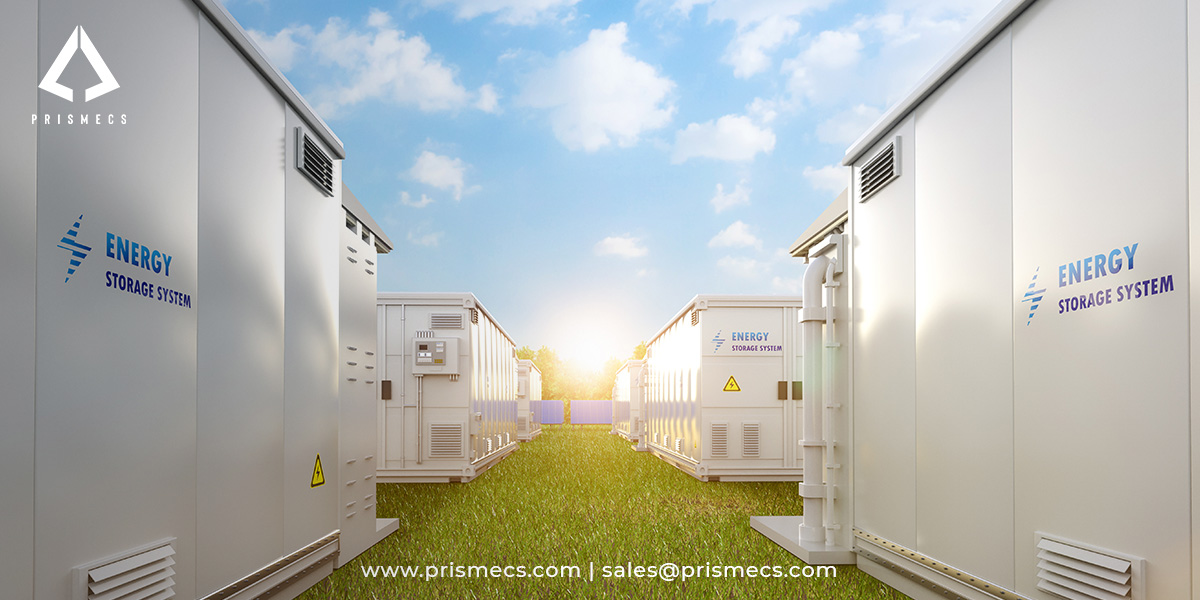
Battery energy storage is no longer an emerging technology decision. It is a procurement, permitting and commissioning decision, and in 2026 the rules governing all three changed.
This guide is written from the owner's side. It covers what a BESS is made of, what chemistry to specify, what it costs once the soft costs are counted, what NFPA 855 (2026) and UL 9540A 6th Edition now require, how interconnection works under IEEE Std 1547-2018, and what to verify before you sign acceptance. Prismecs has engineered, procured, built and commissioned systems from a 7 MW / 28 MWh installation to a 9 MW grid-stability asset, and the guidance here reflects that work.
What a BESS Is, and What It Is Actually Made Of
A battery energy storage system (BESS) is an installation that stores electrical energy in rechargeable batteries and discharges it when a facility, microgrid or grid operator needs power. BESS stands for battery energy storage system.
The battery is a minority of the system. A complete BESS comprises eight subsystems, and most procurement disputes trace to one of the seven that are not the battery.
State of charge (SoC) is the percentage of usable energy currently stored, equivalent to a fuel gauge. The BMS reports it, the EMS dispatches against it, and the operating SoC window you allow directly affects how fast the asset degrades.
Two power ratings describe every system and they are not interchangeable. Power is measured in megawatts (MW) and set by the PCS. Energy is measured in megawatt-hours (MWh) and set by the battery. A 7 MW / 28 MWh system delivers 7 MW for four hours.
What Changed in 2026
Three things changed simultaneously in 2026: costs fell to a new floor, LFP became the default chemistry, and the fire code that governs installation was rewritten.
Deployment accelerated sharply. Global energy storage additions reached 275.3 GWh in 2025, a 61.3% increase year on year, with a further 353.4 GWh expected in 2026 driven substantially by AI data centre demand (InfoLink Consulting). China alone added 167 GWh in 2025 and is expected to add 203.5 GWh in 2026.
In the United States, utility-scale battery storage reached nearly 52 GW of nameplate capacity by June 2026 after adding 8.3 GW in the first six months of the year, with a further 54 GW planned from the second half of 2026 through 2028, according to EIA planning data.
The code position changed in the same window. NFPA 855, Standard for the Installation of Stationary Energy Storage Systems, published its third edition in 2026, making a Hazard Mitigation Analysis the default requirement for nearly all installations. UL 9540A 6th Edition published on 13 March 2026 with an effective date of 1 January 2027.
The practical consequence is that a BESS designed to the previous code cycle may not permit under the current one. Any project in design now needs its fire strategy checked against the 2026 requirements before the equipment order goes in.
What a BESS Costs
A utility-scale four-hour BESS costs roughly $110 to $117 per kWh as turnkey equipment globally, but roughly $334 per kWh as a fully loaded US project including labour, permitting and developer margin. Both numbers are correct. They measure different things, and confusing them is the most common budgeting error in the sector.
BloombergNEF put the volume-weighted average lithium-ion battery pack price at $115/kWh in 2024, with cells alone at $78/kWh, the largest single-year decline since 2017, falling further to $108/kWh in 2025. Utility-grade LFP cell prices in international tenders have clustered in the $55 to $75 per kWh range through 2025 and 2026.
Ember Energy reports all-in capital expenditure for a large four-hour utility-scale BESS outside China and the United States at approximately $125 per kWh, comprising roughly $75 per kWh for core equipment and roughly $50 per kWh for installation and grid connection.
NREL's bottom-up cost benchmark for a four-hour utility-scale lithium-ion system lands far higher at approximately $334 per kWh, because it is built for US conditions and includes American labour, permitting, interconnection and developer margin.
Balance of system and soft costs account for 40% to 55% of total project cost on a typical development. That is why an EPC quote arrives at roughly double the equipment headline, and why a budget built on the headline will fail.
Levelized cost of storage (LCOS) for utility-scale four-hour systems currently falls in the range of $65 to $88 per MWh, depending on cycle life, utilisation and grid connection fees. LCOS is the metric to compare against alternatives, because it normalises capital cost across the asset's throughput.
NREL projects capital expenditure reductions of 18% to 52% by 2035, with BloombergNEF forecasting four-hour turnkey systems reaching approximately $101 per kWh in Europe and $108 per kWh in North America by that point.
Cost items buyers routinely omit
Price these separately or they will arrive as change orders: step-up transformer and medium-voltage switchgear, interconnection study and utility upgrade costs, site civils and foundations, fire suppression and detection, the Hazard Mitigation Analysis and permitting engineering, commissioning and witnessed testing, the EMS licence and its annual fee, and the augmentation reserve for years five through fifteen.
Chemistry: What to Specify and Why
Lithium iron phosphate (LFP) is the correct default for stationary storage, and took close to 95% of new utility-scale BESS awards globally across 2025 and 2026. The reason is thermal, not commercial.
Lead-acid is the oldest rechargeable chemistry in commercial use, not an emerging one. NFPA 855 reflects this by setting a higher permitting threshold for lead-acid and nickel-cadmium systems at 70 kWh, against 20 kWh for lithium-ion, because the failure behaviour is long established.
Specify chemistry by name in the bid documents, not by the generic term lithium-ion. LFP and NMC have materially different fire test results under UL 9540A, which flows directly into your spacing, suppression and permitting requirements.
Sizing and Duration: How Much Storage You Need
Size a BESS from your actual interval load data, not from nameplate demand, because the peak you are shaving may last twenty minutes or four hours and the two require completely different systems.
Duration is the ratio of energy capacity to power rating. A 7 MW / 28 MWh system is a four-hour asset. A 7 MW / 14 MWh system is a two-hour asset delivering identical peak power for half the time at roughly half the battery cost.
Round-trip efficiency is the proportion of energy put into the system that comes back out, after conversion and parasitic losses. Modern LFP systems with liquid cooling typically achieve 85% to 90% at the AC terminals. Specify it at the point of common coupling, not at the DC battery, because the difference is the part you pay for.
C-rate expresses charge or discharge power relative to energy capacity. A 1C system discharges its full energy in one hour; a 0.25C system takes four. High C-rate operation increases heat generation and accelerates degradation, so an undersized battery pushed hard will not meet its warranted cycle life.
AC-coupled versus DC-coupled on a solar retrofit
DC-coupled storage connects on the DC side of the PV inverter and captures clipped energy that an AC-coupled system cannot reach. AC-coupled storage connects on the AC side, is simpler to retrofit and does not disturb the existing PV inverter.
Choose DC-coupled where the array is significantly oversized relative to inverter capacity and clipping losses are material. Choose AC-coupled where the priority is minimising disturbance to an operating asset. Prismecs designed and commissioned a DC-coupled storage addition to an operating 4 MW PV site with no outages, which is the harder of the two to execute on a revenue-generating plant.
What a BESS Earns
A BESS earns money in four distinct ways, and most viable projects stack at least two of them, because no single revenue stream justifies the capital on its own in most markets.
Demand charge management
Behind the meter, the system discharges during your facility's peak demand interval to reduce the billed demand charge. Payback depends entirely on your tariff structure, specifically the demand charge in dollars per kW and the ratchet provisions. Model it against twelve months of interval data before committing capital.
Energy arbitrage
The system charges when energy prices are low and discharges when they are high. The economics depend on the spread between off-peak and on-peak pricing, and on how many cycles per year the spread justifies against the degradation those cycles cause.
Ancillary services and grid support
Front of the meter, the system sells frequency regulation, spinning reserve, voltage support or capacity into the wholesale market. Prismecs engineered, procured, built and commissioned a 9 MW BESS specifically for grid stability and ancillary revenue.
Resilience and renewable capture
The system provides backup during outages and captures renewable generation that would otherwise be curtailed. Prismecs engineered and delivered a 7 MW / 28 MWh BESS to capture PV losses and shift peak generation, which converts energy that was being spilled into dispatchable evening supply.
Front of the meter (FTM) means the asset sits on the utility side and sells into the grid or wholesale market. Behind the meter (BTM) means it sits on the customer side and offsets consumption or demand charges. The distinction determines interconnection pathway, revenue model and tax treatment.
BESS versus a diesel generator
A BESS responds in milliseconds and a generator in seconds to tens of seconds, so storage covers the ride-through window that a generator cannot. A generator delivers unlimited duration with fuel supply, which a BESS cannot. On critical sites the correct answer is usually both, with the BESS covering transfer and the generator covering extended outage.
BESS versus a grid upgrade
Where a utility upgrade to serve additional load carries a multi-year interconnection queue, a behind-the-meter BESS can defer or avoid the upgrade by flattening the peak the utility would otherwise have to serve. Compare the installed BESS cost against the utility contribution charge plus the schedule cost of waiting.
Fire Safety and Code Compliance
NFPA 855, Standard for the Installation of Stationary Energy Storage Systems, is the governing US installation standard for stationary battery storage, and its 2026 third edition makes a Hazard Mitigation Analysis the default requirement for nearly all installations, removing previous exemptions.
This is the section that determines whether your project gets permitted, insured and financed. Treat it as a schedule item, not a compliance formality.
What the 2026 code cycle changed
NFPA 855 (2026) introduces Thermal Runaway Propagation Prevention (TRPP) requirements under Section 9.7.6.6, and states explicitly that passive features such as barriers, spacing and enclosures do not by themselves constitute TRPP. Annex G.11 of the 2026 edition provides guidance on conducting an installation-level large-scale fire test.
UL 9540A 6th Edition published on 13 March 2026, with an effective date of 1 January 2027. Section 10 was revised to incorporate a large-scale fire test method aligned with NFPA 855 Annex G.11. The Unit Level Test is no longer required for non-residential BESS, and a new Annex C adds a large-scale deflagration test for BESS enclosures.
The 6th Edition also extended applicability to alternative battery chemistries including sodium-ion, which matters if you are evaluating anything other than lithium-ion.
The standards that apply, by correct designation
UL 9540 and UL 9540A are routinely confused and the distinction is costly. UL 9540 is the product listing your equipment must carry. UL 9540A is a test method that generates the data your fire protection engineer uses to justify spacing and suppression design. You need both: listed equipment, and test data covering your specific configuration.
Permitting thresholds
NFPA 855 applies to lithium-ion systems from 20 kWh of aggregate energy, and to lead-acid and nickel-cadmium systems from 70 kWh. Below those thresholds the standard's full requirements do not attach, though local amendments vary and the Authority Having Jurisdiction (AHJ) may impose more.
The permitting sequence that works
- Confirm which NFPA 855 edition and which IFC edition your AHJ has adopted, because adoption lags publication and varies by jurisdiction
- Select UL 9540-listed equipment with UL 9540A test data covering your exact configuration, chemistry and enclosure
- Commission a Hazard Mitigation Analysis led by a Registered Design Professional with fire protection and energy storage risk-assessment experience, which Annex G of the 2026 edition now specifically calls for
- Design spacing, ventilation, detection and suppression to the chapter applicable to your chemistry and installation type
- Add explosion control per NFPA 69, or document a performance-based alternative
- Pre-submission meeting with the AHJ and the local fire department before formal application
- Submit the UL 9540 listing, UL 9540A test reports and signed HMA as the permitting package
How often do BESS actually fail
Failure incidence has fallen sharply as the standards regime matured, with BESS failure incidents declining approximately 97% between 2018 and 2023 as safety standards were widely implemented, according to figures drawn from EPRI's BESS failure incident tracking. The risk is real but it is now an engineering and compliance problem with a known solution, not an unquantified hazard.
Interconnection: What the Utility Requires
IEEE Std 1547-2018, Standard for Interconnection and Interoperability of Distributed Energy Resources with Associated Electric Power Systems Interfaces, is the governing US interconnection standard for any storage asset capable of exporting active power.
IEEE Std 1547-2018 sets requirements for performance, operation, testing, safety and maintenance of the interconnection, covering abnormal condition response, power quality, islanding, and test specifications for design, production, installation evaluation, commissioning and periodic testing.
Any energy storage DER capable of active power export falls within the scope of IEEE Std 1547. If your system is configured to charge only and never export, the interconnection pathway differs, and that configuration choice should be made deliberately early because it changes study scope and cost.
Adoption of IEEE 1547-2018 is now widespread, with California Rule 21, Hawaii, New York, CAISO and PJM mandating or transitioning to it as the interconnection baseline. Confirm your utility's adopted version and its Reference Point of Applicability before finalising the design, because the RPA location determines which equipment must be certified.
Grid-forming inverters establish voltage and frequency independently rather than following an existing grid signal, which is what allows a system to black start and to hold an island. Specify grid-forming capability explicitly if you need islanding, because standard grid-following equipment cannot provide it.
For cybersecurity, IEEE Std 1547.3-2023 provides DER-specific guidance, with NERC CIP applying to bulk electric system assets and IEC 62443 providing the industrial automation security framework.
Specification and Procurement
Specify a BESS by performance at the point of common coupling and by named standards, not by product model, because a specification written around one vendor's datasheet cannot be competitively bid.
A BESS project typically runs 12 to 24 months from concept to commercial operation, with interconnection study and permitting, not equipment delivery, as the usual critical path.
What to require in the bid package
The two clauses that matter most
The performance guarantee should name the measurement point, the test method and the measurement period. A round-trip efficiency guarantee measured at the DC battery rather than at the point of common coupling excludes exactly the conversion and auxiliary losses you are trying to control.
The degradation and augmentation clause determines your year-ten position. A battery warranted to retain 70% of usable energy at year ten will not meet your original sizing unless augmentation is funded. Establish now whether augmentation is included, optional at a fixed price, or entirely your problem.
What happens if the integrator fails
Battery warranties run 10 to 20 years and many integrators are younger than that. Require a parent company guarantee, warranty insurance, or escrow. Establish that you own the EMS data and hold the credentials, and that controls are not locked to a single vendor's cloud platform. Specify equipment from cell manufacturers with independent aftermarket support.
Who owns the EMS
The EMS decides what the asset earns, so ownership of its data and control rights is a commercial question rather than a technical one. Write into the contract that you own all operating data in an exportable format, that you hold administrative credentials, and that dispatch rights revert to you at contract end.
Commissioning and Acceptance
Do not sign acceptance on a BESS until a witnessed capacity test and a round-trip efficiency test have been performed at the point of common coupling, because those two results are the only proof that the asset you bought is the asset you received.
Capacity test
The system is charged to its specified upper SoC limit, then discharged at the rated power to its lower limit while metered energy is recorded. The measured usable energy is compared against the warranted value at commercial operation date. Agree the test conditions, ambient temperature correction and pass criteria before mobilisation, not afterwards.
Round-trip efficiency test
Metered energy in and metered energy out are recorded across a complete cycle at the AC terminals, capturing conversion losses, auxiliary load and thermal management parasitic consumption. Specify the measurement point as the point of common coupling. A test run at the DC battery will report a materially better number that you cannot actually use.
Functional and protection testing
Verify IEEE Std 1547.1-2020 commissioning tests, protection settings, anti-islanding response, communication with the utility interface, EMS dispatch against each intended revenue mode, and fire detection and suppression actuation. Where islanding is a requirement, witness an actual transfer and reconnection.
Retrofitting a live site
The hardest commissioning case is adding storage to an operating generating asset, because the plant is earning revenue and cannot simply be taken offline. Sequence the tie-in work around low-generation windows, stage the protection changes so the existing plant is never unprotected, and pre-agree the abort criteria with operations. Prismecs designed and commissioned a DC-coupled storage addition to a 4 MW PV site with no outages, and delivered EPC and commissioning on a large-scale battery retrofit at a utility solar farm.
Operating a BESS
A BESS is not a set-and-forget asset. It degrades measurably every year, its economics depend on how it is dispatched, and its warranty depends on operating it inside the envelope the manufacturer specified.
State of health (SoH) is the ratio of current usable capacity to original rated capacity, expressed as a percentage. It is the number that determines whether you meet your warranted capacity retention curve and when augmentation becomes necessary.
Depth of discharge (DoD) is the proportion of usable energy removed in a cycle. Deeper cycling extracts more value per cycle but accelerates capacity fade, so the dispatch strategy and the degradation curve are directly coupled.
Degradation and augmentation
Lithium-ion capacity fade is driven by cycle count, depth of discharge, operating temperature and calendar age. LFP systems designed for stationary duty are typically warranted for 6,000 or more cycles, and the warranty specifies a capacity retention percentage by year.
Augmentation is the addition of battery capacity during the operating life to restore the system to its original usable energy. Plan and budget for it from day one. The two viable approaches are oversizing at installation so degradation consumes the margin, or reserving physical space and electrical capacity for later racks. The second costs less upfront and more in execution.
Failure modes to monitor
The common failure modes are cell imbalance and BMS fault, thermal management failure leading to elevated cell temperature, PCS and inverter faults, communication loss between BMS, EMS and the utility interface, HVAC and auxiliary system failure, and enclosure sealing or ingress issues. Most unplanned unavailability comes from the seven subsystems that are not the battery.
Operating cost and staffing
Annual operating cost typically includes the O&M agreement, the EMS software licence, auxiliary electricity consumption for thermal management, insurance, and the augmentation reserve. A BESS does not require a permanent on-site crew at most scales, but it does require remote monitoring with defined response times and a contracted party accountable for fire system inspection and testing.
For the broader framework on selecting and contracting an O&M provider, including availability definitions and evaluation criteria, see our guide to choosing a power plant O&M provider.
Second-Order Consequences
A BESS changes your insurance position, your tax position, your permitting relationship with the fire department and your end-of-life obligations. Model all four before award, because they are discovered late and priced badly.
Insurance
Property and casualty underwriters price battery installations on chemistry, UL 9540 listing status, UL 9540A test results, suppression design and separation distances. Engage your broker before equipment selection, because an LFP system with current test data under the 2026 code will underwrite differently from an NMC system on legacy documentation.
Tax and incentives
Standalone storage became eligible for the US federal Investment Tax Credit under the Inflation Reduction Act, with bonus rates available for domestic content and energy community siting. Incentive rules change and are jurisdiction-specific, so confirm current eligibility and the applicable domestic content thresholds with your tax adviser before the procurement decision, since equipment sourcing affects eligibility.
Financing
Lenders underwrite storage on warranted capacity retention, the integrator's balance sheet behind that warranty, contracted revenue, and permitting completeness. A project with a signed HMA, UL 9540 listed equipment and a bankable performance guarantee finances on materially better terms than one without.
Fire department and emergency response
NFPA 855 requires an emergency response plan, and most AHJs will require site familiarisation and pre-incident planning with the responding fire department. Budget for responder training and signage, and expect the fire department to be a stakeholder in the permit rather than a recipient of it.
Decommissioning and recycling
Battery modules are a regulated waste stream at end of life. Establish who holds the decommissioning and recycling obligation in the supply contract, whether the integrator offers takeback, and whether your jurisdiction requires a decommissioning bond. Prismecs also supports asset recovery and resale through equipment marketing solutions where equipment retains residual value.
Emissions and ESG reporting
A BESS itself produces no direct emissions, but its reported impact depends on the carbon intensity of the electricity it charges with. A system charging from on-site solar reduces reported emissions. A system arbitraging grid energy may not, and in some markets may increase them. Confirm the accounting method your ESG framework requires before claiming a reduction.
How the Decision Changes by Sector
The engineering is consistent across sectors. What changes is which failure mode you are buying insurance against.
Data centers
Storage sits alongside UPS and standby generation rather than replacing either, covering the ride-through window and enabling peak shaving against demand charges. Data centres accounted for roughly 36% of BESS market revenue by application in 2025, making them the largest single application segment. Weight response time, redundancy integration and witnessed testing above lifecycle cost. See our analysis of data center power redundancy for how storage fits into N+1 and 2N topologies.
Oil, gas and petrochemicals
Hazardous area classification governs enclosure siting and separation, and the value case is usually process continuity rather than arbitrage. Weight area classification compliance, separation distance from process units, and integration with existing emergency shutdown systems.
Commercial and industrial facilities
Demand charge management is usually the primary revenue stream, so the economics live entirely in your tariff. Size from twelve months of interval data and model against the actual demand charge and ratchet provisions. Behind-the-meter systems at this scale often reach $110 to $580 per kWh installed depending on scale and site complexity.
Metals and mining
Remote sites, weak grid connections and heavy motor starting loads make storage valuable for voltage support and diesel offset rather than arbitrage. Weight ambient temperature range, dust ingress protection and remote monitoring capability.
Power utilities and IPPs
Front-of-meter revenue stacking across capacity, energy and ancillary services dominates, and IEEE Std 1547-2018 or IEEE Std 2800-2022 compliance determines interconnection. Weight grid-forming capability, market interface and dispatch reliability.
Systems below 1 MW
NFPA 855 still applies above 20 kWh for lithium-ion, so the compliance burden does not scale down proportionally. Below roughly 1 MW, packaged and pre-certified systems usually beat custom engineering on total cost, because the fixed engineering and permitting effort is nearly the same at any size.
What Prismecs Has Built
Prismecs engineers, procures, builds, commissions and operates battery energy storage systems, and works on the owner's side of the same projects through owner's engineering and O&M.
Delivered storage scope includes a 7 MW / 28 MWh BESS engineered and delivered to capture PV losses and shift peak generation, a 9 MW BESS engineered, procured, built and commissioned for grid stability and ancillary revenue, a DC-coupled storage addition designed and commissioned on an operating 4 MW PV site with no outages, and EPC plus commissioning on a large-scale battery retrofit at a utility solar farm. The portfolio includes battery-based systems in Florida, New York, Texas and California supporting solar-plus-storage, frequency regulation and retrofits of existing plants.
Prismecs sizes and integrates BESS against actual load profiles and peak demand cycles rather than nameplate figures, and designs microgrid control architecture for seamless islanding, load prioritisation and grid reconnection without manual intervention.
Apply the criteria in this article to us. Ask for the UL 9540A test data covering the configuration we propose, the warranted capacity retention curve, the round-trip efficiency measurement point, and references from the commissioning engineers on the projects above.
To request a BESS feasibility and sizing assessment, send twelve months of interval load data, your tariff structure and your site constraints to sales@prismecs.com or call +1 (888) 774-7632. We return a sizing model, an indicative cost range and a permitting path, not a brochure.
Frequently Asked Questions
What does BESS stand for and what is in one?
BESS stands for battery energy storage system. A complete system comprises eight subsystems: battery modules and racks, a battery management system, a power conversion system, an energy management system, thermal management, an enclosure, safety systems, and a step-up transformer with medium-voltage switchgear. The battery is a minority of both cost and risk, and most procurement disputes involve one of the other seven.
How much does a utility-scale BESS cost per kWh in 2026?
Turnkey four-hour systems averaged roughly $110 to $117 per kWh globally, with regional averages near $73 in China, $177 in Europe and $219 in the United States. All-in project capex outside China and the US runs approximately $125 per kWh. NREL's fully loaded US benchmark is much higher at approximately $334 per kWh because it includes American labour, permitting, interconnection and developer margin.
Why is my EPC quote so much higher than the headline battery price?
Headline prices quote turnkey equipment, which excludes grid connection, step-up transformers, medium-voltage switchgear, civils, permitting engineering and developer overhead. Those balance-of-system and soft costs represent 40% to 55% of total project cost. A budget built on the equipment headline will underfund the project by roughly half.
What changed in NFPA 855 for 2026?
The 2026 third edition makes a Hazard Mitigation Analysis the default requirement for nearly all installations, removing previous exemptions. It introduces Thermal Runaway Propagation Prevention requirements under Section 9.7.6.6, stating that passive features such as barriers, spacing and enclosures do not by themselves constitute TRPP. Annex G.11 adds guidance on conducting an installation-level large-scale fire test.
What is the difference between UL 9540 and UL 9540A?
UL 9540 is the product-level safety listing standard for a complete energy storage system, and fire codes require equipment to carry it. UL 9540A is a test method, not a certification, that evaluates thermal runaway fire propagation and generates the data your fire protection engineer uses to justify spacing and suppression design. You need both: listed equipment and test data covering your specific configuration.
What changed in UL 9540A 6th Edition?
UL 9540A 6th Edition published on 13 March 2026 with an effective date of 1 January 2027. Section 10 was revised to incorporate a large-scale fire test method aligned with NFPA 855 Annex G.11. The Unit Level Test is no longer required for non-residential BESS, and a new Annex C adds a large-scale deflagration test for enclosures. Applicability was extended to alternative chemistries including sodium-ion.
Should I specify LFP or NMC for a stationary system?
Specify LFP for most stationary applications. Lithium iron phosphate took close to 95% of new utility-scale BESS awards globally across 2025 and 2026, driven by cost, cycle life and superior thermal stability compared with NMC. NMC remains relevant only where site footprint is severely constrained and the higher energy density justifies the different fire test result and the resulting spacing requirements.
Is lead-acid a modern option for grid storage?
No. Lead-acid is the oldest rechargeable battery chemistry in commercial use and is appropriate only for legacy and small standby applications. NFPA 855 reflects its established profile by setting a higher permitting threshold of 70 kWh for lead-acid and nickel-cadmium, against 20 kWh for lithium-ion. Cycle life is far below LFP, which makes it uneconomic for daily-cycling grid duty.
What interconnection standard applies to battery storage?
IEEE Std 1547-2018, Standard for Interconnection and Interoperability of Distributed Energy Resources with Associated Electric Power Systems Interfaces, applies to any storage asset capable of exporting active power. IEEE Std 1547.9-2022 provides storage-specific guidance, IEEE Std 1547.1-2020 defines conformance test procedures, and UL 1741 Supplement B certifies inverter compliance with 1547-2018 ride-through and communication requirements.
How fast does a BESS degrade and what is augmentation?
Lithium-ion capacity fades with cycle count, depth of discharge, operating temperature and calendar age. LFP systems for stationary duty are typically warranted for 6,000 or more cycles with a stated capacity retention percentage by year. Augmentation is the addition of battery capacity during operating life to restore original usable energy. Budget for it at procurement, either by oversizing at installation or reserving space and electrical capacity for later racks.
What tests should I witness before accepting a BESS?
Witness a capacity test and a round-trip efficiency test, both measured at the point of common coupling rather than at the DC battery. Also verify IEEE Std 1547.1-2020 commissioning tests, protection settings, anti-islanding response, utility communication, EMS dispatch in each revenue mode, and fire detection and suppression actuation. Agree pass criteria and ambient correction before mobilisation.
Can a BESS replace my diesel generator?
Not usually. A BESS responds in milliseconds and covers the ride-through window a generator cannot, but a generator delivers unlimited duration with fuel supply. On critical sites the correct configuration is typically both, with storage covering transfer and short outages while the generator covers extended events. Sizing storage for multi-day outage duration is rarely economic.
How much energy storage is being deployed globally?
Global energy storage additions reached 275.3 GWh in 2025, a 61.3% increase year on year, with a further 353.4 GWh expected in 2026 driven substantially by AI data centre demand. China added 167 GWh in 2025. US utility-scale battery storage reached nearly 52 GW of nameplate capacity by June 2026, with a further 54 GW planned through 2028.
Does a BESS project require a Hazard Mitigation Analysis?
Under the 2026 edition of NFPA 855, yes for nearly all installations, since the edition removed previous exemptions. The HMA must be led by a Registered Design Professional with fire protection and energy storage risk-assessment experience, which Annex G specifically calls for. It forms part of the permitting package alongside the UL 9540 listing and UL 9540A test reports.
Tags: Battery Energy Storage Systems NFPA 855 Compliance BESS Cost per kWh LFP Battery Storage Distributed Energy Solutions
recent posts

EPCM Services
19 minutes read
25 Questions to Ask a Power Plant EPC Contractor Before You Sign
Most lists of questions to ask an EPC contractor stop at the question. Get why each matters, the strong answer, the red-flag reply and a weighted bid...
Gas Turbines
19 minutes read
Dual-Fuel Gas Turbines: How Gas-and-Liquid Fuel Flexibility Works
A dual-fuel gas turbine switches from natural gas to diesel at load, but most failures start in idle oil lines. Get transfer steps and coking fixes be...
Power Utilities
18 minutes read
Temporary and Bridge Power for Industrial Facilities: When and How to Use It
Planning bridge power past 12 months? Under EPA rules your generators may be stationary from day one. Check Tier 4, NSPS KKKKa and SPCC triggers befor...
Gas Turbines
16 minutes read
What Is a Mobile Gas Turbine Power Plant? TM2500-Class Units Explained
A mobile gas turbine power plant is a transportable power generation system designed to add electrical capacity faster than a conventional permanent p...