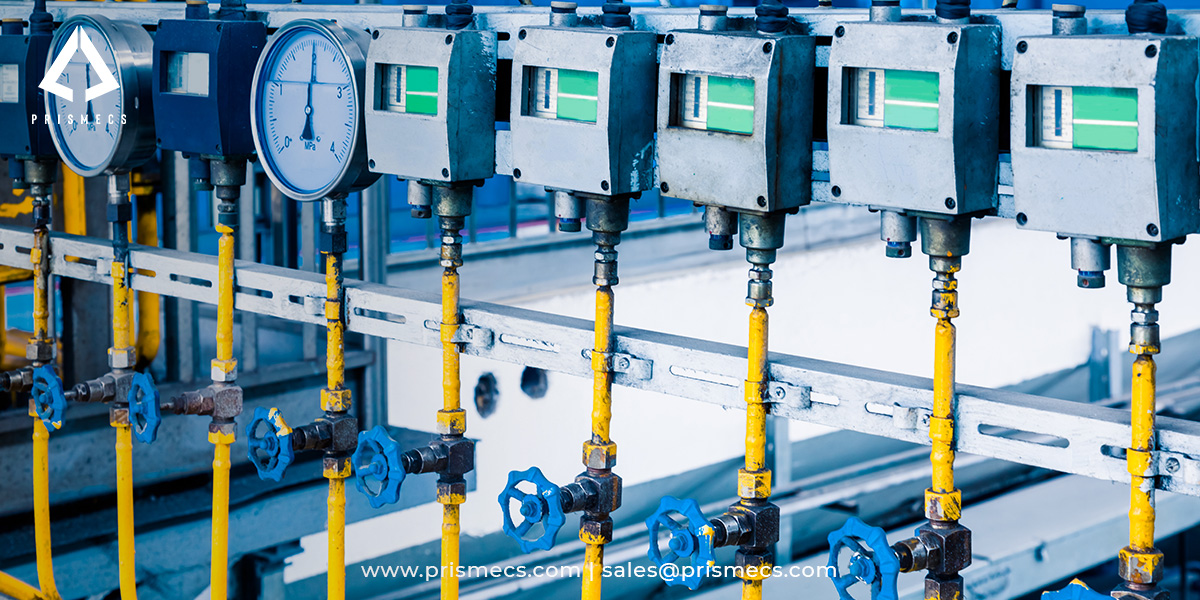
Oil and gas control systems are the layered combination of PLCs, DCS or SCADA supervision, and independent safety systems that operate and protect a plant. Getting the architecture right determines operating cost, diagnostic speed, and whether a hazardous condition reaches a safe state.
This guide covers the control-system layers, how SCADA, DCS, and PLC platforms differ, the critical separation between basic process control and safety instrumented systems, the standards that govern both, what fragmented control costs, and how an integrated master control panel consolidates them.
It is written for plant managers, controls and I&C engineers, and operations leaders specifying or upgrading control systems for power plants and oil and gas facilities.
What Oil and Gas Control Systems Actually Are
An industrial control system in oil and gas is a layered architecture combining field instrumentation, programmable controllers, and a supervisory layer that gives operators visibility and command. The term covers several distinct technologies that work together rather than one single system.
The layers, from the process outward:
- Field layer: sensors and transmitters measuring pressure, temperature, flow, and level, plus actuators such as control valves, motors, and breakers.
- Control layer: programmable logic controllers (PLCs) or distributed control system (DCS) controllers executing the logic.
- Supervisory layer: the master station, human-machine interface (HMI), alarm system, and historian.
- Safety layer: an independent safety instrumented system (SIS) or emergency shutdown (ESD) system, plus fire and gas detection.
The distinction that matters most operationally is between the layer that runs the process and the layer that protects it. Those are separate functions with separate standards, and conflating them is one of the more consequential design errors in process plant control.
SCADA vs DCS vs PLC: How They Differ
SCADA, DCS, and PLC are not competing products but different tools solving different control problems, distinguished by speed, scope, and architecture. Choosing the wrong one raises cost and limits scalability for the life of the plant.
The boundaries are converging in practice. Modern high-end PLCs handle many process control tasks once reserved for a DCS, and major vendors now build DCS platforms on integrated PLC controllers with native supervisory visualization. Standard Ethernet-based protocols have removed much of the historical architectural separation, which is what makes consolidated control panels viable.
BPCS vs SIS: The Separation That Protects the Plant
A basic process control system (BPCS) runs the plant, while a safety instrumented system (SIS) or emergency shutdown (ESD) system independently brings it to a safe state when a hazardous condition occurs. These are two different systems with two different jobs, and the independence between them is a safety requirement, not a design preference.
The BPCS handles normal operation: regulating flows, temperatures, and pressures, and serving as the first layer of protection when a process drifts. The SIS sits behind it as an independent protection layer, monitoring for defined hazardous conditions and executing a shutdown when the BPCS has failed to keep the process within safe limits.
The practical rule for specification is that SIS scope is governed by the site safety lifecycle, not by a platform label. An integrated engineering interface or a vendor's DCS branding does not by itself establish safety-function compliance, so the safety layer must be specified, verified, and documented on its own terms.
Functional Safety Standards for Safety Instrumented Systems
Safety instrumented systems in oil, gas, and process plants are governed by IEC 61511, the international functional safety standard for the process industry sector. Compliance is the recognized good engineering practice for any system performing a safety function.
The standards that govern the safety layer:
The framework is lifecycle-based, not product-based. It requires hazard analysis using methods such as HAZOP and layer of protection analysis (LOPA) to determine the required safety integrity level (SIL), then a safety requirement specification, verification, and ongoing testing and maintenance across the system's operating life. A control panel claiming SIS capability should be assessed against that lifecycle.
Panel and Enclosure Standards to Verify
Industrial control panels are governed by their own construction and enclosure standards, separate from the functional safety standards that govern the logic inside them. Verifying both is what separates a compliant installation from a liability.
The standards that apply to the panel itself:
Environmental rating drives design in oil and gas. Panels in exposed, dusty, or washdown environments require a sealed enclosure rating, and any panel installed in a classified hazardous area must carry the appropriate explosion-protection certification. Specifying the enclosure rating and the panel construction standard together avoids costly retrofits at commissioning.
What Fragmented Control Systems Cost
Non-consolidated control systems raise operating cost, slow fault diagnosis, and create safety exposure, because each separate system carries its own interface, its own specialists, and its own failure modes. The cost is rarely visible as a line item, which is why it persists.
The specific penalties of a fragmented architecture:
- Larger operating teams: separate SCADA, safety, and fire systems each demand trained operators and specialist support.
- Slow diagnosis: correlating an event across disconnected historians and interfaces turns fault-finding into guesswork.
- Safety exposure: delayed or ambiguous alarm information slows the response to a developing incident.
- Training burden: every additional interface and technology adds to the competency an operator must maintain.
- Redundant hardware: duplicated I/O, panels, and networks carry duplicated capital and maintenance cost.
Consolidation flattens the plant architecture. Bringing supervisory control, safety logic, and fire and gas detection into one coordinated system, with a single operator interface and a common historian, removes the seams where diagnostic time and operator error accumulate.
The Prismecs UMCP-100 Universal Master Control Panel
The Prismecs UMCP-100 is a universal master control panel that consolidates SCADA, safety instrumented, and fire safety control into a single engineered system for power plants. It was developed from field experience across power generation projects, where fragmented control architecture repeatedly proved to be a source of cost and downtime.
Core specifications:
Two design decisions matter most for total cost of ownership. The 25% spare capacity across I/O, panel space, and screens means future expansion does not require a new panel, which is where control upgrades usually become expensive. The four-protocol support, including IEC 61850 for substation automation and DNP3.0 for utility telemetry, allows integration with existing SCADA rather than forced replacement.
The panel also includes a historian for direct access to plant data, so downtime figures, trip causes, and event sequences are retrievable without reconstructing them across separate systems.
What an Integrated Master Control Panel Changes
An integrated master control panel reduces operating cost and shortens diagnostic time by replacing multiple separate control interfaces with one coordinated system. The gains come from removing complexity, not from adding technology.
The operational effects of consolidation:
- Lower operating expenditure through fewer required operators, faster installation, and reduced dependence on system-specific specialists.
- Faster diagnosis because event data, trip causes, and downtime figures sit in one historian rather than across disconnected systems.
- A single operator interface, which shortens training and reduces the risk of error under pressure.
- Faster incident response through unified alarm presentation across process, safety, and fire systems.
- Reduced redundancy cost, eliminating duplicated hardware, panels, and the maintenance they carry.
The commissioning benefit is equally practical. A pre-engineered panel arrives configured, which compresses installation and commissioning time compared with integrating multiple vendor systems on site, where interface mismatches typically surface late and cost schedule.
How Prismecs Delivers Control System Projects
Prismecs delivers control systems as a turnkey partner, combining the engineered UMCP-100 panel with integration, commissioning, and 24/7 operational support. The distinction from a software vendor or a panel builder is that the same team specifies, installs, commissions, and supports the system.
The Prismecs capability set for control systems:
- Integrated master control: the UMCP-100 consolidating SCADA, SIS, and fire safety control in one panel.
- Integration with existing systems: MODBUS, DNP3.0, and IEC 61850 support for connecting to installed SCADA rather than replacing it.
- I&C engineering: PLC programming to ISA and IEC standards, with I/O and interface design matched to the plant.
- Fast-track deployment: pre-engineered delivery that minimizes installation and commissioning time.
- 24/7 support: an experienced team that understands plant operations, not only panel hardware.
The differentiator is that Prismecs builds the product and runs the projects. Educational resources explain control architecture and software vendors sell platforms, but neither commissions the panel or answers at 3 a.m. when a trip needs diagnosing.
Frequently Asked Questions
What are oil and gas industry control systems?
Oil and gas control systems are layered architectures combining field instrumentation, programmable controllers, and a supervisory layer. They include PLCs for deterministic logic, DCS or SCADA for supervision and operator visibility, and an independent safety instrumented system for protection. The field layer measures and actuates, the control layer executes logic, and the supervisory layer provides HMI, alarms, and historian functions.
What is the difference between SCADA, DCS, and PLC?
A PLC is a ruggedized field-level controller with roughly 1 to 10 ms scan times, suited to discrete and machine control. A DCS integrates control, I/O, and operator interface with built-in redundancy for large continuous process plants, typically running regulatory loops at 10 to 100 ms. SCADA provides supervisory monitoring, alarms, and historian functions across geographically distributed assets rather than time-critical control.
What is the difference between BPCS and SIS?
A basic process control system (BPCS) runs the plant and acts as the first layer of protection during normal operation. A safety instrumented system (SIS), also called an emergency shutdown system, is an independent layer that brings the process to a safe state when a hazardous condition occurs. Their independence is a safety requirement, and SIS scope is governed by the site safety lifecycle rather than a platform label.
Which standards govern safety instrumented systems in oil and gas?
IEC 61511 is the international functional safety standard for safety instrumented systems in the process industry, with ANSI/ISA 84.00.01 as the mirroring United States standard and IEC 61508 as the umbrella framework. The approach is lifecycle-based, requiring hazard analysis such as HAZOP and LOPA to determine the safety integrity level (SIL), followed by specification, verification, and ongoing testing.
What standards apply to industrial control panels?
Industrial control panels follow UL 508A in North America and IEC 61439-1 internationally for assembly construction. Enclosure ingress protection ratings such as IP65 are defined by IEC 60529. Panels installed in classified hazardous areas additionally require ATEX or IECEx certification. These panel standards are separate from the functional safety standards governing the control logic, and both should be verified.
Why consolidate control systems into one master panel?
Fragmented control systems require larger operating teams, slow fault diagnosis across disconnected historians, add training burden, and duplicate hardware cost. Consolidating supervisory control, safety logic, and fire and gas detection into one coordinated panel with a single operator interface and common historian removes the seams where diagnostic time and operator error accumulate, while reducing installation and commissioning time.
Why Control System Architecture Is a Strategic Decision
Control system architecture is a long-lived decision, not a procurement detail, because the layers you specify determine operating headcount, diagnostic speed, and safety performance for the life of the plant. The technologies are converging, the standards are established, and the difference between a fragmented and a consolidated architecture shows up in every shift.
Operators specifying or upgrading control systems need a partner who understands the architecture, the functional safety lifecycle, and the panel standards, and who can deliver and support the hardware. That is the Prismecs model: an engineered master control panel backed by I&C engineering, commissioning, and 24/7 operational support.
To discuss the UMCP-100 or a control system upgrade for your plant, call +1 (888) 774-7632 or email sales@prismecs.com.
Tags: oil and gas control systems SCADA vs DCS vs PLC safety instrumented systems IEC 61511 functional safety master control panel
recent posts
O&M Services
15 minutes read
Writing a Power Plant O&M RFP That Gets Comparable Bids
Write a power plant O&M RFP every bidder must price the same way. Get the pricing template, data room checklist and weighted scorecard that expose eve...
EPCM Services
19 minutes read
25 Questions to Ask a Power Plant EPC Contractor Before You Sign
Most lists of questions to ask an EPC contractor stop at the question. Get why each matters, the strong answer, the red-flag reply and a weighted bid...
Gas Turbines
19 minutes read
Dual-Fuel Gas Turbines: How Gas-and-Liquid Fuel Flexibility Works
A dual-fuel gas turbine switches from natural gas to diesel at load, but most failures start in idle oil lines. Get transfer steps and coking fixes be...
Power Utilities
18 minutes read
Temporary and Bridge Power for Industrial Facilities: When and How to Use It
Planning bridge power past 12 months? Under EPA rules your generators may be stationary from day one. Check Tier 4, NSPS KKKKa and SPCC triggers befor...