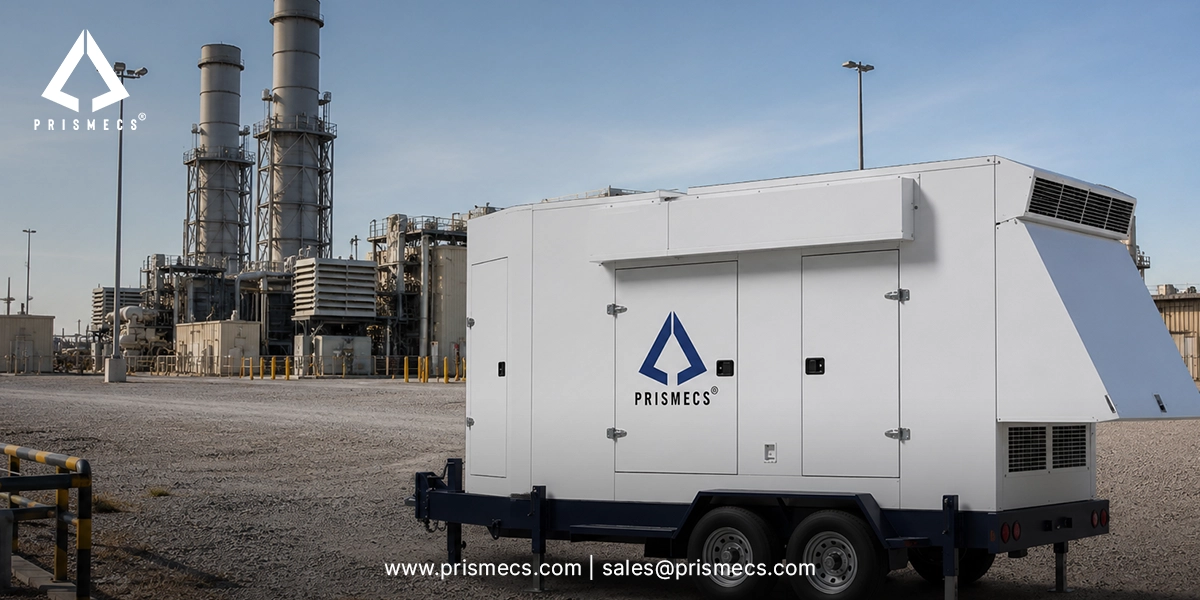
A 110 MW turbine that you cannot take offline starts to drift. Vibration climbs two mils over a week. The exhaust temperature spread widens by a few degrees. The plant is contractually locked into reserve capacity, so a convenient shutdown does not exist.
You decide, with incomplete data, whether the machine finishes the month or fails at 3 a.m. and takes the shaft with it. That decision is what predictive maintenance for power generation assets actually is. Not dashboards. Not buzzwords. The difference between a planned four-hour borescope and a nine-figure forced outage.
This guide is for procurement engineers, plant managers, and reliability teams responsible for power generation assets where uptime is not negotiable.
What Predictive Maintenance Means for Power Assets
Predictive maintenance (PdM) uses real-time condition data to forecast when a specific asset will fail, so repairs happen just before failure rather than on a calendar or after a breakdown. On power assets, the choice of strategy carries direct financial weight.
Reactive maintenance runs an asset to failure. That is defensible on a redundant service-water pump. It is indefensible on a single main transformer whose replacement lead time runs past a year. Preventive maintenance replaces parts on a fixed schedule, so you either discard good components early or miss a fault that develops between intervals.
Condition-based maintenance (CBM) acts on a measured threshold. Predictive maintenance goes one step further and estimates remaining useful life (RUL). It tells you not just that a fault exists, but roughly how long you have.
The concept underneath all of this is the P-F curve. 'P' is the point where a failure first becomes detectable. 'F' is functional failure. The entire value of PdM lives inside that window. Vibration and oil analysis widen it from hours to weeks, which is what converts a forced outage into a planned one.
The P-F Interval: Your Entire Window to Act
The P-F interval is the elapsed time between P (the first detectable sign of failure) and F (functional failure). It is the only window predictive maintenance can exploit, and its length dictates your monitoring strategy. A bearing defect may offer a P-F interval of weeks, giving vibration trending time to catch it. A transformer partial-discharge fault may offer months. A fatigue crack in a turbine blade root can offer days or less, which is why some failure modes justify continuous monitoring while others tolerate periodic sampling. Matching monitoring frequency to the P-F interval of each failure mode, rather than to a generic calendar, is what separates a program that catches faults from one that documents them after the fact.
How Predictive Maintenance Works on Power Generation Assets

A predictive program on rotating and electrical power assets runs through five stages. Each stage is a place where real programs either hold together or quietly fail.
Data acquisition:
Sensors capture vibration, temperature, pressure, and current, streaming through a data historian or SCADA and DCS layer into a CMMS. Sampling rate decides everything. Bearing defect frequencies on a turbine demand high-frequency capture, not one reading per minute.
Baseline determination:
The system learns each asset's healthy signature under known load, ambient, and fuel conditions. A baseline set during commissioning on a cool morning will misread the same machine at peak summer ambient.
Analysis and modeling:
Algorithms compare live data against baseline and flag deviation. A critical distinction lives here. Physics-based models use known failure mechanics, so they work from day one on a new asset. Data-driven machine learning models learn from history and need enough of it to be trusted. Hybrid models combine both, which is usually right for a mixed fleet.
Decision and prioritization:
The model estimates severity and remaining useful life, turning a raw anomaly into a ranked maintenance priority the planner can act on.
Work order and action:
The CMMS generates a work order, checks spares, and schedules the intervention against the plant's outage calendar.
The honest answer to 'how much data does the model need' is that it depends on the model type. A technology-led approach that leans on physics-based methods can protect a new asset from day one, while the data-driven layer accumulates history behind it.
Gas Turbine Fault Signatures
A gas turbine tells you it is in trouble long before it trips, if you read the right signals. Vibration is the loudest. On a heavy-duty industrial or aeroderivative unit, a rising 1x running-speed component points to rotor imbalance, often from blade fouling or a shifted balance weight. A 2x component points to misalignment or a coupling problem.
Exhaust gas temperature (EGT) spread is the second signal, and it is turbine-specific. When thermocouples in the exhaust plane begin reading progressively hotter or cooler than their neighbors, the spread widens. That pattern usually means a combustion problem, a fuel nozzle starting to coke, or early hot gas path distress.
Hot gas path degradation shows performance data as a slow, correlated loss of output and efficiency at fixed firing temperature. On a mobile turbine running in high-ambient conditions, a two-degree EGT spread drift over ten days can precede a fuel-nozzle issue that a scheduled combustion inspection resolves before any hot-section damage. Caught early through remote monitoring, it becomes a planned inspection instead of a liberated blade.
Transformer and BOP Diagnostics
High-value electrical assets fail through different physics, so they need different sensing. Dissolved gas analysis (DGA) is the primary tool for oil-filled transformers. As insulation and oil degrade under electrical and thermal stress, they release specific gases into the oil.
The gas pattern names the fault. Hydrogen with acetylene points to active arcing. Ethylene points to overheating. The interpretation follows IEEE C57.104 guidance, which lets you classify the fault type well before the transformer fails.
Thermographic analysis finds hotspots at bushings, connections, and load tap changer (LTC) contacts. The LTC is a frequent failure point because it switches under load, and its wear shows in both thermal signature and DGA. Partial discharge monitoring catches the small internal discharges that erode insulation, often the only warning before an HV or MV switchgear flashover. These diagnostics sit inside balance-of-plant services, where a single transformer or switchgear failure can strand an entire generating unit.
Reciprocating Engine and Generator Wear
Reciprocating gensets show their wear in the oil first. Lube oil analysis measures wear metals, and the specific metal points to the specific component. Iron suggests liner or ring wear. Copper suggests bearing degradation. Silicon suggests dirt ingress past the air filter, which then accelerates everything else.
Condition monitoring on high-output and mid-range gensets also tracks cylinder exhaust temperatures and crankcase pressure. Both drift as top-end components to wear. A rising trend flags a top-end rebuild before a scored liner turns into a holed piston.
For prime-power diesel generators running continuously, this trend is the difference between a scheduled overhaul and an emergency engine-out. Oil sampling intervals should tighten as an engine approach its rebuild window, not stay fixed on the original calendar.
The Core Detection Techniques and What Each One Cannot See
Most explainers list detection techniques and stop. The more useful knowledge is where each one goes blind. A program built on the wrong technique for the asset gives false confidence, which is worse than no program at all.
The practical rule is that no single technique protects a complex asset. A gas turbine needs vibration for the rotor, oil analysis for the bearings and lube system, and performance analytics for the hot gas path. Vibration alone will never see EGT spread. Thermography alone will never see a developing bearing defect.
This is why recognized reliability frameworks, including ISO 17359 on condition monitoring and the vibration guidance in the ISO 20816 series, treat these as a layered set rather than a menu. A credible operations and maintenance program specifies the combination per asset class, not one tool across the whole plant.
The Challenges Nobody Tells You About

Vendor content sells the upside. Operators who have run these programs know the failure modes are real, and mostly organizational rather than technical. Three problems sink more predictive programs than any sensor limitation: false alarms that destroy trust, insufficient data history, and an ROI case that ignores the cost of getting it wrong.
Each is survivable if you plan for it. Each is fatal if you do not.
False Positives and Alert Fatigue
The fastest way to kill a predictive program is to cry wolf. Set alarm thresholds too tight, and the system floods the team with nuisance alerts. After the fifth false alarm, technicians start ignoring the sixth, and the one real fault gets ignored with it. That is alert fatigue, and it is a leading cause of abandoned deployments.
The opposite error is quieter and worse. Set thresholds too loose to avoid noise, and a real fault slips through as a false negative. On a redundant pump, a missed alert costs a repair. On a main transformer or a turbine rotor, a missed alert costs the asset.
The engineering trade-off is precision versus recall. High precision means few false alarms but higher risk of a miss. High recall means catching everything but drowning in noise. Tuning that balance per asset criticality is skilled work, not a default setting.
This is why a human-in-the-loop layer matters. An experienced analyst reviewing flagged anomalies filters the noise that raw thresholds cannot, which is how a serious condition-monitoring program stays both sensitive and trusted.
Data History and Model Trust
A data-driven model is only as trustworthy as the history it learned from. The cold-start problem is real. A brand-new turbine has no failure history, so a purely machine-learning model has nothing to define normal from during its first months of operation.
There are two honest ways through this. Use a physics-based model that encodes known failure mechanics and works from commissioning day one. Or run a supervised baseline period under tight analyst oversight while the data-driven model accumulates history.
Sensor calibration is the other trust killer. A drifting vibration probe or an uncalibrated thermocouple feeds the model's bad ground truth, and the model confidently learns the wrong baseline. Calibration discipline is not overhead. It is the foundation the predictions stand on.
Cost, ROI, and the Risk of Getting It Wrong
The ROI case for predictive maintenance is strong but usually presented dishonestly. Published industry analyses put maintenance-cost reductions in the range of roughly 18 to 31 percent versus traditional approaches, and research from Deloitte has estimated that poor maintenance strategy can cut a plant's productive capacity by 5 to 20 percent. Those figures are averaged across industries, not a guarantee for your assets.
The honest way to build the case is bottom-up. Take one critical asset. Calculate its unplanned downtime cost per hour, including lost generation, contractual penalties, and collateral damage. Compare that against the sensor, integration, and program cost. On a turbine where a forced outage runs into seven figures, the payback period is short. On a non-critical auxiliary, it may never pay back.
That per-asset discipline is the real skill. Blanket-instrumenting a plant wastes capital on assets that do not justify it. Key metrics to track from day one are mean time between failures (MTBF), mean time to repair (MTTR), and the ratio of planned to reactive work orders. If that ratio does not move toward planned within two quarters, the program needs correction, not more sensors.
Build In-House or Outsource: Choosing Your PdM Delivery Model
Deciding to run predictive maintenance is the easy part. The harder question is who runs it. Building an in-house program means hiring vibration analysts, buying analytics infrastructure, and carrying the calibration and tuning burden yourself. Outsourcing means buying that capability as a service against a defined scope.
The build case makes sense when you operate a large, homogeneous fleet at a single site, with enough asset count to keep specialist analysts fully utilized. Below that scale, in-house analysts sit idle between events, and idle specialists leave.
The outsource case makes sense for mixed fleets, multi-site operations, and any plant that cannot justify a full-time reliability data team. It also removes the cold-start and calibration risk, because a mature provider brings existing physics-based models and calibrated workflows on day one.
A hybrid model is common and often optimal. The operator keeps daily condition monitoring in-house for routine assets and brings in a specialist provider for turbine hot-section analytics, transformer DGA interpretation, and outage-critical diagnostics where a wrong call is expensive.
Real Applications: From Signal to Action to Avoided Failure
Abstract explanations of predictive maintenance are easy. The proof is in the full loop, from a raw signal through analysis to a corrective action that prevented a failure. Two scenarios show how this works on assets where a miss is expensive or dangerous. Both reflect the operational reality of the field service and outage planning that keeps critical fleets running.
Catching Turbine Bearing Wear Before a Trip
Consider a mobile gas turbine committed to reserve capacity, running continuously. Routine vibration trending picks up a slow rise at one journal bearing, climbing from a stable baseline over roughly two weeks.
Spectral analysis narrows it down. The energy concentrates at bearing defect frequencies, not at running speed, which rules out imbalance and points to early bearing degradation rather than a rotor problem. Because the trend is caught inside the P-to-F window, there is time to act deliberately.
The team schedules a borescope and bearing inspection during a low-demand window instead of waiting for a vibration trip. The bearing is found to be scored but not failed and replaced in a planned four-hour intervention. The alternative, a failure at full load, risks the journal and the shaft and turns a minor repair into a rotor rebuild measured in months. This is the same discipline applied across the TM2500 and LM2500 projects Prismecs supports in the field.
When a Missed Alert Is Patient-Critical
Backup power changes the stakes entirely. In a hospital or a data center, standby generators and UPS systems sit idle until the moment they are the only thing between the load and darkness. A false negative here is not a repair bill. In a healthcare setting, it can be patient-critical.
The failure mode is insidious because idle assets degrade silently. Batteries lose capacity, stored fuel degrades, and starting systems seize, and none of it shows during normal operation. Predictive maintenance on backup power therefore centers on validated readiness, not just condition trending.
That means periodic load bank testing to prove the generator carries rated load, runtime validation against the actual critical load profile, and monitoring of battery health and transfer-switch function. For a data center on an N+1 redundancy scheme, the program must also confirm that the redundancy is real and not quietly eroded by a degraded standby unit. Readiness you have not tested is not readiness.
Where Predictive Maintenance Fits in a Full O&M Strategy
Predictive maintenance is a tactic, not a strategy. Treated as a standalone tool, it underdelivers. Positioned inside a broader operations and maintenance framework, it becomes the intelligence layer that directs everything else.
Reliability-centered maintenance (RCM) is the governing discipline. RCM asks which failure modes actually matter for each asset, then assigns the right strategy to each. Some assets warrant predictive monitoring. Some warrant preventive intervals. Some are genuinely run-to-failure. Predictive maintenance is the answer for the critical, high-consequence subset, not for everything.
Maintenance maturity also runs on a curve. An organization still fighting reactive fires cannot leap straight to fleet-wide predictive analytics. The sequence runs from reactive, to preventive, to condition-based, to predictive, and each stage builds the data and discipline the next one needs.
This is where predictive maintenance connects to the wider asset lifecycle. It informs operations and maintenance execution, feeds owner's engineering decisions on repair versus replace, and closes the loop back to design lessons captured during EPCM and commissioning. An OEM-agnostic program applies to this consistently across a mixed fleet, which single-OEM service contracts structurally cannot.
Talk to a Prismecs Power-Asset Reliability Expert
We help operators reach that point without wasted capital. Prismecs delivers OEM-agnostic predictive maintenance and O&M services across turbines, generators, transformers, and balance-of-plant systems, from a single critical asset to a full fleet. If uptime is not negotiable for your operation, talk to our reliability team about a program scoped to your assets.
Frequently Asked Questions
How does predictive maintenance work on a gas turbine?
Sensors track vibration, exhaust gas temperature spread, and performance against a healthy baseline. Rising vibration at specific frequencies signals rotor or bearing faults, a widening EGT spread signals combustion or hot gas path issues, and correlated output loss signals path degradation, each caught before failure.
What are the main types of predictive maintenance?
The five core techniques are vibration analysis, oil and lube analysis, infrared thermography, acoustic or ultrasonic analysis, and motor current signature analysis. Each detects different fault physics, so complex power assets need a layered combination rather than any single method.
How accurate is predictive maintenance, and what about false alarms?
Accuracy depends on sensor quality, model type, and threshold tuning. Thresholds set too tight cause false alarms and alert fatigue. Thresholds set too loose risk of missing real faults. An experienced analyst reviewing flagged anomalies keeps a program both sensitive and trustworthy.
What is the ROI for predictive maintenance for power plants?
Industry analyses cite maintenance-cost reductions around 18 to 31 percent, but the honest case is built per asset. Compare a specific asset's unplanned downtime cost per hour against program cost. Critical turbines and transformers pay back fast, while non-critical auxiliaries may not justify it.
Should predictive maintenance be built in-house or outsourced?
Build in-house for large, single-site, single-OEM fleets with enough events to keep analysts utilized. Outsource for mixed or multi-site fleets, to remove cold-start and calibration risk, or to prefer an OpEx model. A hybrid split is frequently optimal.
How does predictive maintenance fit into O&M services?
It is the intelligence layer within a broader reliability-centered maintenance strategy. It directs where preventive, predictive, and run-to-failure approaches each apply, and connects to the full asset lifecycle across O&M, owner's engineering, and commissioning.
Tags: condition monitoring P-F curve gas turbine maintenance reliability-centered maintenance power plant O&M
recent posts

O&M Services
15 minutes read
Writing a Power Plant O&M RFP That Gets Comparable Bids
Write a power plant O&M RFP every bidder must price the same way. Get the pricing template, data room checklist and weighted scorecard that expose eve...

EPCM Services
19 minutes read
25 Questions to Ask a Power Plant EPC Contractor Before You Sign
Most lists of questions to ask an EPC contractor stop at the question. Get why each matters, the strong answer, the red-flag reply and a weighted bid...
Gas Turbines
19 minutes read
Dual-Fuel Gas Turbines: How Gas-and-Liquid Fuel Flexibility Works
A dual-fuel gas turbine switches from natural gas to diesel at load, but most failures start in idle oil lines. Get transfer steps and coking fixes be...

Power Utilities
18 minutes read
Temporary and Bridge Power for Industrial Facilities: When and How to Use It
Planning bridge power past 12 months? Under EPA rules your generators may be stationary from day one. Check Tier 4, NSPS KKKKa and SPCC triggers befor...