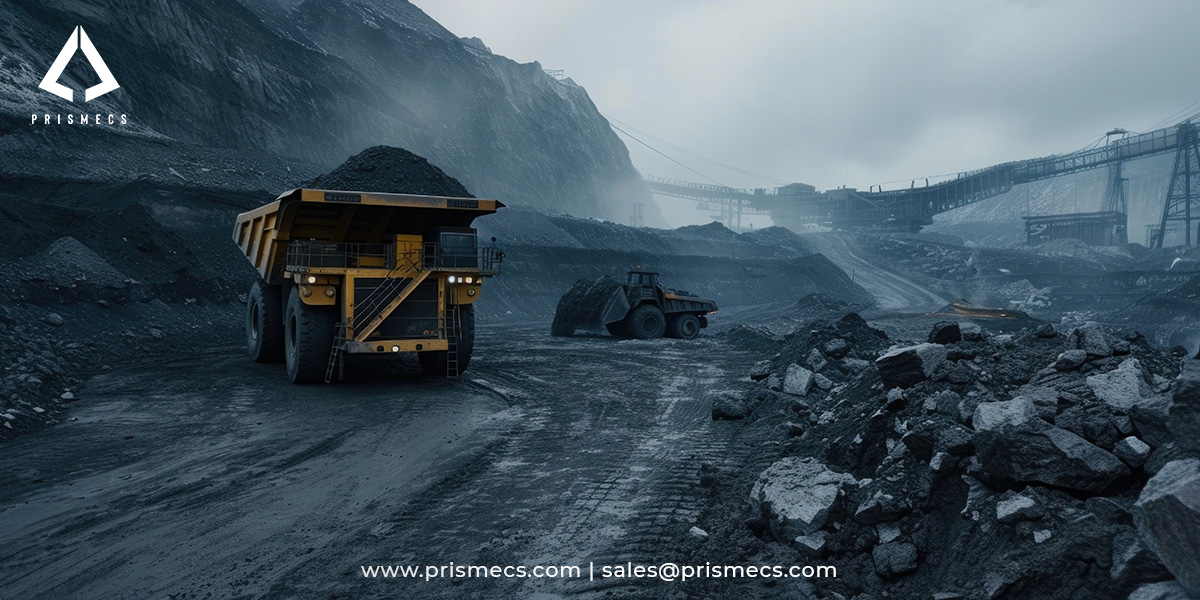
A mine is one of the most power-intensive industrial operations that exists, and two loads dominate everything else.
Comminution, the crushing and grinding of ore, accounts for 50 to 80 percent of mine energy consumption. On an underground operation, ventilation and air conditioning typically account for 40 to 50 percent of the total power consumed by the whole mine.
Those two numbers determine how a mine is powered, and they also explain why fleet electrification pays. Replacing diesel equipment underground removes the heat and diesel particulate matter that ventilation exists to clear, which cuts the ventilation load by 30 to 50 percent. A typical underground gold mine can save $3 to 5 million annually in ventilation costs alone after full fleet electrification.
Most mines are also remote, weakly connected or entirely off-grid, which makes site generation an engineering problem rather than a utility relationship.
This guide covers what a mine's electrical load actually looks like, how off-grid sites supply it, what electrification changes, and what to specify.
The Load Profile
- A mine's electrical load divides into four groups, and they have completely different continuity requirements.
- Comminution is the largest consumer and the most interruptible in safety terms, though an unplanned mill trip is a production event with a long restart.
- Ventilation and dewatering are the smallest in capital terms and the least interruptible, because an outage in either is a safety event rather than a production loss.
- Hoisting and material handling sit between the two, continuous during production and stoppable without immediate hazard.
- Ancillary load covers workshops, camp, offices, water treatment and increasingly fleet charging.
Why the profile matters more than the peak
A power system sized to peak demand without understanding the shape of the load is oversized for most of the year and under-protected where it matters.
The continuous grinding load sets the base. Hoisting and crushing add cyclic demand. Motor starting creates transient demand far above running load. And on an electrifying site, charging adds a controllable load that can be scheduled against the rest.
Model the profile before selecting the generation. A flat continuous load and a highly cyclic one need different answers even at the same average demand.
Comminution: The Single Largest Load
Comminution, the progressive reduction of ore particle size through crushing and grinding, accounts for 50 to 80 percent of a mine's total energy consumption.
Primary crushing reduces run-of-mine ore to a size the mill can accept. A semi-autogenous grinding mill, or SAG mill, uses the ore itself plus a steel ball charge to grind further. A ball mill completes the reduction to the particle size the recovery process requires.
The electrical consequence is a very large, continuous, inductive motor load. Mill drives on a major concentrator run into the tens of megawatts, and they dominate both the energy consumption and the power quality characteristics of the site.
The efficiency opportunity
Energy reduction of 30 to 50 percent is considered achievable in comminution through circuit design and equipment selection, with advanced comminution approaches reported to deliver around 20 percent reduction in total energy use for the comminution stages.
Because comminution is the majority of the load, a percentage saved there outweighs the same percentage saved anywhere else on site.
What it means for power supply
A mill is the hardest load on a mine network. It is large, continuous, and its starting and operating characteristics shape the entire electrical design, including transformer sizing, protection coordination and harmonic management.
Any power system proposal that does not model the mill explicitly has not modelled the mine.
Ventilation: The Underground Load That Electrification Changes
On an underground mine, power consumption for ventilation and air conditioning typically accounts for 40 to 50 percent of the total power consumed by the whole mine.
Ventilation exists to clear heat, dust, blasting fumes and diesel exhaust, and to deliver breathable air at depth. Primary fans move air through the main circuit; auxiliary fans serve development headings and working areas.
Peer-reviewed analysis of battery electric vehicles in underground mining identifies this as the principal economic lever, because ventilation is the load most directly affected by what the fleet burns.
Diesel particulate matter is the driver
- Diesel equipment underground produces carbon monoxide, nitrogen oxides and diesel particulate matter, all of which must be diluted and removed by forced ventilation.
- Electric load-haul-dump machines and underground trucks eliminate diesel particulate matter, with reported reductions from typical diesel levels around 50 µg/m³ to under 1 µg/m³.
- Heat is the second driver. Diesel machine heat output has been measured at 7 to 9 times higher than an equivalent battery electric machine, and energy consumption per run almost 12 times greater.
The ventilation dividend
Removing diesel from the underground fleet reduces ventilation requirement by 30 to 50 percent, and up to 50 percent with a fully electric fleet.
Applied to a load that is 40 to 50 percent of total mine power, that is the single largest operating saving available from electrification. CSIRO analysis puts it at $3 to 5 million annually in ventilation costs alone for a typical underground gold mine.
The caveat the vendors omit
The reduction depends on the specific conditions of the mine and may be limited by the presence of radon or by geothermal heat at depth.
A mine with a radon problem or high virgin rock temperature cannot reduce ventilation to the same extent regardless of what the fleet burns. Model the actual ventilation requirement before booking the saving.
Hoisting, Dewatering and Material Handling
- Three further load groups complete the picture, and one of them is the most reliability-critical system in an underground mine.
- Hoisting raises ore and personnel through the shaft. It is a large cyclic load with high starting demand and regenerative braking capability on the descent, which returns energy to the network.
- Dewatering pumps groundwater out of the workings continuously. On a wet mine it is a very large load and it is the system that cannot stop, because an underground mine without dewatering floods.
- Material handling covers conveyors, stackers, reclaimers and ore transfer. It is continuous during production and relatively steady.
Conveyors against truck haulage
- Electric conveyor systems replacing diesel truck haulage offer energy savings of up to 85 percent for comparable transport distances.
- The Pilgangoora lithium project in Western Australia uses an extensive electric conveyor network that eliminated the need for 26 diesel haul trucks.
- Conveying trades a capital-intensive fixed installation for a dramatic reduction in energy and fleet cost, which makes it a function of haul distance, tonnage and mine life rather than a universal answer.
Grid-Connected, Weak Grid and Off-Grid
Mines fall into three power supply positions, and the engineering differs substantially between them.
Grid-connected sites take supply from a utility network, usually through a dedicated transmission line and site substation. The questions are available capacity, reliability and the cost of the connection itself.
Weak-grid sites have a connection that cannot support the full load or cannot be relied on. These are the most complex cases, because the site needs its own generation that must synchronise with and support an unreliable network.
Off-grid sites have no connection. Site generation is the only supply, and reliability is entirely the owner's problem.
The grid connection question
Where a connection is reachable, interconnection timelines in many markets now run to years, which makes the connection a project schedule item rather than a commercial negotiation. See our analysis of the interconnection constraint.
Where it is not reachable, the capital cost of a transmission line over distance frequently exceeds the cost of building generation at site.
What weak grid actually requires
A site that is nominally connected but experiences frequent interruptions needs generation capable of carrying the mine through an outage, and control systems capable of transferring between sources without dropping the mill or the ventilation.
That is a different design from pure off-grid, and it is the case most frequently underestimated at feasibility.
Off-Grid Power: What Mines Actually Build
Off-grid mines build hybrid systems combining thermal generation with renewables and storage, and the published projects show what renewable fraction is realistically achievable.
A systematic review of energy consumption and renewable integration in mining documents the operating fleet:
Agnew is the outlier and the benchmark. At roughly 50 percent renewable fraction on a 56 MW off-grid system, it demonstrates what wind plus solar plus storage plus firm thermal generation can achieve on a mine load.
The others sit around 20 percent, which is the more typical result for solar plus storage without wind.
Why thermal generation stays
Because the load does not stop and solar does. Firm, dispatchable generation covers the night, the weather and the contingency, and the renewable fraction is the proportion of energy it does not have to supply.
Gas-fired generation where gas is available, and diesel or dual-fuel where it is not, remain the backbone of off-grid mine power.
Spinning reserve
Spinning reserve is generation running but not fully loaded, available to pick up load instantly if another unit fails. On an off-grid mine it is the difference between a unit trip and a site blackout.
High renewable fraction increases the reserve requirement, because solar output can fall faster than a generator can start. Battery storage increasingly serves this role, responding in milliseconds where a generator takes minutes.
Deployment speed
Mine power is frequently needed faster than a permanent plant can be built, particularly during ramp-up or when existing generation fails. For solar specification on a mine site, including temperature coefficient and module selection in high ambient conditions, see our guide to solar power plants and module technology.
Electrification: What Changes on the Electrical System
Fleet electrification converts diesel consumption into electrical load, and the net effect underground is a reduction in total site energy because the ventilation saving exceeds the charging demand.
Battery electric vehicles achieve roughly 90 percent energy efficiency against roughly 30 percent for diesel equivalents, and they recover energy through regenerative braking that a diesel machine converts to heat through friction.
Borden in Canada, operated by Goldcorp, was the country's first fully electric underground mine, using battery electric vehicles for drilling, blasting support, bolting and ore transport.
The charging load
- Electrifying a fleet creates a new electrical load that did not previously exist on the network, because the energy formerly delivered by a fuel truck now arrives through the substation.
- That load is large, and it is controllable. Charging can be scheduled against the mill load, against renewable availability, and against demand charges where a grid connection applies.
- Battery swapping shifts the charging load away from the vehicle cycle entirely, allowing charging to run at the system's convenience rather than the fleet's.
Energy management
Energy management systems control when and where charging occurs, dispatch renewable generation, and recover braking energy from the haul fleet. On a high-renewable site this is not an optimisation layer; it is what makes the renewable fraction achievable.
The staffing barrier
The most frequently cited barrier to electrification is not the equipment. It is the lack of experience among technicians, trainers and mining engineers in dealing with high-voltage equipment.
A battery electric fleet brings high-voltage systems into a maintenance organization built around diesel engines and hydraulics. Budget the training and the competency framework alongside the vehicles.
ESG and reporting
Electrification reduces Scope 1 emissions directly, because diesel combustion at site is replaced by electricity. Where that electricity comes from an off-grid diesel plant, the emissions move rather than disappear, which is why electrification and renewable integration are usually pursued together.
Trolley Assist
Trolley assist feeds electrical power to haul trucks through an overhead line during the loaded uphill haul, which is the most energy-intensive phase of the haul cycle.
A pantograph on the truck reaches up to contact the trolley line, providing power for propulsion rather than generating it on board. The truck operates in several modes, including on-board diesel-electric propulsion, trolley-based propulsion, and trolley retarding, where power generated by retarding the truck is fed back into the trolley grid.
What it saves
Trolley assist reduces diesel consumption by up to 90 percent on uphill segments, and delivers 40 to 60 percent energy savings during assisted climbs and loaded hauls.
Energy recovery during downhill haulage can reduce power consumption by up to 15 percent, capturing energy that would otherwise be lost as heat.
Why it suits surface mines
It targets the specific phase where a haul truck burns most of its fuel, without requiring the truck to carry a large battery. It works on fixed routes, which is what a haul road is.
The operational constraint
The trolley line is an overhead energized conductor on an active haul road. Faults generated where trucks unintentionally steer off or onto the line require the line to be temporarily de-energised, disrupting the flow of operations.
That is the practical problem, and it is an electrical design and operating procedure issue rather than a truck problem.
Power Quality and Reliability
Mine electrical networks carry large motor loads, extensive variable speed drives and, increasingly, high-power charging, all of which degrade power quality unless the system is designed for them.
Harmonic distortion is the distortion of the voltage and current waveform produced by non-linear loads, principally variable frequency drives. IEEE Std 519 provides the recommended practice and requirements for harmonic control in electric power systems, and it is the reference a specification should name.
Motor starting current on a large mill drive can be several times running current, producing voltage dip across the network. On a weak network or an off-grid system, that dip can trip other loads.
Variable frequency drives mitigate starting current and improve process control, and they are also the primary harmonic source. The design has to address both.
The safety-critical loads
Ventilation and dewatering outages in an underground mine are safety events, not production losses.
A ventilation stoppage allows heat, dust and gas to accumulate in working areas. A dewatering stoppage floods the workings. Both require evacuation decisions on a timescale measured in minutes to hours.
Design redundancy against those two loads specifically, rather than applying a uniform redundancy level across the site. For how redundancy levels are defined and proven, the same principles apply as in any critical facility.
Insurance
Insurers assess power system design, redundancy and maintenance regime when pricing mining risk, and a documented reliability case for the safety-critical loads is underwriting evidence.
Governing Standards
Mine electrical systems are governed by mine safety regulation and by general industrial electrical standards, and the specification should name both.
The Mine Safety and Health Administration, or MSHA, is the US regulator for mine safety, and its requirements take precedence over general industrial practice where they differ.
Outside the United States
MSHA and 30 CFR are US federal regulation. Other jurisdictions operate their own mine safety regimes, and Australia, Canada, Chile and South Africa each have distinct electrical and ventilation requirements for mining.
IEEE and IEC standards apply internationally. Confirm which regulatory regime governs before writing the specification, because the mine safety layer is jurisdiction-specific and the industrial electrical layer largely is not.
What to Specify
- A mine power specification is reviewable only if it states the load, the continuity requirement and the horizon.
- The load profile by group, naming comminution, ventilation, dewatering, hoisting, material handling and charging, with continuous and peak demand for each.
- The continuity requirement per load, distinguishing safety-critical loads from production loads.
- The generation configuration, including thermal capacity, renewable capacity, storage and the target renewable fraction.
- Spinning reserve policy and how it is maintained as renewable fraction rises.
- Power quality limits, naming IEEE Std 519 for harmonics and the permitted voltage dip on motor starting.
- The mine life horizon. Off-grid mines plan energy reliability over 20 to 30 years, which is longer than most equipment life and forces a replacement and expansion strategy into the original design.
- Expansion provision, in both capacity and physical space, for fleet electrification that may not be in the current plan.
The horizon point matters most
A power system sized for today's pit on a mine with a twenty-year life will be rebuilt. Phasing the capacity, reserving the land and specifying the switchgear for the ultimate rather than the initial load costs very little at design and a great deal afterwards.
Evaluating a proposal
Ask whether the mill load has been modelled explicitly. Ask what spinning reserve policy applies and how it changes with renewable fraction. Ask what happens to ventilation and dewatering during a generation contingency. Ask what the system supports if the fleet electrifies.
How Requirements Differ by Mine Type
- The load groups are constant. Their proportions and their criticality change substantially.
- Underground mines are ventilation-dominated, with ventilation and air conditioning at 40 to 50 percent of total power. Ventilation and dewatering are safety-critical. Electrification delivers its largest return here.
- Open pit mines have no ventilation load and are dominated by comminution plus haulage. Trolley assist and conveying are the electrification routes, and the haul fleet is the diesel consumer.
- Gold operations typically combine underground development with a concentrator, and the published off-grid renewable projects are weighted toward gold in Australia for exactly that reason.
- Copper operations run very large concentrators, which makes comminution the overwhelming load and the mill drive the defining electrical design problem.
- Coal mines fall under 30 CFR Part 75 with its own electrical and ventilation requirements, which are more prescriptive than the metal and non-metal standards.
- Remote and arctic sites face logistics as the binding constraint. Fuel delivery cost, equipment transport and the practical difficulty of maintenance all favour simpler, more robust configurations over optimal ones.
What Prismecs Does
Prismecs supplies, installs, commissions and maintains power generation for industrial sites, including fast-track deployment where time to power is the constraint.
Delivered project scope includes eight TM2500 dual-fuel units totaling 260 MW at Birr, Switzerland, online in six months on a compact site with a new 220 kV interconnection and engineered noise controls; four TM2500 units totalling 110 MW at Duqm, Oman, kept grid-ready with resident O&M crews, CMMS and parts support; an LM2500XPRESS plant at Miaoli, Taiwan delivered in ten months; DC-coupled battery energy storage for solar and hybrid applications; and owner's engineering on a 7 MW, 28 MWh battery storage system including the utility interconnection application.
Birr and Duqm are the relevant references for a mine power requirement. Dual-fuel capability, six-month delivery, a new high-voltage interconnection and resident operations crews are the components of an off-grid or weak-grid industrial power solution, applied to a different industry.
Capability spans distributed energy solutions for site power, microgrids and storage integration, power generation asset services for the equipment, I&C services for electrical systems, controls and commissioning, O&M services for the operating phase, EPCM services for project delivery, owner's engineering for independent review, supply chain solutions for procurement, and equipment inventory for ready-to-ship generators and transformers. One scope boundary worth stating. Prismecs supplies power infrastructure, not mining equipment. Haul trucks, shovels, drills and blasting services come from the mining OEMs and contractors. The work here is generation, distribution, substations, controls and the operations that keep them running.
Apply this article's criteria to any power proposal, including ours. Ask whether the mill load is modelled explicitly. Ask what the spinning reserve policy is at the target renewable fraction. Ask what carries ventilation and dewatering through a generation contingency. Ask what the design supports if the fleet electrifies later.
To discuss mine site power, off-grid generation or an operations and maintenance scope, send your site location and grid status, connected and peak load by area, mine life, current generation arrangement and any electrification plan to sales@prismecs.com or call +1 (888) 774-7632.
Frequently Asked Questions
What consumes the most power at a mine?
Comminution, the crushing and grinding of ore, which accounts for 50 to 80 percent of a mine's total energy consumption. On underground operations, ventilation and air conditioning typically account for 40 to 50 percent of the total power consumed by the whole mine. Hoisting, dewatering, material handling and ancillary load make up the remainder, with dewatering and ventilation being the least interruptible.
What is comminution and why does it dominate the load?
The progressive reduction of ore particle size through crushing and grinding. Primary crushing reduces run-of-mine ore, a semi-autogenous grinding mill uses the ore itself plus a steel ball charge, and a ball mill completes reduction to the size the recovery process needs. Mill drives on a major concentrator run into tens of megawatts, which makes them the defining electrical design problem on the site.
How much power does mine ventilation use?
On an underground mine, ventilation and air conditioning typically account for 40 to 50 percent of total power consumed by the whole mine. Primary fans move air through the main circuit and auxiliary fans serve development headings. The load exists to clear heat, dust, blasting fumes and diesel exhaust, and to deliver breathable air at depth, which is why what the fleet burns determines how large it must be.
How much does fleet electrification reduce ventilation load?
By 30 to 50 percent, and up to 50 percent with a fully electric underground fleet. Because ventilation is 40 to 50 percent of total mine power, this is the single largest operating saving available from electrification. CSIRO analysis puts it at $3 to 5 million annually in ventilation costs alone for a typical underground gold mine, though the achievable reduction depends on radon and geothermal heat conditions.
Why do battery electric vehicles reduce ventilation requirement?
Because ventilation exists partly to dilute what diesel equipment produces. Electric load-haul-dump machines and underground trucks eliminate diesel particulate matter, with reported reductions from typical diesel levels around 50 µg/m³ to under 1 µg/m³. Heat is the second driver: diesel machine heat output has been measured at 7 to 9 times higher than an equivalent battery electric machine.
How efficient are battery electric mining vehicles against diesel?
Roughly 90 percent energy efficiency against roughly 30 percent for diesel equivalents. Battery electric vehicles also recover energy through regenerative braking, restoring part of the kinetic energy used for braking to the battery rather than converting it to heat through friction. One comparison measured energy consumption per run at almost 12 times greater for a diesel machine than its battery electric equivalent.
What is trolley assist and what does it save?
Overhead electrical supply to haul trucks during the loaded uphill haul, contacted through a pantograph on the truck. It reduces diesel consumption by up to 90 percent on uphill segments and delivers 40 to 60 percent energy savings during assisted climbs and loaded hauls. Trucks can also operate in trolley retarding mode, feeding power generated by retarding the vehicle back into the trolley grid.
What renewable fraction can an off-grid mine achieve?
Published projects suggest roughly 20 percent for solar plus storage and around 50 percent where wind is added. Agnew Gold Mine in Australia runs a 56 MW off-grid system combining solar PV, wind, diesel or gas and battery at roughly 50 percent renewable fraction. DeGrussa Copper at 10.6 MW, Granny Smith Gold at 9.3 MW and Weipa Bauxite at 6.7 MW each achieve roughly 20 percent.
Why do off-grid mines still need thermal generation?
Because the load does not stop and solar does. Firm dispatchable generation covers the night, the weather and the contingency, and the renewable fraction is simply the proportion of energy it does not have to supply. Gas-fired generation where gas is available, and diesel or dual-fuel where it is not, remain the backbone of off-grid mine power regardless of how much renewable capacity is installed.
What is spinning reserve and why does renewable fraction change it?
Generation running but not fully loaded, available to pick up load instantly if another unit fails. On an off-grid mine it is the difference between a unit trip and a site blackout. High renewable fraction increases the requirement, because solar output can fall faster than a generator can start. Battery storage increasingly serves this role, responding in milliseconds where a generator takes minutes.
Which loads at a mine are safety-critical rather than production-critical?
Ventilation and dewatering. A ventilation stoppage allows heat, dust and gas to accumulate in working areas. A dewatering stoppage floods the workings. Both force evacuation decisions on a timescale of minutes to hours, which makes them a different redundancy problem from the mill. Design redundancy against those two specifically rather than applying a uniform level site-wide.
What power quality issues do mine networks face?
Harmonic distortion from variable frequency drives, and voltage dip from large motor starting. Mill drive starting current can be several times running current, and on a weak or off-grid network that dip can trip other loads. IEEE Std 519 provides the recommended practice for harmonic control and should be named in any specification. Variable frequency drives both mitigate starting current and generate harmonics.
Which standards govern mine electrical systems?
In the United States, MSHA regulations under 30 CFR: Part 57 for underground metal and non-metal mines, Part 75 for underground coal including electrical and ventilation requirements, and Part 56 for surface operations. Alongside these, IEEE Std 141 for industrial power distribution, IEEE Std 242 for protection and coordination, and IEEE Std 519 for harmonics. MSHA requirements take precedence where they differ from general industrial practice.
What planning horizon should a mine power system use?
The mine life, which for off-grid operations means planning energy reliability over 20 to 30 years. That is longer than most generation equipment life, which forces a replacement and expansion strategy into the original design. Phasing capacity, reserving land and specifying switchgear for the ultimate rather than the initial load costs very little at design stage and a great deal afterwards.
Tags: Mine Power Mining Electrification Off-Grid Power Mine Ventilation Comminution
recent posts
O&M Services
15 minutes read
Writing a Power Plant O&M RFP That Gets Comparable Bids
Write a power plant O&M RFP every bidder must price the same way. Get the pricing template, data room checklist and weighted scorecard that expose eve...
EPCM Services
19 minutes read
25 Questions to Ask a Power Plant EPC Contractor Before You Sign
Most lists of questions to ask an EPC contractor stop at the question. Get why each matters, the strong answer, the red-flag reply and a weighted bid...
Gas Turbines
19 minutes read
Dual-Fuel Gas Turbines: How Gas-and-Liquid Fuel Flexibility Works
A dual-fuel gas turbine switches from natural gas to diesel at load, but most failures start in idle oil lines. Get transfer steps and coking fixes be...
Power Utilities
18 minutes read
Temporary and Bridge Power for Industrial Facilities: When and How to Use It
Planning bridge power past 12 months? Under EPA rules your generators may be stationary from day one. Check Tier 4, NSPS KKKKa and SPCC triggers befor...