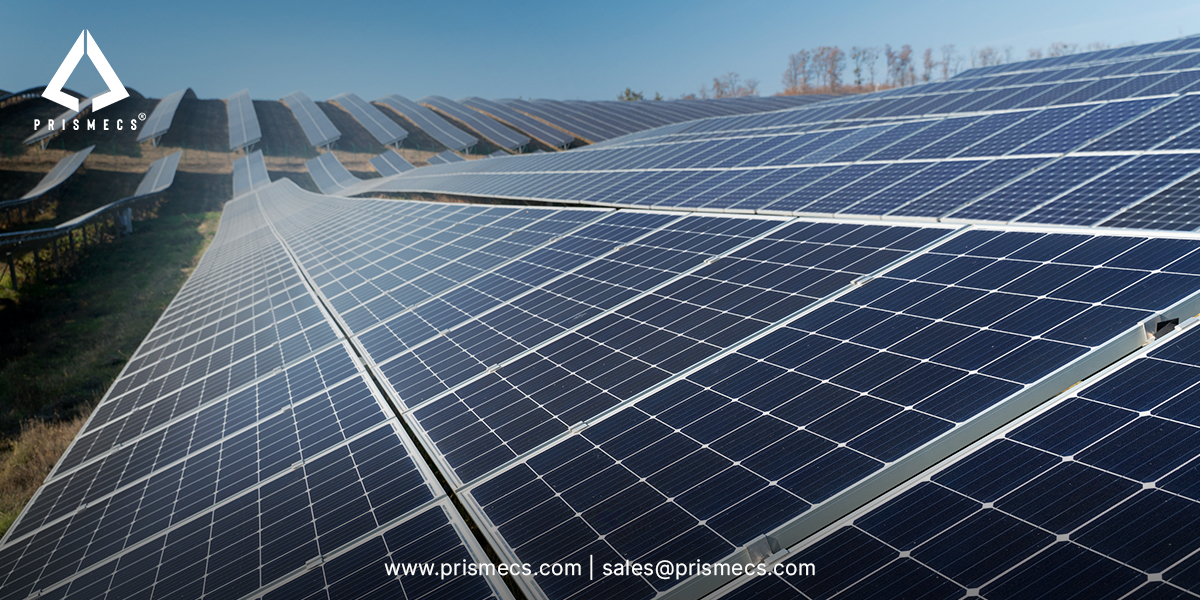
Four decisions sit between wanting solar and having a working array, and the one buyers spend most time on matters least.
Nameplate module efficiency determines how much land you need. On an industrial site with space available, it is rarely the binding constraint. What determines how much energy you actually get over twenty-five years is temperature coefficient, degradation rate and array configuration.
The gap is measurable. A TOPCon array has been shown to out-produce a PERC array by 3.7 percent on annual yield at equivalent kW DC and matched orientation, with the summer afternoon difference reaching 5 to 6 percent.
This guide covers the four decisions: PV or CSP, which module technology, how the array is configured, and what certification to specify.
What a Solar Power Plant Is
A solar power plant is an array of solar panels, mounting structures, inverters and electrical infrastructure that converts sunlight into grid-quality alternating current at scale.
Also called a solar farm, it occupies land in proportion to its capacity and the technology chosen, and it connects to the grid or to a facility through transformers and switchgear in the same way any generating plant does.
The plant is more than the panels. The modules are typically a minority of installed cost once mounting, inverters, electrical balance of system, civil works and interconnection are included.
For the business case behind industrial adoption, see our guide to solar power solutions for modern industry.
How Solar Panels Work
Solar panels generate electricity through the photovoltaic effect, in which light striking a semiconductor frees electrons and produces an electric current.
At the heart of each panel lies the photovoltaic cell, typically made of silicon, a semiconductor material. When sunlight strikes the cell surface it excites electrons and creates an electric charge.
That process produces direct current, or DC. The grid and almost all industrial equipment run on alternating current, or AC.
Inverters perform the conversion from DC to AC, and they do more than change the current type. They track the array's maximum power point as irradiance changes, manage grid interaction, and provide the protection functions that let the array connect safely.
Standard test conditions, or STC, are the reference at which module ratings are quoted: 1,000 watts per square metre of irradiance, a cell temperature of 25°C, and a defined air mass. Every datasheet figure is stated there, and no operating array is ever at those conditions.
Decision One: PV or CSP
Photovoltaic and concentrated solar power are different technologies for different sites, and the deciding input is direct normal irradiance rather than preference.
Photovoltaic systems use panels composed of photovoltaic cells to convert sunlight directly into electricity. They work on both direct and diffuse light, which means they produce usefully in cloudy and hazy conditions.
Concentrated solar power uses mirrors or lenses to focus sunlight onto a receiver, heating a fluid to generate steam. The steam drives turbines connected to generators, producing electricity the same way a conventional thermal plant does.
The deciding criterion
CSP concentrates light, which means it can only use the direct component. Direct normal irradiance, or DNI, is the solar energy arriving in a straight line from the sun, measured perpendicular to that direction.
A site with high global irradiance but significant cloud or haze has poor DNI, and CSP does not work there regardless of how sunny it feels. PV does.
That is why CSP deployment concentrates in desert regions with consistent, intense, cloudless sunlight, and why PV is deployed almost everywhere.
What CSP offers that PV does not
Thermal energy storage. Heat can be stored in molten salt far more cheaply than electricity can be stored in batteries, which lets a CSP plant generate after sunset without a separate storage system.
Solar multiple is the term for how much the solar field is oversized relative to the turbine, and it is what makes that storage useful. A solar multiple above 1.0 collects more heat than the turbine can use at once, and the surplus charges storage.
The practical answer for most industrial sites
PV, because the DNI condition is restrictive, PV capital cost has fallen further, and storage is now addressed with batteries rather than with thermal mass. CSP remains viable at utility scale in high-DNI regions where dispatchable solar is specifically required.
For storage sizing and chemistry, see our guide to battery energy storage systems. For how solar compares against other generation technologies on capacity, efficiency and cost, see our guide to power generation equipment compared.
Decision Two: Module Technology
Three silicon cell technologies dominate the market, and the difference between them is not primarily efficiency.
All three are monocrystalline. Polycrystalline modules, made from multiple silicon crystals and historically chosen for cost, have largely left the utility and industrial market as monocrystalline production costs fell.
What the acronyms mean
PERC stands for Passivated Emitter and Rear Cell, a p-type design that added a rear passivation layer to improve efficiency over earlier cells. It was the industry standard and is now the legacy baseline.
TOPCon stands for Tunnel Oxide Passivated Contact, an n-type monocrystalline cell with an ultra-thin oxide layer between the silicon and the rear contact. It has become the volume standard.
HJT stands for Heterojunction Technology, which sandwiches a crystalline silicon wafer between layers of amorphous silicon. It achieves the best passivation in production and is naturally bifacial.
Why HJT costs more
Manufacturing temperature. Amorphous silicon layers are deposited at roughly 200°C, against the roughly 900°C processing temperatures required for TOPCon and PERC.
That is a different production line rather than a modification of an existing one, and HJT equipment has not amortised the way TOPCon lines have.
The selection logic
TOPCon is the default for most industrial projects: close to HJT on performance, far closer to PERC on price, and widely available.
HJT earns its premium in three specific cases: hot climates, long investment horizons where degradation compounds, and high-albedo sites where its bifaciality advantage pays.
PERC remains defensible where capital is tight, the site is temperate, and the horizon is short.
Temperature Coefficient: The Specification That Beats Efficiency
Temperature coefficient of maximum power measures how much output a module loses for each degree Celsius above the 25°C reference, and on a hot industrial site it determines more of your annual yield than nameplate efficiency does.
Modules are rated at a cell temperature of 25°C. Operating cell temperature on a sunny day routinely reaches 45°C to 65°C, which is 20 to 40 degrees above the rating point.
The arithmetic
At a typical peak operating temperature 45°C above the reference, a PERC panel at −0.35%/°C loses about 15.75 percent of its rated output to heat. An HJT panel at −0.26%/°C loses 11.7 percent.
At a 65°C cell temperature, the comparison across all three runs roughly: PERC at −0.38%/°C loses 15.2 percent, TOPCon at −0.30%/°C loses 12.0 percent, and HJT at −0.26%/°C loses 10.4 percent.
What that means in delivered energy
A TOPCon system out-produced a PERC system by 3.7 percent on annual yield at equivalent kW DC and matched orientation, with the summer afternoon delta running 5 to 6 percent.
HJT recovers a further 2 to 4 percent of annual yield in climates averaging above 30°C in summer.
Why this reverses the efficiency argument
Two modules with identical nameplate efficiency and different temperature coefficients produce different amounts of energy on the same site. The one with the better coefficient wins every hot afternoon for twenty-five years.
On a land-constrained rooftop, efficiency decides whether the system fits. On an industrial ground-mount site with land available, temperature coefficient decides what you actually get.
Degradation, Warranty and What You Own in Year 25
Degradation rate is the annual percentage of output a module loses, and it is the specification the twenty-five-year warranty is written against.
Modules degrade in two phases. First-year degradation is a larger initial drop, driven partly by light-induced degradation, or LID, which is a change in the silicon under initial light exposure. Subsequent years follow a linear rate.
The numbers that compound
PERC degrades at roughly 0.45 to 0.55 percent per year after a first-year drop of about 2.0 percent. TOPCon degrades at roughly 0.40 percent per year after about 1.0 to 1.5 percent. HJT degrades at roughly 0.25 to 0.35 percent per year.
Over twenty-five years, a module at 0.55 percent per year carries a warranted output of at least roughly 84.8 percent of nameplate. A module at 0.25 percent per year sits far above that.
The difference between 0.55 and 0.25 percent per year sounds trivial in any single year. Across a twenty-five-year asset it is the difference between two revenue curves.
Light-induced degradation
TOPCon and HJT are n-type technologies and suffer little to no LID, which is a substantial part of why their first-year drop is smaller than PERC's.
What a linear performance warranty actually is
A commitment that output will not fall below a stated percentage of nameplate in each year of the term, following a defined curve. It is not a guarantee of performance; it is a floor below which the manufacturer owes a remedy.
Read what the remedy is. Replacement, repair or refund are different commitments, and the shipping, labour and reinstallation cost is frequently excluded.
Manufacturer risk
A twenty-five-year warranty is worth the manufacturer's twenty-five-year survival. Tier and bankability assessments exist because of this, and the module warranty is the longest-dated counterparty exposure in the project.
For how degradation is tracked against the warranty in operation and how claims are evidenced, see our guide to renewable energy asset management.
Bifacial Modules and Ground Albedo
Bifacial modules generate from both faces, capturing light reflected from the ground onto the rear of the module, and the gain depends entirely on what is underneath them.
Bifaciality factor is the rear-side efficiency expressed as a percentage of front-side efficiency. PERC bifacial modules reach 65 to 75 percent, TOPCon 80 to 90 percent, and HJT up to 95 percent, helped by its double-glass construction.
The gain is site-dependent
Bifacial gains run from 15 to 25 percent depending on ground albedo and mounting.
Albedo is the proportion of incident light a surface reflects. Snow, light sand and white gravel reflect strongly. Dark soil, grass and asphalt reflect weakly.
Where bifacial pays
High-albedo ground, elevated mounting that leaves clearance beneath the modules, and tracker installations that increase rear exposure.
On a low-albedo site with close-coupled mounting, bifacial gain is small and the module premium is not recovered. Measure or estimate the albedo before specifying bifacial, rather than assuming the headline gain.
Decision Three: Array Configuration
Three configuration choices set yield and cost before a single module is selected: tracking, spacing and the DC to AC ratio.
Fixed tilt or tracker
Fixed tilt mounts modules at a set angle, usually facing the equator. Single-axis trackers rotate the modules east to west through the day to follow the sun.
Trackers increase annual yield substantially, flatten the generation curve across the day, and add capital cost, moving parts and a maintenance obligation that fixed tilt does not have. They also increase bifacial gain by raising rear-side exposure.
The choice turns on whether the yield gain and the flatter profile justify the capital and the maintenance, which depends on latitude, land cost and what the energy is worth at different times of day.
Ground coverage ratio
Ground coverage ratio, or GCR, is the module area divided by the land area it occupies. A high GCR packs more capacity onto less land and increases inter-row shading, where one row shades the next at low sun angles.
A low GCR reduces shading losses and needs more land, more cabling and more civil works.
The optimum is site-specific, and it is one of the few design parameters where more land genuinely produces more energy per installed watt.
DC to AC ratio and clipping
The DC to AC ratio, also called the inverter loading ratio, is the installed DC module capacity divided by the inverter AC capacity.
A ratio above 1.0 means the array can produce more DC power than the inverter can convert at peak. The excess is clipped, meaning it is simply not produced.
Clipping is designed in deliberately. Oversizing the array relative to the inverter improves output in weak light, morning, evening and overcast conditions, at the cost of a small number of peak hours. The net annual energy is higher.
A buyer reading a design with clipping should understand it as a deliberate trade rather than a fault. The question to ask is how much energy is clipped annually, because that is also the energy a battery could capture.
For how clipped energy is quantified and sized against, see our account of a delivered 7 MW, 28 MWh battery storage project.
Decision Four: Inverters
Inverter architecture is an availability and maintenance decision as much as an electrical one.
String inverters serve groups of modules, with many units across a site. Central inverters serve large blocks, with few units.
String inverters limit the production lost when one unit fails, are replaceable by a technician without specialist lifting equipment, and are usually stocked as spares on site. Central inverters have lower cost per watt, fewer units to maintain, and concentrate the consequence of a failure into a large block of capacity.
The maintenance consequence is the practical difference. A string inverter failure is a small loss and a quick swap. A central inverter failure is a large loss and a longer repair.
Inverters are also the component most likely to need replacement within a twenty-five-year asset life, which means replacement cost belongs in the model rather than being treated as a maintenance surprise.
For system integration and commissioning, see our guide to solar power system installation.
Certification: What "Certified Module" Must Mean
A specification that requires a certified module without naming the standard is unenforceable, because certification covers different things under different designations.
IEC 61215 and IEC 61730 are the pair that matters at module procurement. The first establishes that the design performs and endures; the second establishes that it is safe.
What to require in the specification
Name both standards by designation. Require the certificate number, the issuing body, the exact model number certified, and confirmation that the offered model matches the certified model rather than being a variant.
That last point is where specifications fail. A certificate covering a different wattage, a different frame or a different cell configuration does not cover the module being delivered.
Insurance and financing
Insurers and lenders assess module certification during diligence, and an uncertified or mismatched-certificate module is a financing condition rather than a technical footnote.
Outside the United States
IEC standards apply internationally. UL 61730 and NEC Article 690 are North American. Other jurisdictions apply their own installation codes and grid connection requirements, and a specification written for one market does not transfer.
What Actually Determines Annual Yield
Five factors determine how much energy an array produces in a year, and the module nameplate is only one of them.
- Irradiance at the site, measured as global horizontal irradiance for PV planning and as plane-of-array irradiance once tilt and tracking are fixed.
- Temperature, through the temperature coefficient, which is why two identical-efficiency arrays in different climates produce differently.
- Configuration, through tracking, ground coverage ratio and DC to AC ratio.
- Losses, including soiling, shading, cabling, inverter conversion and transformer losses.
- Degradation, which reduces all of the above a little more each year.
Capacity factor
Capacity factor is annual energy produced divided by the energy the array would produce running at nameplate capacity continuously for the year. It converts a megawatt rating into an annual energy figure, and it is the number a financial model actually uses.
Performance ratio
Performance ratio is the ratio of metered AC energy delivered to the energy the measured irradiance should have produced. It is the metric that tells you whether an operating array is performing as designed. For how it is calculated, warranted and disputed, see our guide to renewable energy asset management.
A note on net metering
Net metering is a billing arrangement under which exported energy is credited against imported energy on a customer's bill. It is a residential and small commercial mechanism in most markets, not a utility-scale one, and it stores nothing.
Utility-scale and large industrial arrays sell under power purchase agreements or participate in wholesale markets, and the applicable arrangement should be confirmed before any yield figure is converted into revenue.
How the Decisions Change by Site
The four decisions are constant. Which way each one goes depends on the site.
Hot climates favor the better temperature coefficient. HJT recovers 2 to 4 percent of annual yield in climates averaging above 30°C in summer, and TOPCon produces 4 to 6 percent more annual energy per kWp than PERC in hot conditions.
- Land-constrained sites favor higher module efficiency, because it is the parameter that determines how much capacity fits.
- Land-available industrial sites favor temperature coefficient and degradation rate, because efficiency is not the binding constraint and lifetime yield is.
- High-albedo sites favor bifacial modules and elevated mounting, where gains run 15 to 25 percent.
- Dusty and arid sites make soiling the dominant recoverable loss, which raises the value of a cleaning programme and of monitoring that detects soiling against other losses.
- High-DNI desert sites are the only places CSP merits serious evaluation, and only where dispatchable solar is specifically required.
- Long investment horizons favor the lower degradation rate, because the difference compounds across every year of the term.
- Grid-constrained sites face a different binding constraint entirely. Interconnection queues now run to years in many markets, and the module decision is irrelevant if the connection is not available. See our analysis of the interconnection bottleneck.
What to Specify
- A solar module and array specification is reviewable only if it states the parameters that determine yield rather than the ones that appear on a brochure.
- Module technology by cell type, naming PERC, TOPCon or HJT rather than accepting "high efficiency monocrystalline."
- Module efficiency at STC, as a minimum.
- Temperature coefficient of maximum power, as a maximum permitted value in percent per degree Celsius.
- First-year and annual linear degradation, as maximum permitted values.
- Bifaciality factor where bifacial modules are specified, with the assumed site albedo stated.
- Certification to IEC 61215 and IEC 61730 by certificate number and exact model.
- Warranty terms including the linear performance curve, the remedy and what is excluded.
- Array configuration including tracking, ground coverage ratio and DC to AC ratio, with the expected annual clipping stated.
- Inverter architecture and the spares and replacement assumption.
- For the tax credit position and project economics that sit around these decisions, see our guide to renewable energy economics after the 2026 credit changes.
What Prismecs Does
Prismecs delivers power generation and distributed energy projects for industrial operators, including DC-coupled battery energy storage for solar and hybrid applications, and provides independent owner's engineering where verification rather than delivery is the requirement.
Delivered project scope includes owner's engineering on a 7 MW battery energy storage system with 28 MWh of capacity in North America, covering the technical, performance and safety guidelines, RFI and RFP formulation, assessment of competing manufacturers' designs, a photovoltaic model built to quantify excess energy loss, battery sizing against that modelled loss, and drafting the utility interconnection application on the client's behalf.
Other delivered project scope includes eight TM2500 dual-fuel units totaling 260 MW at Birr, Switzerland, online in six months with a new 220 kV interconnection; four TM2500 units totalling 110 MW at Duqm, Oman, kept grid-ready with resident O&M crews, CMMS and parts support; and an LM2500XPRESS plant at Miaoli, Taiwan delivered in ten months.
The photovoltaic modelling work on the storage project is the relevant reference for this subject. Quantifying what a PV array loses to clipping, and sizing an asset against that loss, is the same analysis that sits behind a DC to AC ratio decision.
Capability spans renewable energy solutions, distributed energy solutions for on-site generation and storage integration, EPCM services for project delivery, owner's engineering for independent technical representation and specification review, technology and consulting for modelling and options analysis, I&C services for electrical systems and commissioning, and O&M services for the operating phase.
Prismecs is OEM-agnostic, which on a module selection matters because the party comparing the technologies is not selling one of them.
Apply this article's criteria to any proposal, including ours. Ask for the temperature coefficient and the degradation rate, not just the efficiency. Ask what annual clipping the DC to AC ratio produces. Ask for the IEC 61215 and IEC 61730 certificate numbers and confirm the model matches. Ask what the warranty remedy actually covers.
To discuss solar technology selection, specification review or storage integration, send your site location and ambient temperature range, available land area, target capacity, grid connection status and intended offtake arrangement to sales@prismecs.com or call +1 (888) 774-7632.
Frequently Asked Questions
How do solar panels work?
Through the photovoltaic effect. Each panel contains photovoltaic cells, typically silicon, a semiconductor material. When sunlight strikes the cell surface it excites electrons and creates an electric charge, producing direct current. Inverters convert that DC into the alternating current the grid and industrial equipment use, while also tracking the array's maximum power point and providing grid protection functions.
What is the difference between PV and CSP?
Photovoltaic systems convert sunlight directly into electricity and work on both direct and diffuse light, so they produce in cloudy and hazy conditions. Concentrated solar power focuses sunlight with mirrors to heat a fluid, generate steam and drive a turbine, which means it can only use the direct component. CSP therefore requires high direct normal irradiance and is restricted to consistently cloudless regions.
When does CSP make sense instead of PV?
Only at utility scale, in high direct normal irradiance regions, where dispatchable solar is specifically required. CSP's advantage is thermal energy storage, because heat can be stored in molten salt far more cheaply than electricity can be stored in batteries, letting the plant generate after sunset. For most industrial sites PV with battery storage is the practical answer.
What is the difference between PERC, TOPCon and HJT?
All three are monocrystalline silicon. PERC is a p-type Passivated Emitter and Rear Cell, the legacy baseline at 20 to 22 percent module efficiency. TOPCon is an n-type Tunnel Oxide Passivated Contact cell at 21.5 to 23 percent and is now the volume standard. HJT is Heterojunction Technology at 22 to 24 percent, with the best temperature coefficient and the lowest degradation, at a 15 to 20 percent price premium.
What is temperature coefficient and why does it matter more than efficiency?
It measures how much output a module loses per degree Celsius above the 25°C rating point. Operating cell temperature routinely reaches 45 to 65°C. At 45°C above the reference, a PERC panel at −0.35%/°C loses about 15.75 percent of rated output while an HJT panel at −0.26%/°C loses 11.7 percent. On a land-available site, that difference outweighs nameplate efficiency.
How much more energy does TOPCon produce than PERC?
A TOPCon system out-produced a PERC system by 3.7 percent on annual yield at equivalent kW DC and matched orientation, with the summer afternoon delta running 5 to 6 percent. Other reported figures put TOPCon at 4 to 6 percent more annual energy per kWp in hot climates. HJT recovers a further 2 to 4 percent of annual yield in climates averaging above 30°C in summer.
What degradation rate should I expect?
PERC degrades at roughly 0.45 to 0.55 percent per year following a first-year drop of about 2.0 percent. TOPCon degrades at roughly 0.40 percent per year after about 1.0 to 1.5 percent. HJT degrades at roughly 0.25 to 0.35 percent per year. Over twenty-five years, a module at 0.55 percent per year carries a warranted output of at least roughly 84.8 percent of nameplate.
What is light-induced degradation?
A reduction in output that occurs in the silicon on initial exposure to light, contributing to the larger first-year degradation figure. TOPCon and HJT are n-type technologies and suffer little to no light-induced degradation, which is a substantial part of why their first-year drop is roughly half that of PERC. It is one of the clearest technical advantages of n-type cells.
What is a bifacial module and how much extra does it produce?
A module that generates from both faces, capturing light reflected from the ground onto its rear side. Gains run 15 to 25 percent depending on ground albedo and mounting height. Bifaciality factor, the rear-side efficiency as a percentage of front-side, runs 65 to 75 percent for PERC, 80 to 90 percent for TOPCon and up to 95 percent for HJT. On low-albedo ground the gain is small.
What is DC to AC ratio and why is clipping designed in?
The DC to AC ratio, or inverter loading ratio, is installed DC module capacity divided by inverter AC capacity. Above 1.0 the array can produce more than the inverter converts at peak, and the excess is clipped. This is deliberate: oversizing improves output in weak light, morning, evening and overcast conditions, and the net annual energy is higher despite losing a small number of peak hours.
Should I use trackers or fixed tilt?
Single-axis trackers rotate modules east to west to follow the sun, raising annual yield, flattening the daily generation curve and increasing bifacial gain. They add capital cost, moving parts and a maintenance obligation. Fixed tilt has none of those and produces less. The choice turns on latitude, land cost, and what the energy is worth at different times of day.
String inverters or central inverters?
String inverters serve groups of modules with many units across a site, limiting production lost to any single failure and allowing quick replacement from site spares. Central inverters serve large blocks with fewer units, offering lower cost per watt and concentrating failure consequence. Inverters are the component most likely to need replacement within a twenty-five-year life, so replacement cost belongs in the model.
Which certifications should a module specification require?
IEC 61215 for design qualification and type approval, covering performance and durability, and IEC 61730 for module safety qualification. In North America, UL 61730 applies for safety and NEC Article 690 governs installation. Require the certificate number, the issuing body and the exact certified model, and confirm the offered model matches rather than being a variant of the certified one.
Is net metering relevant to an industrial solar plant?
Usually not. Net metering is a billing arrangement crediting exported energy against imported energy on a customer's bill, and in most markets it is a residential and small commercial mechanism. It stores nothing and redirects nothing. Utility-scale and large industrial arrays sell under power purchase agreements or participate in wholesale markets, and the applicable arrangement should be confirmed before converting yield into revenue.
Tags: Solar Power Plants Solar Module Technology TOPCon Temperature Coefficient Industrial Solar
recent posts
Power Utilities
16 minutes read
What Is a Mobile Gas Turbine Power Plant? TM2500-Class Units Explained
A mobile gas turbine power plant is a transportable power generation system designed to add electrical capacity faster than a conventional permanent p...
Power Utilities
20 minutes read
Fast-Track Power Plants Deployment: How to Reach Speed to Power in Under 12 Months
Fast-track power plant deployment can hit first power in weeks. See real TM2500 timelines from permitting to COD, proven in Oman and Taiwan. Plan your...

O&M Services
11 minutes read
Gas Turbine Outage Planning: Schedule, Scope Rules, and Checklist
Gas turbine outage planning starts 18 months out. Get the T-minus schedule, scope freeze rules, parts readiness gates and checklist. Talk to a Prismec...

O&M Services
15 minutes read
Predictive vs Preventive Maintenance: How to Choose Per Asset
Most plants apply predictive vs preventive maintenance facility wide and overspend. Match each asset by failure mode, criticality and P-F interval. Ta...