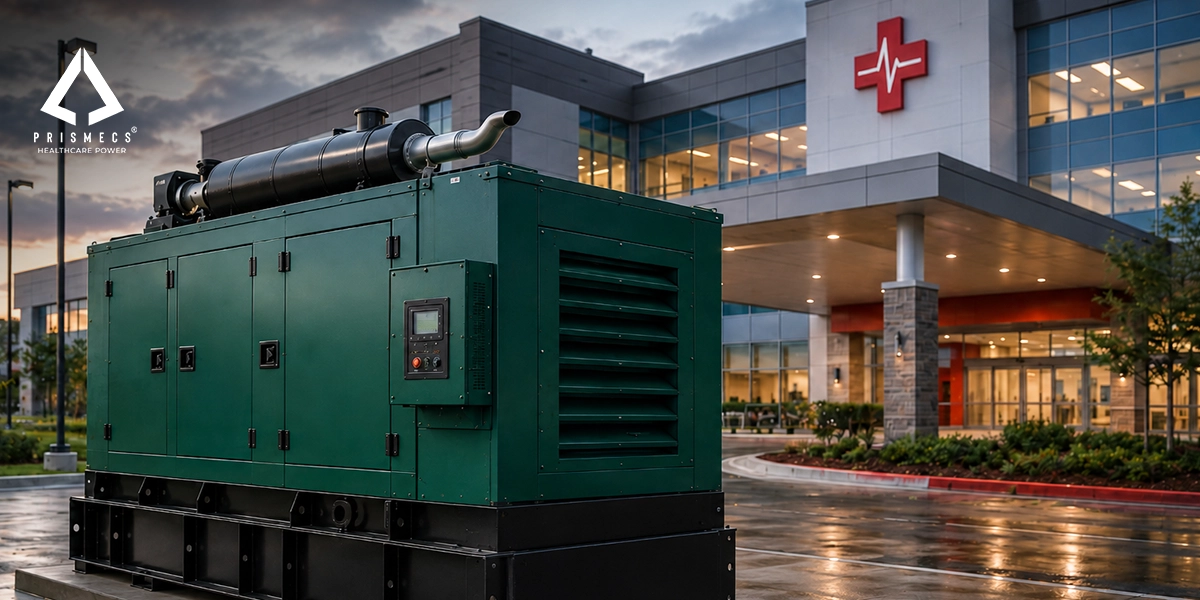
The generator started. The transfer switch operated. The critical branch picked up the load. And then, forty-seven minutes into a utility outage forecast to last two hours, the fuel ran dry. That failure did not happen because the equipment was wrong. It happened because the runtime assumption embedded in the original system design was never revisited after the facility expanded its ICU wing three years earlier. The generator was sized for a load it no longer served. The fuel tank was sized for a runtime it could no longer deliver. Every inspection had passed. Every monthly test had passed. The system failed anyway.
Runtime planning for hospital emergency power is not a procurement line item, and it is not a commissioning checkbox. It is a continuous engineering discipline at the intersection of load forecasting, fuel logistics, transfer architecture, and regulatory compliance. When executed correctly, the hours a facility can sustain emergency power operations become a known, defensible number. When it is not, they become an assumption no one has tested against actual conditions.
This blog works through the engineering decisions that determine how long a hospital can sustain emergency power operations, the standards that govern those decisions, and the points where runtime planning most commonly fails in real deployments. Prismecs Healthcare Power provides a focused overview of how dependable temporary power systems help hospitals maintain operational continuity and critical care during outages.
1. What NFPA 110 Requires and Where It Leaves Your Facility Exposed
NFPA 110 (Standard for Emergency and Standby Power Systems, 2021 edition) establishes baseline requirements for Emergency Power Supply Systems in healthcare facilities. Three performance parameters govern runtime planning. Understanding them is not an academic exercise. Each one maps directly to a failure mode that survives every inspection and surfaces only during an actual event.
Type: Transfer Timing
Type 10, the mandatory classification for healthcare critical branches, requires the EPSS to supply power within ten seconds of a utility interruption. That timing classification is not negotiable for patient care areas. The question your facility should be able to answer is whether that ten-second requirement was verified at your current connected load, not at the load present during original commissioning.
Class: Minimum Runtime
Class specifies minimum fuel storage duration at full rated load. Class 48 requires forty-eight hours of runtime. Class 96 requires ninety-six hours. The Joint Commission and CMS Conditions of Participation both reference NFPA 110, and for hospitals under survey, Class 96 is the operationally relevant benchmark. What the standard does not require is that you recalculate runtime after every capacity expansion. That gap is entirely the facility's responsibility, and it is where most runtime failures originate.
Level: Consequence of Failure
Level 1 is mandatory for all healthcare EPSS. Failure is classified as potentially resulting in loss of human life or serious injury. This designation carries the most stringent installation, testing, and maintenance requirements in the standard. It also means that an untested runtime assumption is not a documentation problem. It is a patient safety exposure.
The standard tells you what performance to achieve. It does not tell you whether your current system, with today's loads and today's fuel, can actually achieve it.
2. Load Calculation Is Not a One-Time Event
Every accurate runtime estimate begins with actual emergency load measured at the transfer switch, not estimated from nameplate ratings of connected equipment. The gap between those two figures is almost always significant, and it widens every time the facility grows. This is the most common reason a system that passed its last annual test cannot sustain the load it faces during a real event.
Essential Electrical System Branch Structure
Under NEC Article 517, a hospital's essential electrical system divides into three branches: the life safety branch covering egress lighting, fire alarm, and nurse call; the critical branch serving patient care areas, operating rooms, ICUs, ventilators, and infusion pumps; and the equipment branch covering HVAC serving surgical and isolation rooms, medical air compressors, and elevators. Branch classification determines transfer timing, ATS configuration, and load pickup sequencing. For a temporary deployment, knowing which branch carries which load determines how a rental generator is connected, sized, and commissioned.
Operating Room Load Variability
Surgical lighting, electrosurgical units, anesthesia machines, warming blankets, and imaging equipment produce a load profile that varies by procedure type and room occupancy. A facility running eight operating rooms during a daytime outage draws fundamentally different emergency load than the same facility at night with two rooms active. Whether that facility is running on permanent infrastructure or a temporary rental generator, the sizing decision must reflect the worst-case scenario, not the statistical average.
HVAC: The Most Underestimated Component
Infection control in isolation rooms and positive-pressure surgical suites requires continuous mechanical ventilation regardless of patient census. A hospital at sixty percent bed capacity does not run at sixty percent HVAC draw. The pressurization and filtration requirements under ASHRAE 170-2021 establish a power floor that cannot be reduced without compromising clinical air quality standards. When Prismecs sizes a temporary generator deployment, HVAC load is always evaluated independently of occupancy figures, because the occupancy number and the ventilation load do not move together.
Load calculations must be revisited after every capital project that adds connected emergency load, every census capacity expansion, and every time new equipment categories join the critical branch. If a temporary generator is being deployed to cover a planned outage during renovation, the load calculation must reflect the renovation phase load, not the pre-renovation baseline. These are different numbers, and treating them as equivalent creates overload risk during the coverage period.
3. Fuel Consumption: Why the Number on the Specification Sheet Is Not Your Runtime

Manufacturer fuel consumption data reflects performance at sea level, at rated load, under ISO 3046-1 standard conditions. Real deployments deviate from those conditions in ways that compound. The runtime figure that appears in a rental proposal or a commissioning document must account for actual site conditions, not published specifications.
Fuel Quality Degradation and On-Site Storage
Diesel stored beyond twelve months accumulates microbial contamination and oxidation byproducts that reduce combustion efficiency and accelerate injector fouling. For a hospital that tests monthly but rarely runs at significant load, fuel sitting in a day tank for an extended period degrades without any visible indicator. ASTM D975 establishes quality standards for diesel fuel, and NFPA 110 requires fuel testing and quality verification as part of the maintenance program. In a temporary deployment, the rental generator arrives with known fuel condition. The facility's day tank supply is a variable that must be confirmed before integration, not assumed to be within specification because it was filled on a known date.
Temperature Effects on Generator Output
Generator enclosures that reach elevated temperatures during summer outages reduce available output by five to eight percent above baseline specifications. NFPA 110 requires generator rooms to maintain conditions that do not impair operation. In a temporary deployment, the generator may be located in a staging area, a parking structure, or a loading dock enclosure rather than a purpose-built generator room. Prismecs evaluates ambient conditions at the planned installation point as part of the source-and-stage process, so the capacity delivered reflects real site conditions rather than manufacturer ratings taken from a controlled environment.
The Runtime Number Your Facility Should Verify
Before accepting any runtime figure, whether it comes from a permanent system commissioning report or a rental proposal, confirm it was calculated using measured emergency bus load rather than nameplate estimates, includes a minimum ten percent fuel consumption margin, and reflects current equipment conditions rather than specifications from the original installation. A runtime figure missing any of those three inputs is an assumption. Prismecs Healthcare Power structures its Assess and Size process specifically to produce a verified runtime number before any deployment begins, so the coverage commitment is based on confirmed data, not specification-sheet arithmetic.
4. The UPS Role: Bridging Transfer Events and Protecting Sensitive Loads
The ten-second transfer window under NFPA 110 Type 10 creates a protection gap for equipment that cannot tolerate any interruption. Anesthesia machines, ventilators, physiological monitors, laboratory analyzers, and imaging control systems all fall into this category. The solution is not a faster generator. It is a correctly specified uninterruptible power supply for healthcare that bridges the transfer event with zero detectable interruption to the load.
Topology: Why the Choice Matters in Patient Care Areas
A line-interactive UPS switches the load to battery only when utility voltage leaves a defined window, introducing a 2 to 6 millisecond interruption. That is acceptable for most IT equipment but sufficient to cause processor resets in certain medical devices. An online double-conversion UPS continuously powers the load from an inverter backed by a live battery string. No transfer occurs. For patient care equipment, double conversion is the only correct specification.
Battery Sizing: Degradation and Manual Transfer Scenarios
Battery sizing must cover more than the nominal ten-second transfer window. IEEE 485-2020 and IEEE 1184-2020 provide the sizing methodology. The healthcare-specific constraint is that runtime assumptions must include the time required to execute a manual transfer under adverse conditions, not just the nominal ATS mechanical operating time.
Battery capacity degrades with both cycling and calendar age. IEEE 1187-2002 establishes acceptance test criteria for valve-regulated lead-acid batteries. NFPA 110 Section 7.3.2 requires functional battery tests at defined intervals. A battery bank designed to deliver ten minutes of runtime at end of life must be sized to deliver substantially more when new, so the degraded state still meets the performance specification.
5. Transfer Switch Architecture: What Fails, What the Code Requires, and What Changes in a Temporary Deployment
Automatic transfer switches are the mechanical and electrical arbiters of emergency power continuity in healthcare facilities. Their failure modes are documented, not theoretical. Contacts weld under high fault current. Sensing circuits misread utility voltage and initiate nuisance transfers that interrupt patient care without any actual utility event. Understanding what the code requires for a permanent installation matters, but the decisions that determine patient safety during a temporary deployment are different, and they are made under time pressure.
Testing and Listing Requirements
NFPA 99 requires ATS units serving the life safety and critical branches to be tested monthly under representative load conditions and within the Type 10 timing requirement, with results documented for AHJ inspection. UL 1008 establishes construction and performance standards for transfer switches. In a temporary deployment, the transfer switch connecting the rental generator to the facility emergency bus must meet the same listing and performance requirements as the permanent equipment it is supplementing. A field-expedient connection that bypasses UL 1008-listed equipment is not an acceptable solution for an occupied healthcare facility, regardless of the urgency driving the deployment.
Branch Separation in Temporary Configurations
NFPA 99 Section 6.4.2 requires that wiring serving different essential electrical system branches remain physically separate. In a temporary deployment, the connection point and cable routing must preserve branch separation from the generator terminals through to the facility connection point. This is not a condition that can be addressed after installation. It must be part of the integration design before the equipment arrives on site. Prismecs Healthcare Power designs the connection architecture for every temporary deployment before mobilization, so branch separation compliance is built into the installation plan rather than improvised at the connection point.
Why Bypass Isolation Matters for Occupied Facilities
Without bypass isolation capability, ATS maintenance requires taking the load offline. For an occupied ICU or an active operating room, that is not acceptable. When a temporary generator is deployed as an extended rental, planning for ATS maintenance access during the rental term is part of the deployment design. A rental arrangement that creates a maintenance access problem three months into the contract transfers operational risk back to the facility. Prismecs structures temporary deployments to maintain maintenance access throughout the rental term, so the coverage commitment holds through the full contract period, not just on day one.
6. Wet Stacking, Load Banking, and Why Monthly Tests Are Not Enough

The Mechanism
A diesel generator operated below 30 percent of rated load accumulates unburned fuel in the exhaust system. At low load, combustion chamber temperatures are insufficient for complete combustion. Unburned hydrocarbons condense on exhaust components and build up as a thick oily residue that compromises exhaust integrity, increases oil consumption, and creates carbon fouling conditions on injectors and cylinder walls.
Why Hospital Generators Are Uniquely Susceptible
Monthly tests under NFPA 110 Section 8.4.2 require thirty minutes of operation, and the building load at the time of testing frequently sits well below the generator's rated capacity. A 500-kW unit tested against 120 kW of building load runs at 24 percent of nameplate, insufficient to prevent wet stacking accumulation over a monthly maintenance interval. NFPA 110 Section 8.4.2.1.1 requires supplemental load bank use when building load alone cannot reach 30 percent of nameplate rating. This provision is not optional.
Annual Load Bank Testing
Annual load bank testing at 75 percent or greater of rated capacity for a minimum of three continuous hours is the operationally correct approach for clearing wet stacking and verifying engine performance at loads representative of an actual emergency. NFPA 110 Section 8.4.9 references the four-hour load test applicable when monthly tests have not achieved the 30 percent threshold. The annual full-load test is the only validation that confirms the system will perform when it matters.
7. Fuel Strategy Beyond Tank Capacity
A 96-hour Class fuel supply is a starting point for fuel planning, not a complete strategy. Extended outages generate resupply logistics challenges that on-site tank capacity alone cannot resolve, particularly in regional events where the delivery infrastructure is itself compromised.
What Regional Emergencies Reveal About Resupply Assumptions
During extended Gulf Coast hurricane events, a consistent pattern emerged across Louisiana hospital networks. Facilities with 96 hours of on-site storage but no contracted resupply arrangement began load-rationing operations at the forty-eight-hour mark, negotiating emergency deliveries in an environment where every competing healthcare facility was doing the same thing simultaneously. Facilities with pre-arranged priority delivery contracts and secondary storage reached that constraint point at seventy-two to eighty hours, buying meaningful additional operational margin in a supply-compressed environment. The difference between those two outcomes was not equipment. It was a signed contract executed before the storm.
Natural Gas and Dual-Fuel Configurations
Natural gas eliminates the diesel resupply logistics chain entirely when utility infrastructure remains intact. The trade-off is that gas distribution networks can be compromised by seismic events, flooding, or underground infrastructure damage. Dual-fuel configurations provide utility-independent runtime when gas is unavailable while still drawing from continuous gas supply when service is intact. NFPA 110 Section 7.9.4 requires a documented resupply plan as part of the EPSS design. That requirement applies whether the power source is a permanent installation or a temporary rental generator. Prismecs Healthcare Power develops fuel resupply plans as part of every deployment, including supplier relationships and delivery scheduling, so that the 96-hour fuel figure on a rental proposal reflects a real operational commitment rather than a tank capacity calculation.
8. EPSS Testing Documentation and Audit Readiness
The Joint Commission's EC.02.05.07 standard requires hospitals to test emergency power systems under load, document results, and maintain records accessible during survey. Surveyors use testing logs to evaluate both interval compliance and system performance.
What Complete Documentation Captures
Adequate records include utility dropout time, time to generator start, time to voltage and frequency stabilization, transfer switch operation time, and load pickup confirmation. Monthly test records should log the actual load percentage achieved and separately document any load bank contribution. Annual test records should include voltage and frequency readings at multiple intervals, creating a performance trend that identifies degradation before it becomes a failure event.
Alarm System Verification
NFPA 110 Table 7.6.6 defines the conditions requiring remote annunciation: low fuel level, high coolant temperature, low oil pressure, battery charger failure, and overcurrent. Each must be tested at the specified interval, with the simulated condition, observed annunciation, and restoration all documented. Missing alarm verification is among the most frequently cited TJC survey deficiencies. It is also among the most preventable with a structured maintenance calendar. When Prismecs Healthcare Power deploys a temporary generator, alarm system verification is part of the commissioning scope, and documentation-ready test records are included throughout the rental term. The facility enters the contract period with audit-ready records from day one, not scrambling to reconstruct them before a survey.
9. Commissioning as Runtime Verification, Not Administrative Formality
Generator commissioning in healthcare applications covers technical scope that extends beyond manufacturer startup and functional testing. The commissioning process must verify complete EPSS performance under conditions that replicate, as closely as practicable, those the system will face during an actual event. For temporary deployments, several conditions exist that are simply not present in permanent installations, and they must be addressed explicitly rather than assumed to match the permanent system baseline.
Grounding and Bonding in Patient Care Areas
Healthcare facilities require isolated ground circuits in patient care areas under NFPA 99 Section 6.3.2. The interaction between generator-sourced power, UPS output, and patient equipment grounding creates complexities absent from conventional commercial installations. NFPA 70 (NEC) Article 250.30 governs bonding and grounding for separately derived systems operating as the supply source during an outage. In a temporary deployment, the generator is a separately derived system that must be grounded and bonded per these requirements regardless of its duration. Prismecs Healthcare Power verifies grounding and bonding compliance at commissioning for every temporary deployment, because the patient safety requirement does not have an exception for rental equipment.
Exhaust Backpressure in Temporary Installations
Manufacturer specifications define maximum allowable exhaust backpressure in inches of water column. In a permanent generator room, exhaust routing is engineered to meet those limits. In a temporary deployment, the generator may be located at a loading dock, in a parking structure, or outside a facility entrance, with exhaust routed through corridors or around obstructions that were not part of the original design. Those routing conditions introduce backpressure that reduces power output, increases fuel consumption, and accelerates wear. This is not a theoretical risk. It is a measurable condition that must be verified at commissioning, and Prismecs Healthcare Power includes exhaust backpressure measurement as a standard commissioning step in every temporary deployment rather than accepting manufacturer specification as sufficient evidence of compliant installation.
10. Temporary Emergency Power Deployment: Where Runtime Planning Gets Compressed

Utility failures, infrastructure repair outages, and renovation projects requiring normal power disconnection compress the runtime planning timeline from months to days. The engineering decisions normally made iteratively over a design phase must be made quickly and correctly the first time. There is no tolerance for error when a temporary generator is the only source of emergency power for an occupied facility.
Load Verification Cannot Be Skipped
A utility metering download or a thirty-minute submeter recording of the emergency bus under normal operating conditions provides the data needed to confirm that the temporary generator has adequate capacity with appropriate margin. Deploying based on nameplate ratings of connected equipment without actual load measurement introduces unacceptable overload risk during the temporary power period. The cost of that measurement step is measured in hours. The cost of skipping it can be measured in a facility-wide emergency during the coverage period.
Fuel Resupply Must Be Confirmed Before the First Tank Is Consumed
In planned outages with a defined window, fuel consumption can be calculated with reasonable precision and a resupply schedule established in advance. In emergency response deployments, the resupply commitment must be confirmed before the first tank is consumed, not after. A temporary generator arriving with 48 hours of on-board fuel is not a 96-hour solution without a confirmed delivery arrangement with a supplier carrying an active relationship with the deployment team. Prismecs Healthcare Power holds active fuel supplier relationships in operating markets and confirms resupply scheduling before mobilization, not after arrival.
Transfer Coordination and Synchronization Protection
Paralleling a temporary generator to a facility bus without proper synchronization protection creates catastrophic equipment damage risk. The correct approach is an isolated connection to the emergency bus through a dedicated transfer switch that provides the same protection and transfer timing as the permanent installation it is temporarily replacing. Speed of deployment does not change this requirement. A faster connection that bypasses synchronization protection is not an acceptable trade-off in an occupied healthcare facility.
11. N+1 Generator Configuration: When Redundancy Is the Right Rental Decision
A single generator sized to carry full emergency load meets minimum code requirements. For most planned outages and short-duration emergency deployments, a correctly sized single unit is the right solution. For extended rental periods covering high-census critical care facilities, there is an operational case for N+1 generator configuration that goes beyond redundancy.
The Wet Stacking Argument for N+1 Rentals
In an N+1 configuration, each unit is sized to carry 100 percent of emergency loads independently. When both units operate in load-sharing mode, each unit carries a proportional share of total facility load. If total emergency load is relatively low compared to generator capacity, two units sharing the load will each run at a higher individual percentage of their nameplate rating than a single larger unit carrying the same total load at a lower percentage. This matters because both units stay above the 30 percent threshold that prevents wet stacking during the rental period, reducing maintenance risk and improving combustion performance without requiring a separate load bank deployment for monthly testing.
When N+1 Makes Sense for a Temporary Deployment
N+1 rental configurations are appropriate when the planned outage duration extends beyond thirty days, when the facility is a high-acuity critical care environment where generator failure during the rental period creates patient safety exposure, or when the rental period overlaps with a scheduled generator maintenance interval that would otherwise create a coverage gap. Prismecs Healthcare Power evaluates N+1 configuration as part of the Assess and Size process for every extended deployment, so the coverage recommendation reflects actual facility risk rather than defaulting to minimum code compliance.
Paralleling Controls and What They Require
Synchronization and paralleling equipment add engineering complexity relative to single-generator installations. Paralleling controls manage voltage and frequency matching before closing the paralleling breaker, load sharing during parallel operation, and orderly unit separation when a unit goes offline. These requirements must be addressed explicitly in the deployment design. Prismecs Healthcare Power includes paralleling control engineering in every N+1 rental configuration, so the operational benefits of redundant generation are not offset by integration complexity that creates its own failure modes.
The Question Every Healthcare Facility Should Be Able to Answer
Every section of this guide converges on a single question that every healthcare facility should be able to answer with documented evidence rather than engineering assumption: under the actual load conditions of this facility, with the fuel currently on site, accounting for site-specific conditions at this installation, how many hours of verified emergency power can this EPSS actually provide?
The answer changes every time load increases, every time fuel quality degrades, every time a battery bank ages, and every time ambient conditions diverge from design assumptions. Facilities with a current, verified, documented answer to that question are operationally prepared. Facilities relying on commissioning figures from a decade ago, unchanged through multiple expansions and equipment additions, are operating on a number that no longer reflects reality.
Before accepting any emergency power runtime figure, confirm it was calculated at actual derated load capacity, uses measured emergency bus load rather than nameplate estimates, applies a 10 percent fuel consumption margin, and accounts for current battery bank condition. If any of those four inputs are missing, the runtime number is an assumption, not a specification.
Partner with Prismecs Healthcare Power for Runtime Planning
Most facilities that contact Prismecs Healthcare Power do not have a confirmed answer to the question above. They have a commissioning date, a specification sheet, and a passing monthly test result. Those three data points do not tell you whether your EPSS can sustain your actual load through a 96-hour event. They tell you the system started and transferred on the day it was last tested.
If any of the four runtime conditions in this guide are unverified at your facility, a structured assessment will tell you exactly where the gap is and what it takes to close it. Prismecs Healthcare Power provides that assessment as the first step in every engagement, whether the outcome is a temporary rental deployment, a preparedness contract, or a planned generator replacement bridge.
Two ways to start:
Talk to an engineer - Bring your current power setup, operational concerns, site constraints, and outage history. A focused consultation will identify which runtime assumptions in your current EPSS need verification and what a corrective deployment would involve.
Schedule a site visit -Prismecs Healthcare Power conducts on-site assessments that produce documented findings your facilities, clinical, and executive teams can act on. The assessment covers load measurement, fuel condition, transfer switch performance, and documentation status against TJC and NFPA 110 requirements.
Tags: NFPA 110 compliance hospital backup generators emergency power supply system 96-hour fuel runtime healthcare power continuity
recent posts

Power Utilities
18 minutes read
Temporary and Bridge Power for Industrial Facilities: When and How to Use It
Planning bridge power past 12 months? Under EPA rules your generators may be stationary from day one. Check Tier 4, NSPS KKKKa and SPCC triggers befor...
Gas Turbines
16 minutes read
What Is a Mobile Gas Turbine Power Plant? TM2500-Class Units Explained
A mobile gas turbine power plant is a transportable power generation system designed to add electrical capacity faster than a conventional permanent p...
Power Utilities
20 minutes read
Fast-Track Power Plants Deployment: How to Reach Speed to Power in Under 12 Months
Fast-track power plant deployment can hit first power in weeks. See real TM2500 timelines from permitting to COD, proven in Oman and Taiwan. Plan your...

Gas Turbines
11 minutes read
Gas Turbine Outage Planning: Schedule, Scope Rules, and Checklist
Gas turbine outage planning starts 18 months out. Get the T-minus schedule, scope freeze rules, parts readiness gates and checklist. Talk to a Prismec...