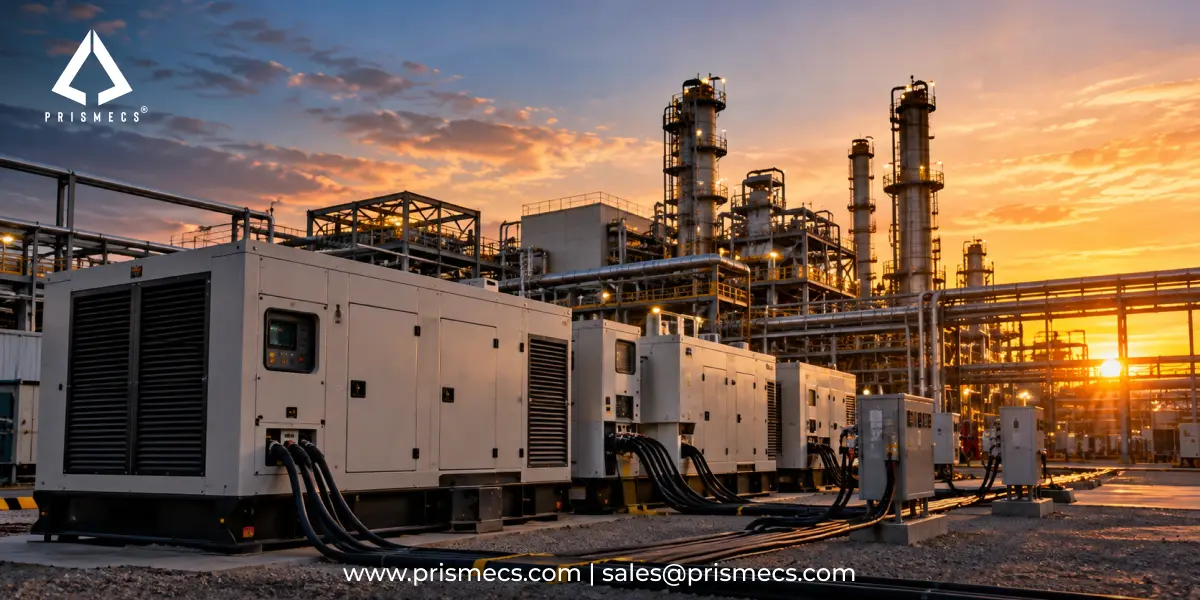
Industrial facilities use temporary power when a planned shutdown, equipment failure or grid outage cuts their normal supply for days to a few months. They use bridge power when a new plant or expansion is ready before permanent utility service or onsite generation can support it. In both cases, the reason is the same: interim power keeps production, safety systems and revenue running while the permanent power source is unavailable.
Temporary power is short-term, event-driven onsite generation that is removed once the permanent system returns. Bridge power is a planned interim generation that carries the full operating load for months or years. This guide explains how to choose between them, and how to plan, size, connect and permit interim power at a US industrial site.
What Are Temporary Power and Bridge Power?
Both are forms of interim onsite power, but they solve different problems. The difference comes down to duration, the load the equipment carries and how the project is planned.
Temporary Power
Temporary power fills a short, defined gap. A plant brings in rental generators, temporary transformers and distribution equipment to ride through a maintenance outage, a failed asset or a storm. The setup is mobilized quickly and removed once the permanent system is back in service.
Bridge Power
Bridge power is a planned stage of a project. It supplies the facility's full operating load while a utility connection, service upgrade or permanent onsite plant is still being built. Because it runs continuously for long periods, it is engineered more like a small power plant than a rental hookup.
Temporary vs. Bridge vs. Standby vs. Prime Power
One technical detail matters here. Generator sets carry standby, prime and continuous ratings under ISO 8528-1. Bridge duty needs equipment selected on its prime or continuous rating, never its standby rating.
When to Use Temporary Power at an Industrial Facility

Temporary power fits when an interruption has a known cause and a defined end. Hurricane Beryl shows what that looks like. The Category 1 storm made landfall near Matagorda, Texas on July 8, 2024, and cut power to 2.26 million CenterPoint Energy customers across the Houston region, one of the densest refining and petrochemical corridors in the country. Nearly three days later, more than a million of them were still dark, and about a quarter of affected customers waited more than 10 days (PBS NewsHour / AP). A facility with pre-arranged rental generators and a ready tie-in point can restart within hours; one without joins the queue for equipment that every other site wanted the same week.
Beryl was not an outlier. U.S. customers averaged 11 hours of interruptions in 2024, nearly double the prior decade's average, and Hurricanes Beryl, Helene and Milton drove 80% of those hours (U.S. EIA).
Planned Shutdowns and Turnarounds
Maintenance on a main transformer, switchgear lineup or onsite generator often requires de-energizing part of the plant. Temporary generation keeps critical processes, safety systems and utilities running so the outage window does not become a production loss.
Transformer or Switchgear Failure
A failed transformer can take a plant offline for weeks or months, because replacement units now carry multi-year manufacturing lead times (see the lead-time data under Plan the Electrical Tie-In below). A temporary transformer or generator package fed into the plant bus restores operations while the permanent asset is repaired or sourced.
Storms and Grid Outages
Facilities in hurricane, wildfire or winter-storm regions use temporary power when outages exceed what their standby systems can carry. Pre-arranged rental agreements, a pre-wired tie-in point and a fuel delivery contract signed before storm season cut response time from days to hours.
When Bridge Power Makes More Sense
Bridge power fits when the gap is measured in months or years and the facility must operate at full output during it. It turns a utility delay from an idle asset into a producing one.
The Plant Is Ready Before the Utility Service
New manufacturing plants and expansions increasingly finish construction before the utility can deliver the required capacity. Bridge generation lets the facility commission, ramp up and earn revenue instead of waiting.
A Service Upgrade or New Substation Is Pending
Adding a large load often requires a new substation, feeder or transmission upgrade. Bridge power covers the incremental demand until the utility completes that work.
Permanent Onsite Generation Is Under Construction
Sites building a captive or cogeneration plant can run bridge units during construction, then hand over once the fast-track power plant is commissioned.
What Bridge Power Looks Like in Practice
Two Prismecs projects show the two ends of the range: an isolated plant carrying a whole load until the grid arrives, and a large mobile fleet held ready as reserve capacity. Duqm is the closer match to an industrial bridge project: an isolated site, a fixed end point (grid integration) and full load in the meantime, carried by trailer-mounted mobile gas turbines built to be shipped and installed quickly.
A Simple Rule of Thumb
- Short, event-driven, firm end date: temporary power.
- Long, scheduled, full load: bridge power.
- Either way: start the permit review before equipment is ordered.
How to Plan Temporary or Bridge Power

Most interim power problems trace back to planning, not equipment. The steps below follow the order engineers typically use for an industrial site.
Build a Real Load Profile
Start with metered data, not nameplate totals. Capture running kW, peak demand, power factor and load variation over a representative production cycle, including nights and weekends. A 15-minute billing peak hides short spikes, so use a power quality analyzer at the main switchgear where possible.
Size for Motor Starting and Step Loads
Large motors are the most common reason interim power fails. Across-the-line starting can draw roughly six to eight times full-load current, causing voltage and frequency dips that trip sensitive equipment. Soft starters, VFDs and sequenced starts reduce the generator size needed. Check every large start against the generator OEM's transient response data, not just its kW rating.
Assume a plant with these metered values. All figures are approximate and for illustration; final sizing should use the OEM's sizing software and fuel curves.
Worked Example: Sizing and Fuel for a 1.5 MW Plant
Assume a plant with these metered values. All figures are approximate and for illustration; final sizing should use the OEM's sizing software and fuel curves.
- Peak demand in kVA. 1,800 kW ÷ 0.85 ≈ 2,120 kVA.
- Motor start. Across-the-line at about 6× full-load current, the 250 hp motor briefly demands roughly 1,500 kVA. A soft starter limited to about 3× cuts that to roughly 750 kVA, which is what makes the selection below workable.
- Generator selection. Two 1,250 kW prime-rated units (about 1,560 kVA each at 0.8 PF) give 2,500 kW online. Peak load sits at 72% and average load at 60% of online capacity, inside the efficient range.
- Fuel burn. At roughly 0.07 gal/kWh, 1,500 kW burns about 105 to 110 gal/h, or about 2,600 gal/day.
- Storage and deliveries. 72 hours of autonomy needs about 7,800 gallons onsite. A standard 7,500 to 8,000 gallon tanker delivery is needed about every three days.
- Compliance flag. 7,800 gallons is far above the 1,320-gallon SPCC threshold (see Permits and Compliance), and Tier 4 Final units also need diesel exhaust fluid on the same delivery schedule.
The same plant on pipeline gas would need roughly 13,000 standard cubic feet per hour at about 9,000 Btu/kWh, with no truck deliveries.
Redundancy Without Wet Stacking:
N+1 and wet stacking pull in opposite directions, so resolve them in the control design rather than by adding running units. In the example above, running a third 1,250 kW unit for N+1 would drop all three to 40% load on day shift and about 21% on night shift. Diesel engines run for long periods below roughly 30% load accumulate unburned fuel in the exhaust (wet stacking), and Tier 4 Final aftertreatment fouls faster at low exhaust temperatures.
The usual answer combines three measures:
- Load-demand start/stop. Paralleling controls run only the units the load needs. At night, one unit carries 800 kW at 64% load; the second starts automatically as load rises.
- Hot standby, not spinning reserve. The +1 unit stays warm and starts and synchronizes in seconds if a running unit trips or load crosses a set point.
- Ride-through for the gap. Automatic shedding of non-critical loads, or a battery system sized for the start-and-sync window, keeps critical loads up while the standby unit comes online.
Where long light-load periods are unavoidable, schedule a load bank to burn off deposits.
Choose the Operating Mode
Decide how the interim source connects to the plant:
- Feeding the plant bus through a tie-in point, replacing the utility for part or all of the load.
- Islanded operation, where the generation carries the whole site with no grid connection.
- Grid-parallel operation alongside a reduced utility service, which requires utility approval and interconnection protection.
Plan the Electrical Tie-In
The tie-in usually sets the schedule. Confirm voltage, phase rotation and connection point, whether a camlock tie-in panel at low voltage or a medium-voltage connection through temporary switchgear. Decide between open-transition transfer, which causes a brief outage, and closed-transition transfer, which needs synchronizing controls. Generators supply far less fault current than the utility, so protective device coordination and the arc flash study must be reviewed for the temporary configuration.
Plan Around Equipment Lead Times
New electrical equipment is often the longest item on the schedule. Wood Mackenzie's Q2 2025 survey put average lead times at:
Sources: POWER Magazine, EEPower. Wood Mackenzie also estimated a 30% U.S. supply deficit for power transformers in 2025.
A plant that orders new after a failure waits years, not weeks. Prismecs starts with a load and tie-in assessment, then sources matching generators, transformers and switchgear from ready inventory so the interim system is not held up by factory queues.
Secure Fuel and Logistics
Fuel planning follows directly from the sizing example: a written delivery schedule, onsite storage sized to the delivery risk, and spill containment. Pipeline natural gas removes delivery risk but requires adequate supply pressure and a gas service agreement.
Include Utilities and Redundancy
Industrial outages rarely affect power alone. List the cooling, compressed air and process heating that depend on the outaged system and apply the redundancy approach above to the loads that cannot drop.
Commission and Plan the Exit
Load-bank test the system, verify protection settings and run a transfer rehearsal before the real cutover. Define the demobilization or transition plan at the start, not at the end.
Equipment Options for Industrial Interim Power
The right technology depends on load size, duration and fuel availability. Many sites combine options, such as gas engines for base load with battery storage for step loads. Unit sizes and performance below are typical ranges; confirm against the specific OEM data sheet. For loads of 20 MW and up, mobile gas turbines arrive pre-packaged on trailers, which keeps site work to foundations, fuel and the electrical tie-in.
Permits and Compliance in the US
Start the permit review before equipment is ordered. The engine type, emission tier and fuel you choose decide which rules apply, and some of those rules look back to the day the equipment arrived. Rules also differ by state and air district, so confirm requirements with your state agency early.
The Intent Test for Portable Engines
A trailer-mounted engine is generally a nonroad engine, which keeps it out of stationary-source permitting. Under 40 CFR 1068.30, it loses that status if it remains, or will remain, at one location for more than 12 consecutive months.
The words "will remain" are the intent test. Under 40 CFR 1068.31(e), if EPA determines an engine will be or has been used at one location for 12 months or longer, it became a stationary engine when it was placed there, not on day 366. A bridge project scheduled for 18 months is therefore stationary from day one and running it without the right permit and emission controls is a violation from the start.
Swapping in a replacement unit that performs the same function does not reset the clock. How agencies treat moving a unit within the same facility varies by state, so get that position in writing rather than relying on it.
The 24-Month Rule for Temporary Turbines
Combustion turbines, including mobile units, are regulated as stationary sources rather than nonroad engines. EPA's new turbine standard, NSPS Subpart KKKKa (published January 15, 2026), adds a temporary subcategory for turbines up to 850 MMBtu/h at a single location for up to 24 consecutive months.
- Standard: 25 ppm NOx on natural gas and 74 ppm on other fuels, shown through a manufacturer guarantee and a performance test within the prior five years (EPA fact sheet, Trinity Consultants).
- The clock: 24 months of residence after the turbine starts operating, whether or not it runs the whole time. Replacement units and moves within the site do not restart it.
- The trap: a turbine that stays longer than 24 months is not temporary for any period of its operation, so non-compliance in the first 24 months becomes enforceable.
The subcategory eases emission standards and monitoring. It does not remove state preconstruction permitting, so a temporary turbine still generally needs an air permit before it runs.
Engine Emission Tiers
The tier you rent decides what you can legally do with it. Rental and other non-emergency diesel generator sets above 560 kW must meet EPA Tier 4 Final, which uses SCR and diesel exhaust fluid. Tier 2 units are allowed only as stationary emergency engines with limited non-emergency hours (Power Engineering). A Tier 2 "standby" unit cannot legally run as bridge or prime power. Many states and nonattainment areas add tighter limits on top.
Fuel Storage and Spill Prevention
EPA's Spill Prevention, Control and Countermeasure (SPCC) rule applies when a site stores more than 1,320 gallons of oil aboveground in containers of 55 gallons or more, and a discharge could reach navigable waters. Generator sub-base tanks, day tanks and mobile or portable tanks all count toward that total (EPA guidance).
The worked example above, at about 7,800 gallons, would need an SPCC plan, secondary containment for the largest tank and documented transfer procedures. Sites over 10,000 gallons need the plan certified by a Professional Engineer. Local fire codes add separate rules for aboveground tanks.
Electrical Safety Requirements
NEC Article 590 permits temporary wiring for maintenance, repair, emergencies and testing, and requires its removal once that purpose is complete. OSHA 29 CFR 1910.305 covers temporary wiring in general industry, and NFPA 70E governs arc flash risk during connection and switching.
Costs and the Transition to Permanent Power
Interim power is an operating expense that grows with every month it runs. Planning the commercial terms and the exit together keeps that cost under control.
What Drives the Cost
The main cost drivers are equipment rental, fuel, mobilization, installation, operators and demobilization. For short events, renting is usually the most economical choice. For bridge periods longer than a year, compare rental with purchase or rent-to-own. Always model a scenario where the utility date slips, because the rental and fuel bill keeps running.
Moving to Permanent Power
Schedule the cutover as its own planned outage, with switching procedures and a rollback plan. Once permanent power is stable, decide whether to demobilize the units or keep them for standby, peak shaving or reserve.
Frequently Asked Questions
What is the difference between temporary power and bridge power?
Temporary power covers a short, event-driven gap such as a shutdown or equipment failure. Bridge power carries a facility's full operating load for months or years until permanent utility or onsite generation is available.
How long can a temporary generator stay at an industrial site?
A portable engine that remains, or is planned to remain, at one location for more than 12 months is treated as stationary under federal rules, and that status applies from the day it arrived. Temporary gas turbines can qualify for a 24-month subcategory under NSPS KKKKa, but still generally need an air permit.
What permits does interim power need?
It depends on equipment type, duration and fuel. Expect an air permit review for any turbine and any engine likely to stay beyond 12 months, an SPCC plan if onsite oil storage exceeds 1,320 gallons, electrical inspection under NEC Article 590, and local fire code approval for fuel tanks. Start the review before equipment is ordered.
How much does temporary or bridge power cost?
Cost depends on capacity, duration, fuel and site work, so there is no single per-MW price. Fuel is usually the largest running cost, followed by equipment rental, operators, mobilization and demobilization. A load profile and a fuel estimate, as in the worked example above, are the starting point for a firm quote.
Should I rent or buy interim power equipment?
Renting usually wins for events measured in days to months. For bridge periods beyond a year, compare rental against purchase, rent-to-own or financed purchase. Owned units can stay on as standby, peak shaving or reserve after permanent power arrives.
Diesel or natural gas: which is better for bridge power?
Diesel mobilizes fastest and handles large block loads well, which suits short events. Natural gas reciprocating engines and mobile turbines suit long bridge periods where pipeline gas is available, because they remove fuel deliveries and cut running cost. Many projects start on diesel and switch to gas once the gas service is in place, as at Duqm.
Can battery storage replace generators?
Not on its own for a long outage, because typical systems hold one to four hours of energy. BESS works best alongside generators: it handles motor starts and step loads, rides through a unit trip, and lets generators run fewer, more heavily loaded hours.
How long does installation take?
Rental diesel generators with a pre-wired tie-in can be online within days. Medium-voltage tie-ins, temporary substations and gas connections take weeks. A full mobile turbine plant with fuel, water and site utilities takes months; Prismecs commissioned the 110 MW Duqm plant in under 200 days. Permitting often sets the schedule more than installation does.
Can temporary power connect to existing plant switchgear?
Yes. Connections are made through a tie-in panel or temporary medium-voltage switchgear. Voltage, phase rotation, protection coordination and the arc flash study must all be checked first.
Plan Interim Power Before You Need It
Temporary power protects a facility through short, defined disruptions. Bridge power keeps a new or expanding plant producing while permanent capacity catches up. In both cases, success depends on an accurate load profile, a well-designed tie-in, a secure fuel plan and a permit review that starts before equipment is ordered.
Prismecs supports industrial facilities with three ways to start:
- Source equipment now. Generators, mobile gas turbines, transformers and switchgear from ready inventory, matched to your voltage and load.
- Book a project consultation. A load and site assessment, tie-in design and permitting roadmap from our power generation team.
- Explore financing. Rental, rent-to-own and financing options for bridge periods that may outlast a standard rental term.
Or call a power expert at +1 (888) 774 7632.
Tags: bridge power generation temporary power for industrial facilities interim onsite power prime vs standby generator rating bridge power permitting
recent posts

Power Utilities
18 minutes read
Temporary and Bridge Power for Industrial Facilities: When and How to Use It
Planning bridge power past 12 months? Under EPA rules your generators may be stationary from day one. Check Tier 4, NSPS KKKKa and SPCC triggers befor...
Power Utilities
16 minutes read
What Is a Mobile Gas Turbine Power Plant? TM2500-Class Units Explained
A mobile gas turbine power plant is a transportable power generation system designed to add electrical capacity faster than a conventional permanent p...
Power Utilities
20 minutes read
Fast-Track Power Plants Deployment: How to Reach Speed to Power in Under 12 Months
Fast-track power plant deployment can hit first power in weeks. See real TM2500 timelines from permitting to COD, proven in Oman and Taiwan. Plan your...

O&M Services
11 minutes read
Gas Turbine Outage Planning: Schedule, Scope Rules, and Checklist
Gas turbine outage planning starts 18 months out. Get the T-minus schedule, scope freeze rules, parts readiness gates and checklist. Talk to a Prismec...