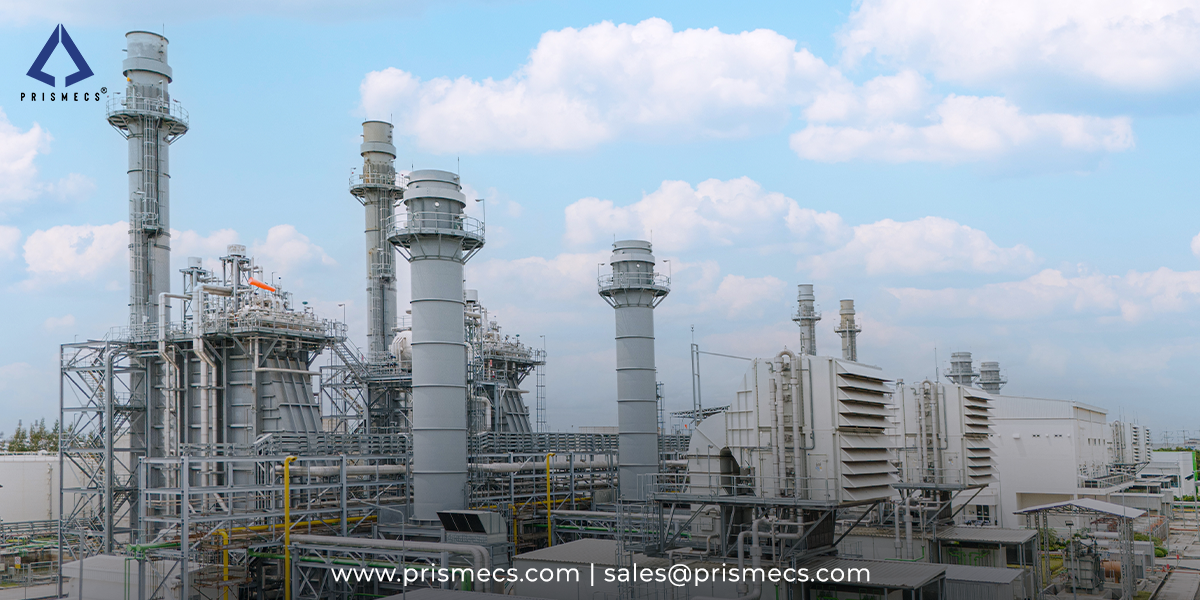
A dual-fuel gas turbine is a gas turbine that can burn natural gas, a liquid fuel such as diesel (distillate fuel oil), or a blend of both, and switch between them while running at load, without shutting down.
Fuel flexibility works through two independent fuel systems, a gas fuel train and a liquid fuel train, that feed shared dual-fuel nozzles in the combustor. During a fuel transfer, the turbine control system ramps one fuel down while ramping the other up, so power output stays steady.
Power plants, oil and gas facilities, and industrial sites use dual-fuel turbines to stay online when pipeline gas is curtailed, fuel prices spike, or extreme weather strains supply. But the capability is only as good as the backup system behind it. After Winter Storm Uri in 2021, federal regulators found that 12 of the 14 Texas generating units that attempted to switch fuels failed or reduced generation.
This guide covers the key components, the fuel transfer process, emissions, maintenance, troubleshooting, and best practices for reliable backup fuel.
What Is a Dual-Fuel Gas Turbine?
A dual-fuel gas turbine is a gas turbine generator or mechanical-drive unit equipped with two independent fuel delivery systems, one for gaseous fuel and one for liquid fuel, that feed a shared combustion system. The turbine control system decides which fuel is burning, how much of each is flowing, and when to transfer from one to the other.
In most installations, natural gas is the primary fuel because it is cleaner and usually cheaper. Distillate fuel oil (No. 2 diesel), kerosene, or another light liquid fuel is stored on site as the secondary or backup fuel. Some plants reverse the arrangement, running on liquid fuel until a gas pipeline or LNG terminal is commissioned, then converting to gas as the main fuel.
The capability is far from niche. As of January 2021, the United States had almost 200 GW of generating capacity that could functionally switch fuels, about 18% of utility-scale capacity, and switching from natural gas to petroleum liquids was the most common mode at almost 132 GW, according to the U.S. Energy Information Administration (EIA).
Dual-fuel capability is concentrated where gas supply is most constrained. In New York, 41% of combined cycle capacity can switch fuels, compared with 28% in New England, and in Florida 94% of gas-fired combustion turbine capacity can switch.
Primary Fuel vs. Backup Fuel
The primary fuel is what the turbine burns during normal operation. The backup fuel sits in tanks, ready for a planned or emergency switch. Because backup liquid fuel may go weeks or months without use, much of the engineering in a dual-fuel system is about keeping that idle fuel path clean, pressurized, and ready to start.
Which Turbines Offer Dual-Fuel Capability?
Dual-fuel firing is available across most turbine classes:
- Heavy-duty (frame) gas turbines used in simple-cycle and combined-cycle power plants, often with large on-site oil storage.
- Aeroderivative gas turbines, including trailer-mounted and fast-start packages used for peaking, grid support, and emergency power.
- Industrial and light-industrial turbines that drive compressors and pumps or supply power at refineries, LNG plants, and offshore platforms.
Prismecs services dual-fuel and liquid-fuel units across these classes, including TM2500 mobile aeroderivative, LM-series units, and heavy-duty frames, through its OEM-agnostic power generation asset services.
Dual-Fuel vs. Bi-Fuel vs. Multi-Fuel
These terms overlap:
- Dual-fuel usually means gas plus liquid with online switching.
- Bi-fuel is common in reciprocating engines that blend diesel and gas.
- Multi-fuel or fuel-flexible describes turbines that can burn a wider range, such as LPG, naphtha, associated gas, syngas, or hydrogen blends.
For smaller loads or modular capacity, reciprocating gensets such as the Caterpillar C175 offer another route to fuel resilience. These are available from Prismecs ready-to-ship equipment inventory.
How Does Gas-and-Liquid Fuel Flexibility Work?

Fuel flexibility works because the turbine has two complete fuel trains that meet at the combustor, plus control logic that can ramp one fuel down while ramping the other up. Each train conditions its fuel, meters it precisely, and delivers it to the fuel nozzles at the right pressure and temperature.
The Gas Fuel System
The gas side typically includes inlet filtration and coalescing separators to remove liquids and particulates, and a fuel gas heater to keep the gas above its dew point. Downstream are a stop/ratio (or speed ratio) valve, gas control valves, and the manifolds that distribute gas to each combustor can or burner. On low-emission units, several gas circuits are staged to control flame shape and NOx.
The Liquid Fuel System
The liquid side starts at the storage tank and usually includes:
- A fuel forwarding skid with pumps and filters that moves oil from storage to the turbine package.
- A main liquid fuel pump and fine filtration to raise pressure and protect nozzles.
- A flow divider or individual control valves that split fuel evenly between combustors.
- Check valves near the combustor that stop fuel from draining or backflowing when the system is idle.
- Atomizing air (on many designs) that breaks the oil into a fine spray so it ignites and burns cleanly.
- Water or steam injection on many units, used to control flame temperature and NOx while firing oil.
Dual-Fuel Nozzles and the Combustor
The two systems meet at dual-fuel nozzles. Each nozzle has separate passages: gas ports for premixed or diffusion gas flow, and a central liquid fuel cartridge or atomizer. Because many dry low NOx (DLN) and dry low emissions (DLE) combustors are optimized for gas premixing, liquid fuel is often burned in a diffusion-style flame with water injection to keep emissions within permit limits.
How an Online Fuel Transfer Happens
Most modern dual-fuel turbines can transfer fuels at load without tripping. A typical gas-to-liquid transfer follows this sequence:
- Fill and prime. The liquid fuel lines are filled and pressurized up to the combustor so oil is ready the instant it is called.
- Stop the purge. Purge air that was protecting the idle liquid passages is shut off.
- Ramp and co-fire. The control system ramps liquid fuel up while ramping gas down, holding total fuel energy and megawatt output steady. For a short period, both fuels burn together.
- Complete the transfer. Gas flow reaches zero, and the gas passages are purged with air so hot combustion products cannot flow back into them.
- Stabilize. Water injection and combustion settings move to their liquid-fuel schedule.
A liquid-to-gas transfer reverses the process, followed by purging the oil passages. Some sites can also hold a steady mixed-fuel ratio for extended periods when gas supply is limited but not lost.
Purge Systems: Protecting the Idle Fuel Path
Whenever one fuel is out of service, its nozzles still sit in hot compressor discharge air. Purge systems continuously blow clean air (or sometimes nitrogen) through the idle passages to cool them and keep combustion gases out. Without effective purging, nozzles overheat, oil degrades, and the next transfer becomes a gamble.
Natural Gas vs. Liquid Fuel: Operating Trade-Offs
Why Fuel Flexibility Matters for Power Reliability
Dual-fuel capability turns a single point of failure, the gas pipeline, into a manageable risk. When one fuel is unavailable or uneconomic, the turbine keeps running on the other.
Fuel Supply Security During Extreme Weather
Cold snaps create a double squeeze: homes and businesses burn more gas for heating at the exact moment the grid needs more electricity. In pipeline-constrained regions such as New England and New York, generators that can switch to stored oil have repeatedly kept power flowing when gas deliveries to power plants were curtailed. During the January 2022 cold snap, for example, some New England generators switched to petroleum liquids as cold weather and pipeline constraints limited gas delivered to power plants, as EIA reported.
Grid operators and regulators now treat on-site backup fuel and tested transfer capability as core winter-readiness measures. NERC’s cold weather reliability standards were tightened after recent winter storms.
What the Winter Storm Data Shows
Two federal investigations show both why dual-fuel capability matters and how often it fails when tested for real.
- Winter Storm Uri (February 2021). According to the FERC-NERC report on the February 2021 event, only about a third of the 41 fuel-switching-capable units in ERCOT attempted to switch, and roughly 86% of those that attempted failed or reduced generation. The documented causes included fuel oil pump fouling, fuel oil system trips, valve failures, units that had never operated on their alternate fuel, uneven oil burning that caused blade path temperature spreads, and loss of flame during startup on the alternate fuel.
- Winter Storm Elliott (December 2022). The FERC-NERC inquiry found that fuel issues caused 24% of all generating unit outages, derates and failures to start, and natural gas fuel issues alone accounted for 20% of all MW generation outages.
The lesson for asset owners is direct. Dual-fuel capability on paper is not the same as dual-fuel capability on demand. The failure modes regulators documented are the same ones covered in the challenges and troubleshooting sections below.
Cost Management and Market Flexibility
When gas prices spike, a plant with liquid fuel on hand can choose the cheaper option, or at least avoid paying emergency prices for interruptible gas. Capacity markets with performance penalties, and regional fuel-security programs, raise the value of a unit that can prove firm fuel availability. That makes dual-fuel capability part of a plant’s commercial value, not just its engineering design.
Remote, Island, and Developing-Grid Sites
Across the Middle East, Africa, South and Southeast Asia, Latin America, and island grids, many power projects start on diesel or another liquid fuel because gas infrastructure is not yet in place. Dual-fuel turbines let these sites generate power immediately, then switch to cheaper, cleaner natural gas once a pipeline, LNG regasification terminal, or associated-gas supply comes online, without replacing the turbine.
In Lubango, Angola, Prismecs delivered EPC specifications, installation, and startup for a 56 MW mobile gas turbine dual-fuel grid expansion.
Emergency, Peaking, and Black Start Duty
Fast-start peaking units and emergency power packages often rely on liquid fuel as insurance. Where a unit is designated to help restart the grid after a blackout, on-site oil provides fuel that does not depend on pipeline pressure, which may itself be affected by the outage.
Reserve and seasonal duty is where liquid fuel readiness is tested hardest:
- Birr, Switzerland: eight TM2500 dual-fuel units totaling 260 MW serve as national reserve capacity. Prismecs supported O&M setup, the CMMS, and spares management for the Birr reserve plant.
- Kos, Greece: Prismecs provides seasonal O&M for a 32 MW TM2500 liquid-fuel turbine, keeping it ready for rapid restart.
- Kiev, Ukraine: Prismecs also supports a 32 MW TM2500+ Gen 6 liquid-fuel turbine.
For data centers and hospitals, the same logic applies to onsite generation. Critical facilities place heavy weight on fuel stored on site, so a dual-fuel plant can run on pipeline gas day to day and still hold a stored-fuel reserve for emergencies. See how this fits into data center power redundancy and Prismecs data center power solutions.
Challenges of Operating a Dual-Fuel Gas Turbine

The biggest risk with dual-fuel turbines is not the switch itself but a backup system that fails when called. Liquid fuel systems that sit idle for months are the most common source of failed starts and failed transfers. That is exactly the pattern regulators found when most attempted fuel switches during Winter Storm Uri failed.
Liquid Fuel Coking and Failed Transfers
Oil left standing in hot lines near the combustor slowly oxidizes and breaks down into varnish and carbon deposits, a process called coking. Deposits can stick check valves open or closed, plug purge valves, and foul nozzle tips. The result is a turbine that trips during a gas-to-oil transfer, or refuses to start on liquid fuel, at precisely the moment backup power is needed.
Common countermeasures include water-cooled check valves, three-way purge valves, fuel recirculation that keeps oil away from hot zones, and nitrogen purging of liquid lines after oil firing.
Emissions and NOx Control on Liquid Fuel
Liquid fuel burns hotter and dirtier than natural gas. Per the EIA, burning natural gas produces about 117 pounds of CO2 per million Btu, while petroleum produces about 161 pounds of CO2 per million Btu, roughly 38% more. Oil firing also tends to raise NOx, particulate matter, and sulfur dioxide. To compensate, operators inject water or steam into the combustor, and many air permits cap the number of hours a unit may run on oil each year.
Fuel Quality and Hot Gas Path Wear
Gas turbine liquid fuels are commonly specified against standards such as ASTM D2880. Trace contaminants matter. Sodium, potassium, vanadium, and lead can cause hot corrosion of turbine blades and vanes, while water and microbial growth in long-stored tanks clog filters.
Because liquid fuel firing is harder on hot section parts, OEM maintenance schedules often count oil-fired hours more heavily than gas-fired hours when setting combustion and hot gas path inspection intervals.
Controls and Combustion Tuning
Every fuel change shifts flame temperature, combustion dynamics, and emissions. Control logic, valve calibration, and combustion settings must be correct for both fuels and for the transition between them. Units with low-emission combustors may need periodic DLN tuning after outages, hardware changes, or seasonal ambient swings to stay within NOx limits and avoid damaging pressure pulsations.
Troubleshooting Dual-Fuel Transfer and Liquid-Fuel Start Failures
Most dual-fuel failures trace back to a small set of root causes. This table maps the symptoms operators see to the likely causes and the first checks to make.
When troubleshooting points to hardware, replacement check valves, purge valves, nozzles, filters, and pumps can be sourced through eIndustrify, Prismecs’ procurement-as-a-service platform.
Best Practices for Reliable Dual-Fuel Operation
A dual-fuel turbine is only as reliable as its least-used fuel system. Plants with strong backup-fuel performance tend to share the same habits.
Test Fuel Transfers on a Schedule
Regular gas-to-liquid and liquid-to-gas transfers, ideally at load, prove the system works and burn off stagnant oil before it degrades. Many operators run monthly or quarterly transfer tests and extra checks before winter or peak season.
Manage Fuel Quality in Storage
- Sample and test stored oil periodically for water, sediment, and trace metals.
- Drain tank water bottoms and treat for microbial growth.
- Polish or recirculate fuel that has been stored for long periods.
- Track fuel age and turnover so backup oil does not sit for years.
Inspect the Critical Small Parts
Check valves, purge valves, atomizing air components, and nozzle tips are inexpensive compared to a failed start. Inspecting or replacing them during combustion and hot gas path inspections prevents many transfer failures.
Keep Controls, People, and Procedures Current
Transfer logic, alarms, and valve calibrations should be verified after every major outage. Operators need regular practice on transfers and liquid-fuel starts, since these events may be rare. Plants without in-house specialists often lean on independent, multi-OEM gas turbine field service and O&M teams for transfer testing, controls troubleshooting, and outage support.
Converting a Gas-Only Turbine to Dual-Fuel
Many gas-only units can be converted when fuel security, market rules, or a planned gas pipeline make backup fuel worth adding. A conversion is a project, not a parts swap. It typically involves:
- Hardware: liquid fuel forwarding skid, pumps and filtration, dual-fuel nozzles, flow divider or control valves, purge systems, and water injection.
- Storage: on-site distillate tanks sized to the required run time, with secondary containment and spill prevention planning.
- Controls: fuel transfer logic, liquid-fuel start sequences, and updated protection settings.
- Permitting: an air permit modification covering oil firing, NOx controls, and annual operating-hour limits.
- Commissioning: proven liquid-fuel starts and transfers at load before the unit is declared dual-fuel capable.
Feasibility depends on the turbine model, available space, permit pathway, and the cost of fuel storage. Prismecs supports conversions through EPC delivery, independent owner’s engineering for feasibility and specification, and financing solutions for capital-constrained projects.
What’s Next for Fuel-Flexible Gas Turbines?
Fuel flexibility is expanding beyond gas and diesel. Turbine makers are developing and validating combustors that can burn natural gas blended with hydrogen, with long-term goals of much higher hydrogen fractions. Renewable diesel (HVO), biodiesel blends, LPG, and associated gas from oil fields are also being used where available.
The same principles apply to every new fuel: proper conditioning, accurate metering, effective purging, and combustion tuning matched to each fuel’s properties. Prismecs technology and consulting services help owners assess fuel-flexibility options against their permits and operating plans.
Frequently Asked Questions About Dual-Fuel Gas Turbines
Can a gas turbine run on diesel?
Yes, if it is equipped with a liquid fuel system. A dual-fuel gas turbine can burn distillate fuel oil (diesel) as a primary or backup fuel. A gas-only turbine cannot burn diesel without adding liquid fuel hardware, nozzles, and control logic.
Can a dual-fuel turbine switch fuels while running?
Most modern units can transfer fuels online, at load, without shutting down. The control system ramps one fuel down while ramping the other up, briefly co-firing both, so power output stays steady through the transition.
Can a dual-fuel turbine burn gas and oil at the same time?
Many can. Co-firing happens during every transfer, and some turbines can hold a steady mixed-fuel ratio for longer periods when gas supply is limited. Allowed ratios and durations depend on the combustor design and OEM limits.
Does burning liquid fuel increase maintenance?
Generally, yes. Liquid fuel adds wear to combustion and hot gas path parts, and maintenance schedules often weight oil-fired hours more heavily. Idle liquid systems also need purging, testing, and fuel quality management.
Can a gas-only turbine be converted to dual-fuel?
Often, yes. A retrofit typically adds a liquid fuel forwarding skid, pumps, filters, dual-fuel nozzles, purge and water injection systems, and updated controls. Feasibility depends on the turbine model, available space, emissions permits, and the cost of on-site fuel storage.
How long does an online fuel transfer take?
An online transfer is usually completed within minutes. The exact duration is set by the OEM’s programmed ramp rates, the unit’s load, and the combustion system design. The fill-and-prime step matters most: if the liquid lines are not fully primed when the transfer begins, the unit can trip regardless of how slowly the fuels are ramped.
How often should dual-fuel transfers be tested?
Many operators test transfers at load monthly or quarterly, with additional tests and liquid-fuel starts before winter or peak season. The right interval depends on OEM guidance, permit limits on oil-firing hours, and the unit’s history. Units that have gone a long time without a transfer test should be treated as unproven until a successful transfer at load is demonstrated.
Key Takeaways
Dual-fuel gas turbines combine a gas fuel train and a liquid fuel train at shared combustor nozzles, letting operators switch between natural gas and diesel online to protect power output. The value is reliability during gas shortages, price spikes, and extreme weather, plus a practical path for developing grids to start on liquid fuel and move to gas later.
The trade-offs are higher emissions on oil, added hot section wear, and a backup system that must be actively maintained. Winter Storm Uri showed what happens when it isn’t: most units that attempted to switch fuels failed or reduced generation.
Across Prismecs’ work on dual-fuel and liquid-fuel turbines, from the Birr reserve plant to seasonal duty in Kos and grid expansion in Lubango, the plants that transfer cleanly on demand share three habits. They test transfers on a schedule, manage stored fuel quality, and inspect check valves and purge systems at every outage.
Ready to Make Your Backup Fuel Truly Ready?
A dual-fuel gas turbine protects output when gas supply tightens, prices spike, or weather strains the grid. A backup fuel system only delivers that protection if it starts and transfers on demand. In every case, success depends on clean, well-stored fuel, healthy check and purge valves, correct transfer logic, and regular testing under load.
Prismecs supports power plants and industrial facilities with fuel system assessments, transfer readiness testing, controls troubleshooting, and dual-fuel conversion engineering.
- Preparing for winter or peak season? Schedule transfer readiness testing with Prismecs O&M services.
- Chasing liquid-fuel trips? Get troubleshooting and field support from Prismecs gas turbine services.
- Need fuel system parts fast? Source check valves, purge valves, nozzles, and filters through eINDUSTRIFY.
- Planning to add backup fuel? Scope a dual-fuel conversion with Prismecs owner’s engineering team.
Explore more of Prismecs’ gas turbine projects, or talk to our power expert today at 1 (888) 774 7632.
Tags: dual-fuel gas turbine online fuel transfer liquid fuel system coking dual-fuel conversion gas turbine fuel switching reliability
recent posts

Gas Turbines
19 minutes read
Dual-Fuel Gas Turbines: How Gas-and-Liquid Fuel Flexibility Works
A dual-fuel gas turbine switches from natural gas to diesel at load, but most failures start in idle oil lines. Get transfer steps and coking fixes be...
Power Utilities
18 minutes read
Temporary and Bridge Power for Industrial Facilities: When and How to Use It
Planning bridge power past 12 months? Under EPA rules your generators may be stationary from day one. Check Tier 4, NSPS KKKKa and SPCC triggers befor...
Gas Turbines
16 minutes read
What Is a Mobile Gas Turbine Power Plant? TM2500-Class Units Explained
A mobile gas turbine power plant is a transportable power generation system designed to add electrical capacity faster than a conventional permanent p...
Power Utilities
20 minutes read
Fast-Track Power Plants Deployment: How to Reach Speed to Power in Under 12 Months
Fast-track power plant deployment can hit first power in weeks. See real TM2500 timelines from permitting to COD, proven in Oman and Taiwan. Plan your...