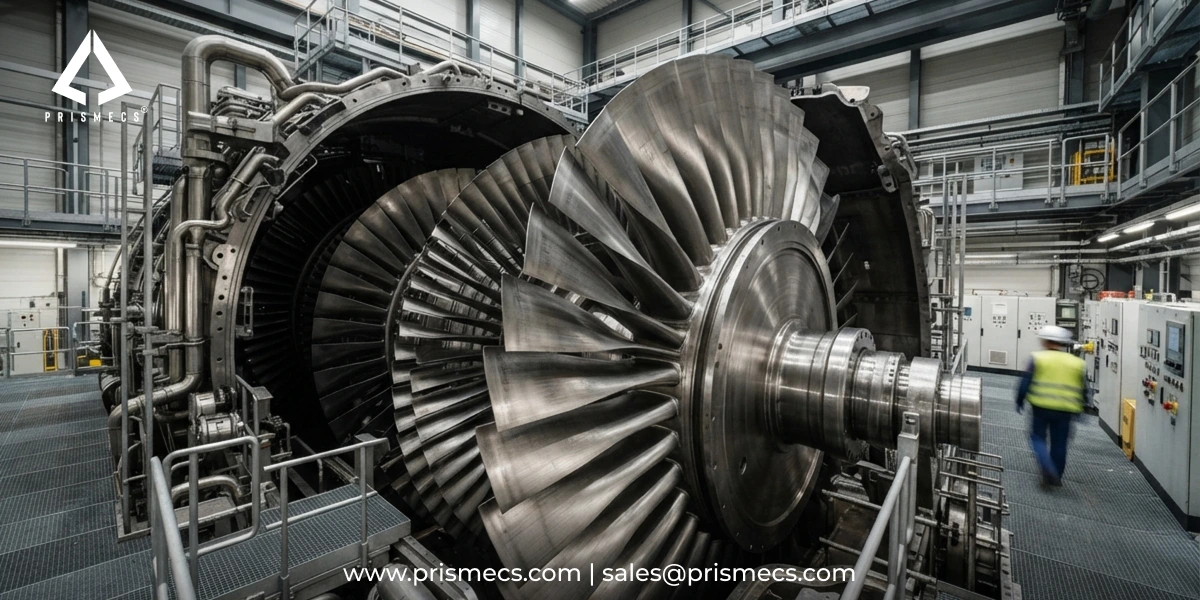
A gas turbine overhaul comes down to four decisions: what to include in the scope, when to take the outage, who does the work and how much to budget. The best decisions start with condition data, not the calendar. They weigh repairs against replacement part by part, and compare OEM, independent and hybrid providers on the same scope. For scale, a hot gas path inspection alone on a 7EA cost $750,000 to $1 million, and a major overhaul goes further.
This guide is written for asset managers, plant managers, and finance partners who approve the capital. It covers heavy-duty frames such as the GE Frame 6B and 7EA, and aeroderivative units such as the LM2500, LM6000, and TM2500. Prismecs supports both fleet types through its OEM-agnostic gas turbine overhaul services.
Why Are Gas Turbine Overhauls More Important Now?
New units are expensive and years away, while gas generation is growing fastest where data centers are being built. Existing turbines must run reliably for longer, and the overhaul is where that is decided.
New Units Are Years Away and Costly
Wood Mackenzie Estimates that gas turbine factories ran at about 90% of capacity in 2025, and some US developers may not add new combined-cycle capacity until 2030 or later. Combined-cycle equipment costs are at record highs, and tariffs could push them toward $2,800 per kW by 2028. Against that replacement cost, extending the life of an existing unit is often the best-value option.
Gas Generation Is Growing Where Data Centers Are
Nationally, gas-fired generation is broadly flat. In its January 2026 Short-Term Energy Outlook, the US Energy Information Administration (EIA) forecasts about 1,696 billion kWh in 2026, similar to 2025, rising to 1,711 billion kWh in 2027. Regionally, the picture is different: gas-fired generation is set to grow 23% in ERCOT and 5% in PJM between 2025 and 2027, partly driven by data center demand.
Plan Early
Existing units must run longer and harder, and parts and shop slots face the same supply pressure as new turbines. Start overhaul planning 18 to 24 months ahead.
Quick Answer: The Four Overhaul Decisions
Every gas turbine overhaul comes down to four linked decisions. Get one wrong and the others suffer, so it helps to settle them in this order.
What a Major Overhaul Includes: Heavy-Duty vs Aeroderivative

A major overhaul is the largest scheduled maintenance event in a gas turbine’s life. The unit is opened end to end, and every major part is repaired, replaced, or upgraded.
Heavy-Duty Frames
On a Frame 6B or 7EA, the work is done on site. Each major part comes with its own decision:
- Rotor: Run a remaining life assessment to choose between life extension and replacement.
- Compressor blades and vanes: repair erosion and foreign object damage or replace rows where damage is beyond limits.
- Turbine blades (buckets) and nozzles: repair and recoat while repair cycles remain; replace when they don’t.
- Combustion hardware: liners, transition pieces and fuel nozzles are usually refurbished or swapped for exchange sets.
- Bearings and seals: usually refurbished. Bearing conditions also reveal lubrication or alignment problems.
- Coatings: Thermal Barrier Coating (TBC) is stripped and reapplied on hot parts.
Many 6B and 7EA units have run for decades, so on these frames the rotor assessment and the first-stage hot parts usually decide whether the overhaul is a routine repair or a life extension project.
According to EPRI research presented at ASME Turbo Expo, a complete overhaul of a large frame unit can take up to 10 to 12 weeks, and planned maintenance outages account for more than 70% of gas turbine unavailability. That makes outage planning as important as the technical scope.
Aeroderivative Units
An aeroderivative engine overhaul works differently. The LM2500, LM6000, and TM2500 are built in modules, so the engine is usually removed and sent for a depot overhaul in a specialist shop. Hot section repair is often handled the same way, by module. While the engine is away, a lease engine can keep the site running.
LM6000 Overhaul: Intervals and Exchange Options
For the LM6000PF, Baker Hughes lists a 25,000-hour hot section interval and a 50,000-hour overhaul interval. Typical aeroderivative intervals of 8,000, 25,000, and 50,000 hours extend to 10,000, 30,000 and 60,000 hours on the LM6000PF+.
At the overhaul, owners usually choose between three routes:
- Send their own engine to the depot and run on a lease engine.
- Take an exchange engine and keep it up.
- Exchange only the modules that need to work.
An on-site engine or module swap typically takes only a few days. Logistics carry risk, especially for international sites. In one fleet review reported by the Combined Cycle Journal, most of the outage time in one forced-outage category came from a lease engine held up in customs. Prismecs has handled LM6000 units in the field, including a relocation of LM6000 units to Crete.
Timing: Interval-Based vs Condition-Based Triggers
The right time to overhaul is set by two clocks: the OEM’s hours and starts limits, and the unit’s actual condition. The best decisions weigh before locking in an outage date.
The OEM Interval
The gas turbine major overhaul interval is set in factored fired hours and factored starts, whichever limit comes first. GE’s GER-3620 guide, Heavy-Duty Gas Turbine Operating and Maintenance Considerations, explains how fuel, load, trips and starts speeding up the count. OEM service bulletins can change the requirements for specific parts. On aeroderivative, Baker Hughes cites a typical major interval of 50,000 hours.
Condition-Based Overhaul
A condition-based overhaul uses measured conditions to time the work. Useful signals include:
- Output degradation: lost megawatts that washing no longer recovers.
- Heat rate: rising fuel use per megawatt hour.
- Borescope and vibration trends that show wear speeding up.
- Availability: more forced outages, which can be benchmarked against NERC’s Generating Availability Data System (GADS).
When to Overhaul Early
Overhauling before the interval can make sense when degradation is costing more than the outage, when a planned market window such as a low-demand season is coming, or when parts and crews are already available. Running the interval makes sense when trends are stable, and the unit is earning well.
A simple test puts a number on the degradation. Take a unit that has lost 4 MW that washing won’t recover, runs 5,000 hours a year and earns a $25/MWh margin. It gives up about $500,000 a year (4 MW × 5,000 hours × $25). If the interval is still 18 months away, that is roughly $750,000 of lost margin. Compare that against the cost of moving the outage forward into a low-demand window.
Scope Decisions: Repair, Replace or Upgrade
Scope decides most of the overhaul cost and what the unit can deliver afterward. It is built part by part, from inspection findings, remaining life and performance goals.
Repair vs Replace vs Upgrade
Each major part gets one of three outcomes:
- Repair when the part is within repairable limits and has repairs left in its life.
- Replace when damage is beyond limits or repeated repairs no longer pay back.
- Upgrade when a newer design adds output, efficiency, or life.
An upgrade belongs in scope when its payback, in recovered output and heat rate over the next interval, beats its cost. Because the unit is already open, the major overhaul is usually the cheapest time to install one.
Remaining Life Assessment and Life Extension
A remaining life assessment (RLA) checks the rotor and other life-limited parts against their design limits. If the results are good, a gas turbine life extension program lets the unit run past its original design life.
The economy is straightforward. With new combined-cycle equipment heading toward $2,800 per kW and delivery slots stretching toward 2030, a life extension buys another full interval of operation, often tens of thousands of fired hours, for a fraction of the cost of replacement capacity. That makes it the best-value path for many owners. The RLA tells you whether the rotor can safely deliver that interval, and that answer should come before any quote is accepted.
New, Repaired or Non-OEM Parts
Operators can choose new OEM parts, repaired parts, or non-OEM parts made by third parties, often reverse-engineered and sometimes loosely called PMA parts. (Formally, PMA is an aviation approval; no regulator certifies replacement parts for land-based gas turbines.) Non-OEM parts can cut costs and lead time. Before using them, check how they affect your warranty, your service contract, and your insurance cover. Many operators mix all three across one overhaul. When you need parts fast, eINDUSTRIFY, Prismecs’ sourcing platform, compares new, repaired and third-party options from qualified suppliers.
Budget Drivers: What Sets Gas Turbine Overhaul Cost
Gas turbine overhaul cost depends far more on decisions than on a price list. As a reference point, EPRI reports that a 7EA hot gas path inspection costs $750,000 to $1 million, with $100,000 to $150,000 for technical oversight of the outage. A major overhaul adds the compressor, rotor, and casings to that scope. These drivers set the final number:
Finance teams should also agree early on how the overhaul will be treated on the books. Many owners capitalize on major overhaul costs and depreciate them over the interval the work buys. Confirm the approach with your accounting team before the budget is approved.
Look Beyond the Quote
Compare overhaul options on total cost of ownership (TCO), not the quote alone. A useful yardstick is cost per fired hour: the full overhaul cost divided by the hours it buys until the next one. A cheaper overhaul that brings back less heat rate recovery can cost more over the cycle.
The example below shows how. The figures are illustrative assumptions, not price benchmarks: an 80 MW unit running 6,000 hours a year, with a heat rate of 11,000 Btu/kWh and gas at $3.50/MMBtu. Fuel costs about $3,080 per fired hour, so each 1% of heat rate is worth about $31 per fired hour.
Quote B is $600,000 cheaper upfront, but over the interval it costs about $900,000 more. Ask every bidder to state the heat rate and output recovery they will stand behind after restarting and put both numbers in the comparison.
OEM, Independent or Hybrid: How to Choose
Overhaul is often when owners review who services their fleet. Each model has real strengths.
Questions to Ask Any Provider
- What experience do you have on this exact platform?
- Which parts will be new, repaired or non-OEM, and why?
- How will findings be approved and priced during the outage?
- What heat rate and output recovery will you stand behind after restarting?
- If we are under an LTSA or CSA, what notice, termination or buyout terms apply before we change providers?
- An LTSA or CSA can lock in these choices for years, so read its terms before the overhaul is scoped.
Prismecs works as an OEM-agnostic partner on both fleet types, including an LM6000 relocation to Crete and the 260 MW TM2500 dual-fuel reserve plant at Birr, where Prismecs supports O&M, the CMMS and spares management.
Comparing OEM and independent overhaul quotes? Prismecs will review the scope line by line, and if we are also quoting, we will tell you up front.
Cutting Outage Duration: Lease Engines, Pre-Staged Parts and Crew Planning

Outage days are often the biggest hidden cost of overhaul. Since planned outages drive most gas turbine unavailability, three levers matter most.
Lease Engines and Engine Swaps
For aeroderivative, a lease engine replaces your engine while it is in the depot. An on-site engine exchange can cut the outage to a few days. A lease makes sense when lost revenue during the depot visit is higher than the rental cost. For international sites, plan customs clearance as carefully as the swap itself.
Pre-Staged Parts
Long-lead parts set the outage critical path. Order them early, based on the last inspection, and have repaired or exchanged sets ready before the unit comes offline.
Crew Planning
Run parallel work streams where safety allows; plan shifts around the critical path and agree in advance how findings will be approved. Slow approvals stretch more outages than slow repairs do.
Overhaul Decision Checklist
A clear timeline keeps scope, contracts, parts, and capital approval on track. Use this checklist to work back from your target outage date.
18 to 24 Months Out
- Pull factored fired hours, factored starts and trip history.
- Review output degradation, heat rate, and availability trends.
- Commission for a remaining life assessment if life extension is on the table.
- Check LTSA or CSA notice periods if you might change providers.
12 Months Out
- Set the draft scope: repair, replace or upgrade for each major part.
- Request quotes from OEM, independent and hybrid providers on the same scope, including stated heat rate and output recovery.
- Check LTSA or CSA terms, warranty and insurance rules for parts choices.
- Submit the capital request with a TCO comparison and a contingency for findings.
6 Months Out
- Order long-lead parts and book a lease engine if needed.
- Lock the outage window, crews, logistics and customs clearance.
- Agree how findings will be approved and priced.
Frequently Asked Questions
These are the questions asset managers and finance teams ask most often when planning a gas turbine overhaul.
What Is Included in a Gas Turbine Major Overhaul?
A major overhaul opens the unit from end to end. It covers the rotor, compressor blades and vanes, turbine blades and nozzles, combustion hardware, bearings, seals, and coatings. Each part is repaired, replaced, or upgraded. On aeroderivative, the engine usually goes to a depot for work.
What Drives the Cost of Gas Turbine Overhaul?
The main drivers are the parts strategy, scope of growth from findings, outage days, upgrades, lease engines and logistics. For scale, EPRI reports that a 7EA hot gas path inspection alone costs $750,000 to $1 million, and a major overhaul has a larger scope. Comparing options on total cost of ownership and cost per fired hour, including heat rate recovery, gives a truer picture than comparing quotes alone.
When Should You Overhaul Instead of Running to the Next Interval?
Overhaul early when output degradation or heat rate losses cost more than the outage, when forced outages are rising, or when a low-demand window and parts are available. Run to the interval when condition trends are stable, and the unit is earning well.
OEM vs Independent Overhaul: What Are the Trade-Offs?
OEMs offer design data, the latest upgrades, and one point of accountability. Independent providers offer more flexibility on scope, parts and scheduling. A hybrid model combines independent labor with OEM parts. The right choice depends on the platform, the contract terms, and the provider’s experience.
How Long Does an Overhaul Outage Take?
It depends on the unit and the plan. EPRI research describes complete overhauls of large frame units taking up to 10 to 12 weeks. Aeroderivative units can return in a few days if a lease engine or engine exchange is used while the original engine is in the depot.
What Is a Lease Engine and When Does It Make Sense?
A lease engine is a rental unit installed while your own engine is overhauled. It is common for an LM6000 overhaul and other aeroderivative work. It makes sense when the revenue lost during the depot visit is higher than the lease cost, or when the site cannot go offline. For international sites, including customs time in the plan.
Is Overhauling Cheaper Than Replacing Gas Turbine?
In most cases, yes. With new combined-cycle equipment heading toward $2,800 per kW and delivery slots stretching toward 2030, an overhaul with life extension buys another full interval for a fraction of the cost of new capacity. A remaining life assessment confirms whether the rotor can safely deliver that interval.
Get an Independent Overhaul Scope and Budget Review
Planning an overhaul in the next 24 months? Prismecs reviews overhaul scope and budget for heavy-duty and aeroderivative units, independent of the OEM. Share your unit model, fired hours, starts, and target outage window. Our engineers will check the scope part by part, flag where repair, replacement or an upgrade makes the most sense, and help you compare quotes on a like-for-like basis, including heat rate recovery and cost per fired hour.
If Prismecs is also quoting on your overhaul, we will say so up front. Where you need a fully independent reviewer, our owner’s engineering team can support projects we are not bidding on.
Want to talk about it first? Call our team at 1 (888) 774 7632, available 24/7.
Tags: gas turbine major overhaul gas turbine overhaul cost gas turbine life extension OEM vs independent gas turbine service cost per fired hour
recent posts

Gas Turbines
15 minutes read
Gas Turbine Major Overhaul: How Operators Decide Scope, Timing and Budget
A gas turbine major overhaul hinges on scope, timing, provider and budget. Weigh repair vs replace, OEM vs independent and RLA life extension before y...

O&M Services
12 minutes read
Combustion vs Hot Gas Path vs Major Inspection: What Each Covers and When It's Due
Combustion vs hot gas path vs major inspection timing is not just hours. A peaker can owe an HGPI in 4 years on starts alone. Check which limit hits y...
O&M Services
15 minutes read
Writing a Power Plant O&M RFP That Gets Comparable Bids
Write a power plant O&M RFP every bidder must price the same way. Get the pricing template, data room checklist and weighted scorecard that expose eve...

EPCM Services
19 minutes read
25 Questions to Ask a Power Plant EPC Contractor Before You Sign
Most lists of questions to ask an EPC contractor stop at the question. Get why each matters, the strong answer, the red-flag reply and a weighted bid...