Gas Engine Overhaul Intervals: What Gets Replaced at Each Stage and Why It Matters
O&M Services
November 20, 2026
15 minutes read
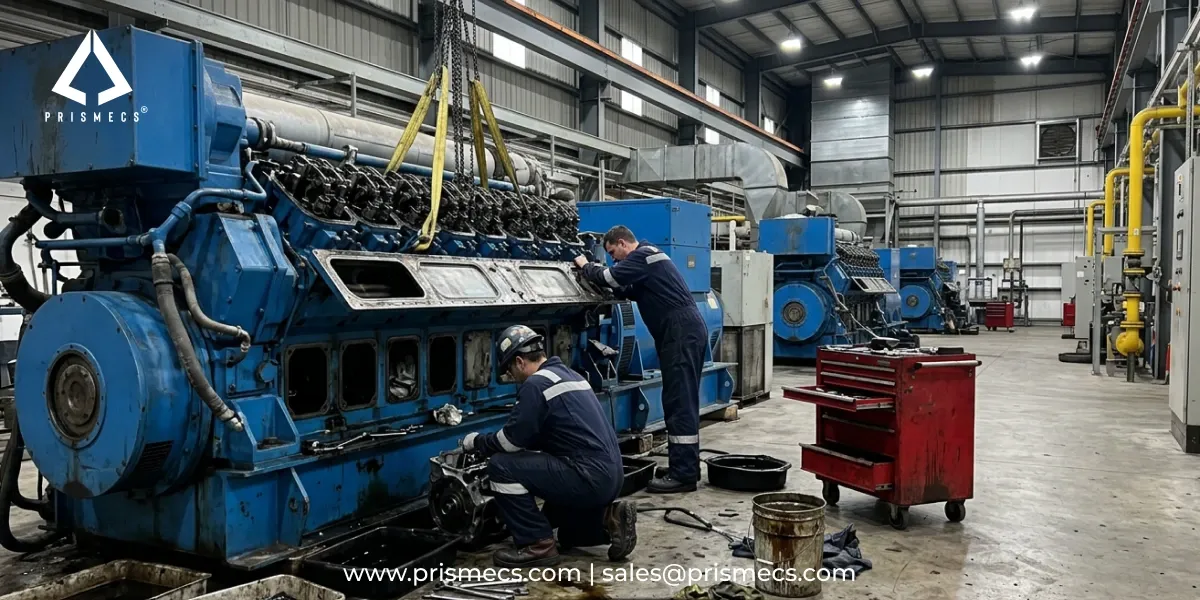
Most natural gas generator engines follow three overhaul stages. A top-end covers cylinder heads and valves. An in-frame covers pistons, liners, rods and bearings. A major covers the crankshaft, camshaft, gear train and block. For 1.5 to 2.5 MW natural gas gensets, manufacturers typically set the in-frame at around 40,000 operating hours and the major at 64,000 to 80,000 hours, with top-ends earlier and based on condition. Fuel quality, load profile and condition data move each stage earlier or later.
At each stage, the replacement scope becomes more extensive. A top-end overhaul focuses on cylinder heads and valve-train components, an in-frame overhaul addresses pistons, liners, connecting rods, and bearings, while a major overhaul involves deeper internal assemblies, including the crankshaft and gear train.
Understanding what gets replaced at each stage helps operators plan maintenance around actual component condition, prepare the required parts, and schedule shutdowns. It also helps prevent excessive wear from progressing into more costly mechanical failures and unplanned downtime.
What Determines Gas Engine Overhaul Intervals?
Gas engine overhaul intervals depend on manufacturer recommendations, operating conditions, fuel characteristics, and measured component deterioration. Operating hours provide a maintenance reference, but inspection findings determine whether an engine needs an overhaul earlier or can continue operating within approved limits.
Several factors influence these intervals:
Engine speed and design: Engine configuration, cylinder displacement, rated speed, and component design influence wear rates and maintenance requirements.
Operating load: Continuous baseload operation, frequent starts, and extended low-load operation expose engine components to different thermal and mechanical conditions.
Fuel quality: Natural gas composition, contaminants, and variations in fuel quality can affect combustion, deposits, valve condition, and lubrication requirements.
Lubrication quality: Oil condition, contamination, viscosity, and maintenance practices influence bearing surfaces, piston rings, cylinder liners, and other lubricated components.
Maintenance history: Regular inspections, valve adjustments, oil analysis, and timely replacement of consumables help identify developing problems before they affect other engine components.
Ambient and site conditions: Altitude, ambient temperature, humidity, and installation environment influence engine derating, cooling requirements, and thermal loading. These conditions can affect component operating temperatures and maintenance requirements, depending on the engine design and site conditions.
For example, MWM's published service schedule for its TCG 3020 gas engines sets general overhaul intervals at 80,000 operating hours for high-quality gas, 64,000 hours for medium-quality gas, and 48,000 hours for low-quality gas. Similarly, Caterpillar specifies an in-frame maintenance interval of 40,000 operating hours and a major overhaul period of 80,000 hours for its G3512H natural gas generator set. These model-specific intervals provide maintenance planning references, although requirements may differ across engine models and operating applications.
What Are the Main Stages of a Gas Engine Overhaul?
Gas engine maintenance generally progresses through routine servicing, top-end overhaul, in-frame overhaul, and major overhaul. Each stage addresses a different group of components and requires a progressively broader inspection and repair scope.
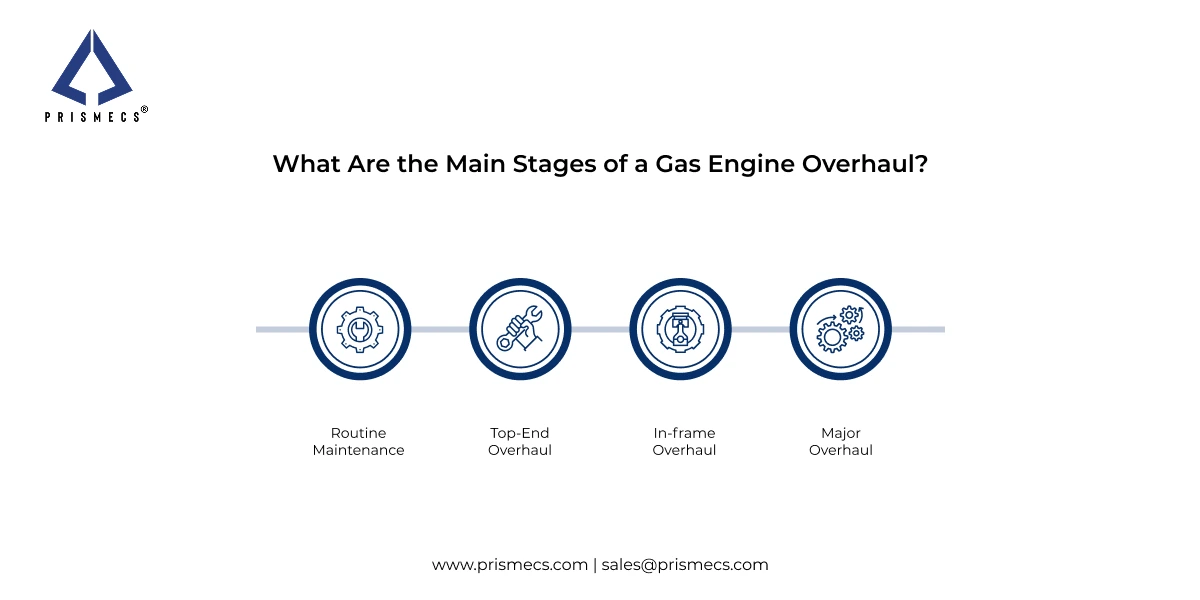
Maintenance stage | Main work | Components involved |
Routine maintenance | Inspection and scheduled servicing | Engine oil, filters, spark plugs, coolant |
Top-end overhaul | Cylinder-head and valve-train work | Valves, seats, guides, springs, cylinder heads |
In-frame overhaul | Internal engine reconditioning | Pistons, rings, liners, connecting rods, bearings |
Major overhaul | Extensive engine rebuilding | Crankshaft, camshaft, gear train, bearings, engine block |
These categories describe common industrial gas engine maintenance practices. Individual manufacturers may use different terminology, combine certain maintenance stages, or prescribe different replacement scopes.
Overhaul planning also affects maintenance expenditure and generation availability. As the scope progresses from top-end to in-frame and major work, operators must account for additional replacement components, specialist labor, inspection requirements, and longer equipment shutdowns. Planning these activities around scheduled maintenance windows helps coordinate parts procurement, technical resources, and alternative generation capacity.
An in-frame overhaul generally allows technicians to service internal engine components without removing the complete engine block from its installed position. A major overhaul usually requires more extensive disassembly and may involve removing the engine for workshop inspection and rebuilding.
What Gets Replaced During a Gas Engine Top-End Overhaul?
A gas engine top-end overhaul primarily addresses cylinder-head and valve-train wear by rebuilding or replacing components that can no longer meet manufacturer specifications. The work focuses on maintaining proper combustion sealing, valve operation, and cylinder performance.
Cylinder Heads, Exhaust Valves, and Valve Seats
Cylinder heads, exhaust valves, and valve seats receive particular attention because repeated combustion cycles expose these components to high temperatures and mechanical contact. Technicians inspect their condition and replace or recondition components according to measured wear.
Exhaust valves gradually recede into their seats through repeated contact and exposure to combustion heat. Excessive recession changes valve geometry and can affect valve clearance, sealing, and combustion performance.
Depending on the engine design and inspection results, technicians may replace:
Cylinder-head assemblies.
Exhaust valves and valve seats.
Valve inserts and associated components.
Cylinder-head gaskets and seals.
Valve-stem projection provides an important measurement for tracking valve recession. Comparing measurements against the manufacturer's limits helps determine when cylinder heads require servicing or replacement.
Valve Guides, Springs, and Related Components
Valve guides, springs, rotators, keepers, and related hardware require inspection because they control valve alignment, movement, and seating. Worn guides can affect valve movement, while weakened springs may prevent consistent valve operation.
A top-end overhaul commonly involves replacing or rebuilding these components as part of cylinder-head servicing. Their condition matters because improper valve movement or seating can cause compression losses, abnormal wear, and reduced engine performance.
The exact replacement scope depends on cylinder-head inspection findings and the engine manufacturer's specifications.
Spark Plugs and Other Associated Parts
Spark plugs are commonly replaced during scheduled gas engine maintenance and may also be included in a top-end overhaul. Their condition affects ignition reliability, combustion stability, and cylinder-to-cylinder performance.
Technicians inspect electrode erosion, deposits, insulation damage, and spark-plug condition. They may also inspect ignition leads, pre-chamber components, and related ignition hardware where fitted.
Replacing worn ignition components helps prevent misfires, incomplete combustion, and operating irregularities. Lubricating oil is also changed as part of the associated maintenance work.
What Gets Replaced During a Gas Engine In-Frame Overhaul?
An in-frame overhaul extends beyond cylinder-head servicing to address internal components such as pistons, piston rings, cylinder liners, connecting rods, and bearings. Technicians perform this work with the engine block remaining in its installed position.
Pistons, Piston Rings, and Cylinder Liners
Pistons, piston rings, and cylinder liners require inspection because they experience continuous thermal loading, friction, and combustion pressure. Excessive wear can reduce compression, increase oil consumption, and allow combustion gases to enter the crankcase.
An in-frame overhaul commonly includes:
Pistons: Inspected for cracking, scoring, thermal damage, and dimensional wear.
Piston rings: Replaced when ring wear, loss of tension, or excessive clearance affects combustion sealing and oil control.
Cylinder liners: Inspected for bore wear, glazing, scoring, and dimensional deviations before reconditioning or replacement.
Cylinder liner glazing is particularly relevant in engines experiencing prolonged operating conditions that do not allow effective cylinder lubrication and combustion behavior. Bore inspection helps technicians identify surface deterioration that may contribute to increased oil consumption. In field practice, liner glazing is commonly observed in engines running extended periods at loads below 40% of rated capacity, where insufficient cylinder pressure and temperature prevent proper ring seating and oil-film management.
Connecting Rods and Engine Bearings
Connecting rods and their bearings transfer combustion forces from the pistons to the crankshaft. Their inspection is essential because bearing wear and excessive clearances can affect lubrication, mechanical loading, and engine reliability.
Technicians inspect connecting rods for dimensional deviations, cracks, and signs of damage. Main and connecting rod bearings are evaluated for wear patterns, surface condition, and clearance against manufacturer specifications.
Depending on the inspection results, bearing shells, connecting rod assemblies, fasteners, and associated seals may require replacement. Reusing components outside approved dimensional limits can increase the risk of lubrication failure and internal engine damage.
Turbocharger and Associated Components
Turbochargers require inspection during an in-frame overhaul because their rotating assemblies operate at high speeds and temperatures. Technicians examine bearing condition, shaft movement, compressor and turbine wheels, seals, and housing surfaces.
Depending on the findings, the turbocharger may undergo reconditioning or complete replacement. The inspection should also consider oil supply and drainage because lubrication problems can damage the turbocharger even after reconditioning.
Other associated systems, including cooling components, pumps, and lubrication circuits, may receive additional inspection according to the engine configuration and overhaul scope.
In reciprocating gas engine applications, turbocharger-related failures represent a measurable share of unplanned shutdowns. Proactive turbocharger inspection during an in-frame overhaul, including shaft-play measurement, compressor-wheel condition assessment, and oil-drain line verification, reduces the risk of secondary damage to downstream components such as intercoolers and intake manifolds.
What Happens During a Major Gas Engine Overhaul?
A major gas engine overhaul involves extensive disassembly, dimensional inspection, reconditioning, and replacement of internal components to restore the engine to its specified serviceable condition. It includes the applicable work from earlier overhaul stages and additional attention to deeper mechanical assemblies.
Crankshaft and Main Bearing Inspection
The crankshaft requires detailed inspection because it converts reciprocating piston movement into rotational power. Technicians examine journals, bearing surfaces, runout, and other dimensions against manufacturer limits.
Main bearings support the crankshaft and maintain the required oil film between moving surfaces. Excessive clearance, scoring, overheating, or abnormal wear can compromise lubrication and lead to serious mechanical damage.
Depending on inspection findings, technicians may replace bearings, polish or regrind crankshaft journals where permitted, or replace the crankshaft if it cannot meet serviceability requirements.
Camshaft and Gear Train Components
The camshaft and gear train control valve timing and coordinate mechanical movement throughout the engine. Wear in these assemblies can affect valve operation, timing accuracy, and overall mechanical reliability.
A major overhaul may include inspection or replacement of:
Camshaft bearings and related components.
Timing gears and gear-train bushings.
Gear-drive components and associated fasteners.
Vibration dampers and related assemblies.
Technicians examine gear teeth for pitting, cracking, excessive backlash, and abnormal contact patterns. Camshaft surfaces and bearing locations are also checked for wear and dimensional deviations.
Engine Block Inspection and Reassembly
The engine block requires inspection during a major overhaul because its structural condition determines whether internal assemblies can be reinstalled within acceptable tolerances. Technicians examine bearing bores, mounting surfaces, and other critical dimensions.
A line-bore inspection may be required to verify the alignment of main bearing bores. Incorrect alignment can affect crankshaft positioning, bearing loading, and lubrication clearances.
After inspection and approved reconditioning, technicians reassemble the engine using components that meet manufacturer specifications. The process includes checking clearances, torque requirements, lubrication passages, and sealing surfaces before commissioning and performance verification.
How Do Engineers Determine When a Gas Engine Needs an Overhaul?
Engineers determine overhaul timing by combining operating hours with condition-monitoring measurements, performance trends, and inspection results. These indicators help identify component deterioration before it develops into a more serious mechanical problem.
Condition indicator | What it can reveal | Relevant overhaul stage |
Increased valve-stem projection | Exhaust valve and seat recession | Top-end |
Rising blowby volume | Possible piston-ring or cylinder wear | In-frame |
Increased oil consumption | Possible liner glazing or internal wear | In-frame or major |
Abnormal wear metals in oil | Potential bearing and internal-component deterioration | In-frame or major |
Reduced or uneven cylinder compression | Possible combustion-sealing problems | In-frame or major |
Increased vibration and mechanical noise | Potential rotating-component or bearing problems | Major investigation |
Engineers assess these indicators together to determine whether an engine needs an overhaul and which components require attention. The following factors help establish the extent of wear and identify the maintenance work needed:
Valve-stem projection: Measurements track exhaust valve recession over time. Comparing these readings with the OEM's maximum allowable limits helps engineers estimate cylinder-head service requirements.
Crankcase blowby: Increasing blowby can indicate that combustion gases are passing the piston rings into the crankcase. Engineers investigate the trend alongside compression and other cylinder-condition measurements.
Lubricating oil analysis: Laboratory analysis identifies changes in wear-metal concentrations, contamination, and lubricant condition. Elevated aluminum, copper, chromium, or iron levels can indicate developing component wear, although interpretation depends on the engine and oil-analysis history.
Oil consumption: A sustained increase can indicate cylinder liner glazing, piston-ring deterioration, or other oil-control problems. Engineers compare consumption against an established operating baseline rather than relying on one isolated reading.
These indicators must be interpreted together. For example, abnormal exhaust emissions may result from fuel-system calibration or combustion-control problems rather than internal mechanical deterioration. An overhaul decision therefore requires investigation of the underlying cause.
Why Do Gas Engine Overhaul Intervals Matter?
Following appropriate gas engine overhaul intervals helps maintain mechanical reliability, control maintenance expenditure, and reduce the risk of unplanned generation interruptions. Delayed maintenance can allow localized component deterioration to damage connected assemblies.
Engine reliability: Replacing worn components before they exceed serviceability limits reduces the likelihood of bearing damage, valve failure, compression losses, and other mechanical problems.
Maintenance expenditure: Planned component replacement allows operators to evaluate reconditioning against replacement costs. It also reduces the likelihood of secondary damage that can increase the scope and expense of an overhaul.
Power generation availability: Scheduling major maintenance around planned outages helps operators coordinate equipment availability, spare parts, technical labor, and recommissioning activities.
Equipment service life: Maintaining lubrication clearances, combustion sealing, valve operation, and rotating assemblies within approved limits helps preserve the engine's designed operating condition.
Insurance and compliance requirements: Many power generation facilities operate under insurance policies and regulatory frameworks (such as NFPA 110 for emergency and standby power systems) that require documented adherence to OEM maintenance schedules. Failure to maintain overhaul records can affect insurance coverage, warranty claims, and regulatory compliance during facility audits.
An overhaul should not be delayed simply because the engine continues producing its rated output. Some components can deteriorate before noticeable performance losses appear, making inspection records and condition trends essential to maintenance decisions.
How to Plan a Gas Engine Overhaul
Effective gas engine overhaul planning requires reviewing the OEM maintenance schedule, evaluating component condition, confirming the required replacement scope, and coordinating parts and technical resources before shutdown.
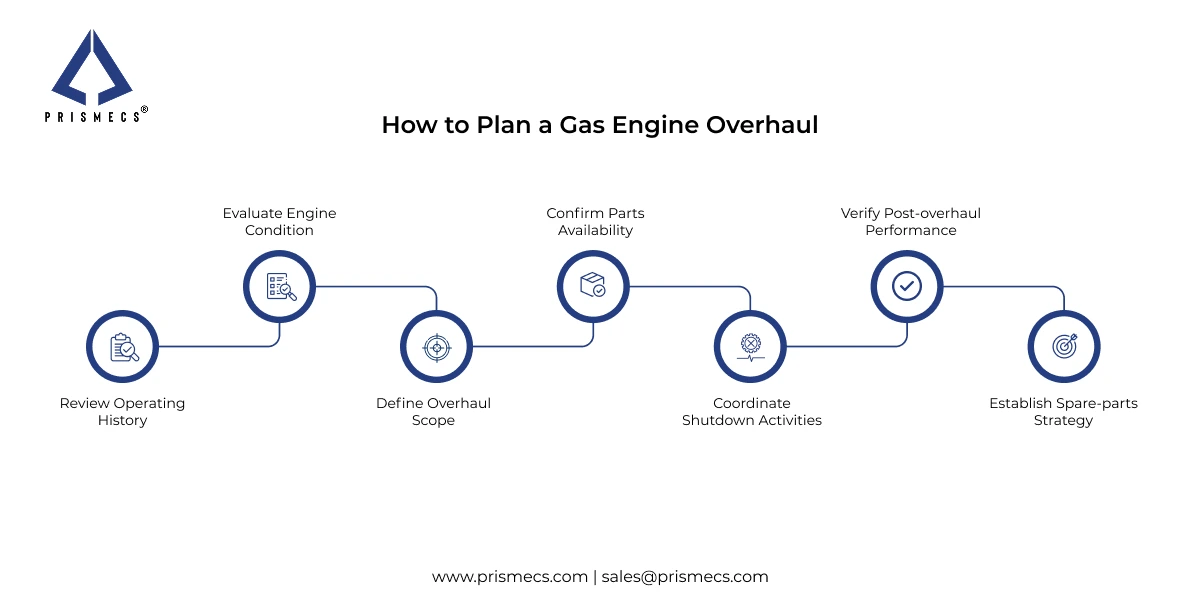
A practical planning process includes:
Review operating history: Confirm accumulated service hours, previous overhaul dates, fuel conditions, load profile, and maintenance records.
Evaluate engine condition: Review valve-stem projection, compression, blowby, oil consumption, vibration, and lubricant analysis.
Define overhaul scope: Identify components requiring inspection, reconditioning, replacement, or further engineering assessment.
Confirm parts availability: Check part numbers, dimensional requirements, OEM specifications, and procurement lead times, plus how to verify non-OEM parts where alternatives are considered.
Coordinate shutdown activities: Arrange specialist technicians, lifting equipment, workshop support, and the required outage window.
Verify post-overhaul performance: Complete manufacturer-prescribed checks, commissioning procedures, and operating assessments before returning the engine to service.
Establish spare-parts strategy: Evaluate whether to stock critical overhaul components (cylinder heads, liner kits, bearing sets) on-site or arrange procurement through a parts management agreement. For remote or island-mode installations, maintaining a consignment inventory of long-lead-time components can reduce outage duration by several days.
Planning should also consider generator inspection requirements and associated systems that may benefit from maintenance during the same shutdown. Coordinating these activities can reduce repeated outages and improve maintenance efficiency.
Frequently Asked Questions
What is a top-end overhaul on a gas engine?
A top-end overhaul involves removing and reconditioning cylinder heads, replacing exhaust valves, valve seats, guides, springs, and gaskets. Spark plugs and ignition components are also replaced. The engine block remains installed, and work focuses on restoring combustion sealing and valve-train function.
How many hours before a gas engine needs a major overhaul?
For 1.5 to 2.5 MW natural gas gensets, manufacturers typically publish major overhaul intervals of around 80,000 operating hours on natural gas, falling to about 64,000 hours on biogas, landfill gas or sewage gas. Regulator-filed maintenance plans show majors assessed at 80,000 to 100,000 hours. Actual timing depends on condition-monitoring data and duty.
What is the difference between in-frame and out-of-frame overhaul?
An in-frame overhaul services pistons, liners, bearings, and connecting rods with the engine block remaining in place. An out-of-frame (major) overhaul requires removing the engine for complete disassembly, including crankshaft, camshaft, gear train, and block inspection.
What makes more sense: overhaul, remanufactured exchange, or replacement?
Overhauling suits engines with a sound block and reusable core components. Remanufactured exchange engines reduce downtime when outage windows are tight. Full replacement makes sense when cumulative wear, obsolescence, or parts unavailability makes reconditioning uneconomical compared to a new or reman unit.
What signs show an overhaul is due?
Key indicators include rising valve-stem projection, increasing crankcase blowby, elevated oil consumption, abnormal wear metals in oil analysis, reduced or uneven cylinder compression, and increasing vibration. These should be evaluated together against OEM limits and historical operating baselines.
How long is a genset down for a major overhaul?
A top-end overhaul typically requires 3 to 5 days. An in-frame overhaul takes 1 to 3 weeks. A major overhaul can extend to 3 to 6 weeks depending on engine size, component condition, parts availability, and whether the engine requires removal for workshop reconditioning.
Get the Right Support for Your Gas Engine Overhaul
Ensure your gas engines receive the right maintenance and overhaul support to maintain reliable performance and minimize unplanned downtime. Prismecs provides gas engine maintenance and overhaul services, supporting component inspection, replacement planning, and performance requirements.
Explore our services and solutions or call us at +1 (888) 774-7632 or email at sales@prismecs.com to discuss your requirements with our field experts and receive technical guidance.
Tags: Gas engine major overhaul in-frame overhaul natural gas genset maintenance reciprocating engine condition monitoring gas engine top-end overhaul
recent posts

O&M Services
15 minutes read
Gas Engine Overhaul Intervals: What Gets Replaced at Each Stage and Why It Matters
Gas engine overhaul intervals decide your downtime. See exactly what gets replaced at top-end, in-frame and major stages, then talk to Prismecs field...

Gas Turbines
13 minutes read
Turbine Control System Upgrade: What to Evaluate Before Replacing Turbine or Generator Controls
Before any vendor pitches a turbine control system upgrade, run 7 checks: obsolescence, logic, protection, excitation, interfaces and NERC CIP. Then p...
Owner’s Engineer
11 minutes read
When Do You Actually Need an Owner’s Engineer?
When to hire an owner’s engineer? Before your EPC terms are locked, not after. See 6 signs you need one, when targeted reviews are enough, and what it...
Gas Turbines
15 minutes read
Gas Turbine Major Overhaul: How Operators Decide Scope, Timing and Budget
A gas turbine major overhaul hinges on scope, timing, provider and budget. Weigh repair vs replace, OEM vs independent and RLA life extension before y...