What to Evaluate Before Replacing a Turbine or Generator Control System
Gas Turbines
November 17, 2026
13 minutes read

Before replacing a turbine or generator control system, evaluate seven technical factors: the existing control architecture, hardware obsolescence and spare parts, control logic compatibility, turbine protection and safety functions, generator protection and excitation integration, plant communication interfaces, and cybersecurity requirements. Together, these factors determine whether a full replacement or a partial retrofit best fits the facility's needs.
This guide is written for plant managers, controls engineers and asset owners planning a controls upgrade on gas turbines, steam turbines or generator systems. It covers each factor, the NERC and cybersecurity requirements a replacement can trigger, and how to test and schedule the work.
When Should You Replace an Existing Turbine Control System?
Replace a turbine control system when it can no longer deliver reliable operation, effective protection, or dependable support. Age alone is not the trigger. Recurring faults, discontinued components, and lost vendor support are.
Obsolescence can arrive sooner than owners expect. At Engie’s Cycofos combined-cycle plant in France, a 420 MW unit with a gas turbine installed in 2010, the plant DCS and turbine control systems were obsolete and causing operations and maintenance problems within about 14 years.
Use these signals to judge whether your system has reached that point:
Signal | What to check | Red flag |
Failure history | Control-related trips and forced outages over the last 3 years | Rising trend, or repeat failures of the same module |
Spare parts | Lead time and source for processors, I/O cards, power supplies | Only refurbished or salvage parts available |
Vendor support | Published end-of-support or last-time-buy dates | Support already ended, or ends before your next major outage |
Diagnostics | Ability to trace trips and alarms to a root cause | Trips that cannot be explained from system data |
Software | Ability to edit, backup and restore application logic | No working engineering tools or verified backups |
Integration | Ability to connect to current plant, grid and security systems | Interfaces that cannot meet current protocol or cybersecurity needs |
If several rows show red flags, start the evaluation below. If only one does, a targeted fix may be enough.
Seven Technical Factors to Assess Before Replacing a Turbine Control System
The seven technical factors that determine a suitable turbine control system replacement include control architecture, hardware obsolescence, software compatibility, turbine protection, generator and excitation systems, plant communication interfaces, and cybersecurity requirements. Evaluating each area helps plant owners define the upgrade scope, maintain system compatibility, and avoid operational issues during implementation.
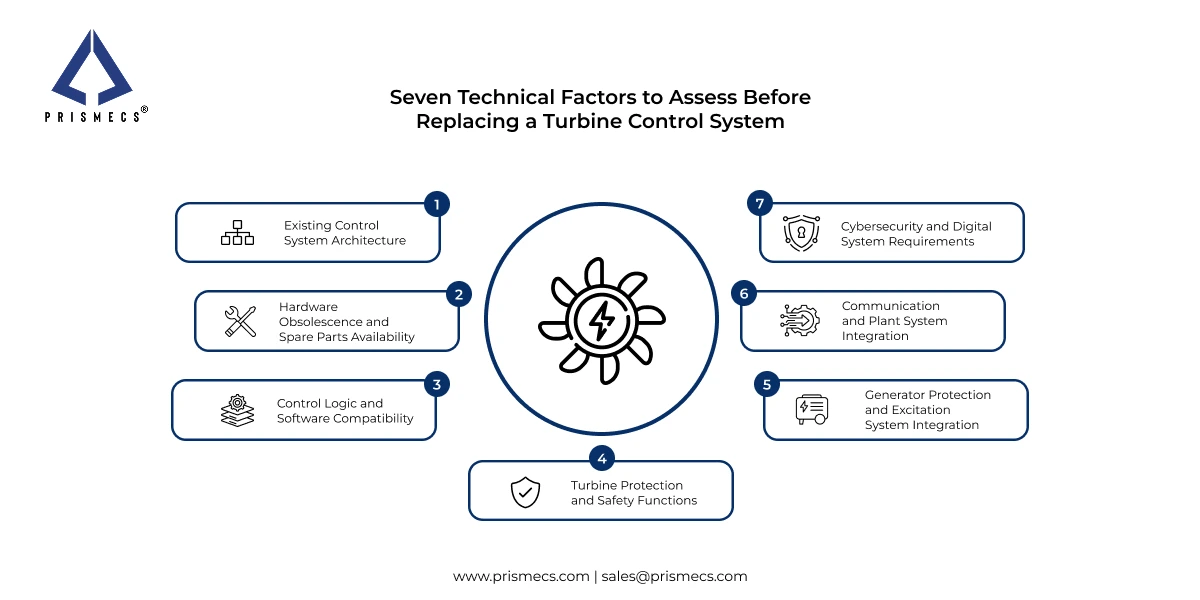
1. Existing Control System Architecture
The existing control architecture determines which components can be retained, replaced, or modified during an upgrade. Engineers should first document the installed controller, input/output modules, communication networks, operator interfaces, software configuration, and field connections.
For example, a gas turbine operating with a legacy control platform may have different migration requirements than a unit using a newer system. Even an upgrade within the same product family requires an assessment of existing hardware, software, application logic, and termination arrangements. The objective is to establish whether the project requires a complete panel replacement or a more limited migration.
This assessment helps identify:
Existing controller and processor configurations
Input/output module types and signal arrangements
Control panel dimensions and available installation space
Existing software, logic, and operator interfaces
Communication protocols and connected plant systems
Hardware that can remain in service
Certain control system migration approaches allow existing field wiring and termination arrangements to be retained, reducing the need for extensive site modifications.
2. Hardware Obsolescence and Spare Parts Availability
Hardware obsolescence should be evaluated by identifying components that are discontinued, difficult to repair, or no longer supported by their manufacturers. A control system may continue operating while its long-term maintainability becomes increasingly difficult.
Power plant engineers should review the availability of processors, I/O cards, power supplies, communication modules, operator stations, and other critical components. They should also examine spare parts inventory and repair arrangements. Depending on the manufacturer and platform, replacement parts may be available through existing inventories, refurbished equipment, or specialist repair providers.
A complete replacement is not always necessary. If the main controller remains supported but selected components have reached the end of their lifecycle, a targeted hardware upgrade may address the immediate problem.
3. Control Logic and Software Compatibility
Control logic compatibility determines whether the replacement system can reproduce the existing turbine's required operating sequences, protective functions, and control responses. Engineers should review application software, operating limits, trip logic, alarm configurations, fuel control sequences, and auxiliary equipment interfaces before migrating to a new platform.
A software conversion should not simply copy the existing logic without verification. Differences in controller architecture, execution timing, signal processing, and programming environments can affect how the new system behaves.
The engineering assessment should include:
Start-up and shutdown sequences
Speed and load control algorithms
Fuel and combustion control logic
Temperature and pressure limits
Alarm and trip configurations
Interlocks and permissive conditions
Emergency shutdown responses
Each critical function should be checked against the original design requirements and current operating conditions.
4. Turbine Protection and Safety Functions
Turbine protection functions must remain effective after the control system replacement, particularly for overspeed protection, emergency shutdown, and other equipment-critical trip conditions. The evaluation should identify which protective functions operate through the primary controller, and which use independent protection hardware or separate safety systems.
Engineers should review trip initiation signals, voting arrangements, redundancy, sensor configurations, and final control elements. They must also establish whether the new architecture introduces additional failure modes. For digital upgrades, redundancy deserves particular attention. Triple Modular Redundancy (TMR), for example, uses three processing channels and voting logic to maintain control functionality when an individual channel develops a fault.
However, redundancy does not automatically guarantee system safety. The complete design must be reviewed, including input devices, output arrangements, diagnostics, and failure responses.
5. Generator Protection and Excitation System Integration
Generator control system replacement requires a separate evaluation of excitation control, voltage regulation, and electrical protection functions. These systems influence generator stability and must coordinate correctly with turbine controls and the wider electrical network.
The excitation system regulates the DC current supplied to the generator rotor windings. Its control functions influence terminal voltage, reactive power, and generator response to changing operating conditions.
Generator protection relays perform a different function by detecting electrical faults and abnormal operating conditions that could damage the generator.
Before upgrading these systems, engineers should assess:
Automatic voltage regulator (AVR) functionality
Excitation control hardware and software
Generator protection relay settings
Synchronization and breaker interfaces
Reactive power and voltage control requirements
Coordination between turbine, generator, and plant protection systems
IEEE C37.102-2023 provides generator protection guidance that should be considered when evaluating the need for excitation system and generator protection relay upgrades.
6. Communication and Plant System Integration
A replacement control system must communicate reliably with existing plant equipment, monitoring platforms, and electrical systems. Compatibility should be verified before selecting the new controller. Common interfaces include distributed control systems (DCS), human-machine interfaces (HMI), historians, protection relays, turbine auxiliary systems, and remote monitoring platforms.
Engineers should review communication protocols, signal mapping, network architecture, data exchange requirements, and interface responsibilities. For example, an existing plant may use Modbus/TCP for communication between its excitation system and plant controls. A replacement platform must preserve the required data exchange or provide an appropriately engineered alternative.
Poorly planned integration can produce missing signals, incorrect alarm displays, communication interruptions, and commissioning delays.
7. Cybersecurity and Digital System Requirements
Cybersecurity should be included in the control system upgrade assessment because digital controllers introduce network connections, software dependencies, and additional access requirements.
Engineers should evaluate remote access arrangements, user permissions, network segmentation, software maintenance, backup procedures, and system recovery capabilities. The assessment should also consider applicable cybersecurity requirements for the facility. For bulk electric system assets, relevant NERC Critical Infrastructure Protection (CIP) requirements may apply, depending on the asset's classification and regulatory scope.
The replacement design should define how control networks are separated from business networks and how authorized personnel access system information. These measures help protect critical control functions while maintaining the connectivity needed for plant operations and maintenance.
Should You Choose a Complete Replacement or a Partial Retrofit?
A complete replacement is appropriate when the existing control architecture has widespread obsolescence, major compatibility limitations, or insufficient functionality. A partial retrofit may be more practical when the main platform remains supportable, and only selected components require modernization.
The decision depends on the condition of the existing installation and the technical requirements of the project.
Evaluation Area | Complete Replacement | Partial Retrofit |
Existing hardware | Widespread obsolescence | Selected components are obsolete |
Control architecture | Major limitations | Architecture remains suitable |
Software | Extensive redevelopment required | Existing logic can be retained or adapted |
Field wiring | May require modification | Existing wiring may be reusable |
Installation scope | Broader replacement work | Limited component modifications |
Project cost | Generally higher | Potentially lower |
Outage requirements | May require a longer outage | Can reduce installation scope |
For example, a turbine operating with a legacy controller may not require a complete panel replacement if its existing termination boards and field wiring remain suitable for a supported migration platform.
However, retaining existing infrastructure should depend on verified compatibility, electrical condition, and engineering approval rather than cost savings alone.
How Can Replacement or Retrofit Maintain Equipment Performance?
Whether a turbine or generator undergoes a complete control system replacement or a partial retrofit, the selected approach must preserve the equipment's required operating performance. The extent of engineering changes will differ, but both approaches must maintain accurate control responses, operating sequences, and protection functions.
For a complete replacement, engineers should ensure that:
Existing speed, load, temperature, and pressure control requirements are correctly transferred to the new platform.
Start-up, shutdown, and load-changing sequences retain their intended operation.
Control algorithms and tuning parameters are configured to match the turbine or generator's operating characteristics.
Protection settings and trip responses remain consistent with equipment requirements.
For a partial retrofit, the assessment should focus on:
Compatibility between upgraded controllers or modules and retained hardware.
Consistent signal processing and communication across old and new components.
Proper coordination between modified control logic and existing protection functions.
Continued performance of retained equipment under normal and changing operating conditions.
In both cases, testing should confirm that the selected configuration performs as intended. Any changes to control logic, operating parameters, or system interfaces should be validated before the equipment returns to service.
Planning Timeline: Align the Controls Upgrade with Your Next Turbine Outage
Most of the upgrade cost is outage time, so the most effective step is aligning the controls work with an outage you already have planned. Combining it with a hot gas path or major inspection avoids a second shutdown.
18 months out
Complete the seven-factor evaluation and decide between replacement and retrofit.
Confirm NERC and cybersecurity scope.
12 months out
Issue the specification and select the platform and integrator.
Freeze the signal list and interface design.
6 months out
Finish logic conversion and run the FAT with the simulator.
Plan cutover, training, and spares for the new system.
During the outage
Install, loop, check, and run the SAT.
Complete trip testing and tuning.
Run compliance tests before returning to service.
Neither replacement nor retrofit is always right. The decision depends on how far obsolescence has spread, whether existing equipment is compatible, and whether the plant can stay reliable through the change. A structured evaluation gives you a defensible basis for that choice.
Wrapping Up: Making the Right Upgrade Decision
A turbine or generator control system upgrade should address the limitations of the existing installation while preserving the equipment's essential operating requirements. A complete replacement may provide a new control architecture, whereas a partial retrofit can modernize selected components while retaining suitable existing infrastructure.
Neither approach is always the right one. The right decision depends on the extent of obsolescence, compatibility of existing equipment, required modifications, and the ability to maintain reliable operation. A thorough technical evaluation provides the basis for choosing an upgrade approach that meets both current and long-term plant requirements.
Frequently Asked Questions (FAQs)
1. When should a turbine control system be replaced?
A turbine control system should be replaced when recurring failures, obsolete hardware, discontinued manufacturer support, or software limitations affect reliable operation. Replacement may also be necessary when existing controls cannot meet current protection, integration, or operational requirements.
2. When should you choose a full replacement over a partial retrofit?
A full replacement is better when the existing control architecture has widespread obsolescence or major compatibility limitations. A partial retrofit is more suitable when the main platform remains supportable, and only selected hardware or software components require modernization.
3. How long does a control system upgrade outage take?
Outage duration depends on the upgrade scope, how much existing panel and field wiring is reused, the number of I/O changes, and the testing required. A partial retrofit that keeps existing panels and wiring needs far less outage time than a complete replacement with new panels and full recommissioning. The best way to limit downtime is to complete logic conversion and factory testing before the outage, and to schedule the controls work inside a planned hot gas path or major inspection.
4. What happens during FAT and SAT?
Factory Acceptance Testing (FAT) verifies control hardware, software, logic, alarms, and protection functions before delivery. Site Acceptance Testing (SAT) confirms correct installation, field wiring, communication interfaces, and system performance under actual site conditions before operation.
5. How is cybersecurity handled in a controls upgrade?
Cybersecurity is addressed through network segmentation, restricted remote access, user permissions, software maintenance, secure backups, and recovery procedures. Engineers should also assess applicable NERC CIP requirements for bulk electric system assets based on their regulatory classification.
6. Should the excitation system be upgraded at the same time?
The excitation system should be evaluated alongside generator control replacement to verify compatibility, voltage regulation, reactive power control, and protection coordination. An upgrade may be necessary when existing excitation hardware or software cannot meet operational or integration requirements.
7. Do you need to re-verify NERC generator models after a controls upgrade?
Often, yes, for units within NERC’s applicability thresholds. Replacing excitation or governor controls changes the unit’s dynamic behavior, so the models covered by MOD-026 and MOD-027 (being consolidated into MOD-026-2) may need new verification. Relay and limiter settings may need re-coordination under PRC-019 and PRC-024. Build these tests into the commissioning plan.
Plan Your Next Turbine Control System Upgrade
Replacing a turbine or generator control system requires careful evaluation of existing hardware, control logic, protection functions, and system compatibility. Prismecs helps assess control-related limitations and identify upgrades that support reliable operation and equipment performance.
Explore our installation and commissioning services to find the right control system upgrade approach for your facility, or call us at +1 (888) 774-7632 for expert technical advice.
Tags: turbine control system retrofit control system obsolescence generator excitation system upgrade NERC MOD-026 verification gas turbine controls migration
recent posts

Gas Turbines
13 minutes read
What to Evaluate Before Replacing a Turbine or Generator Control System
Before any vendor pitches a turbine control system upgrade, run 7 checks: obsolescence, logic, protection, excitation, interfaces and NERC CIP. Then p...
Owner’s Engineer
11 minutes read
When Do You Actually Need an Owner’s Engineer?
When to hire an owner’s engineer? Before your EPC terms are locked, not after. See 6 signs you need one, when targeted reviews are enough, and what it...
Gas Turbines
15 minutes read
Gas Turbine Major Overhaul: How Operators Decide Scope, Timing and Budget
A gas turbine major overhaul hinges on scope, timing, provider and budget. Weigh repair vs replace, OEM vs independent and RLA life extension before y...

O&M Services
12 minutes read
Combustion vs Hot Gas Path vs Major Inspection: What Each Covers and When It's Due
Combustion vs hot gas path vs major inspection timing is not just hours. A peaker can owe an HGPI in 4 years on starts alone. Check which limit hits y...