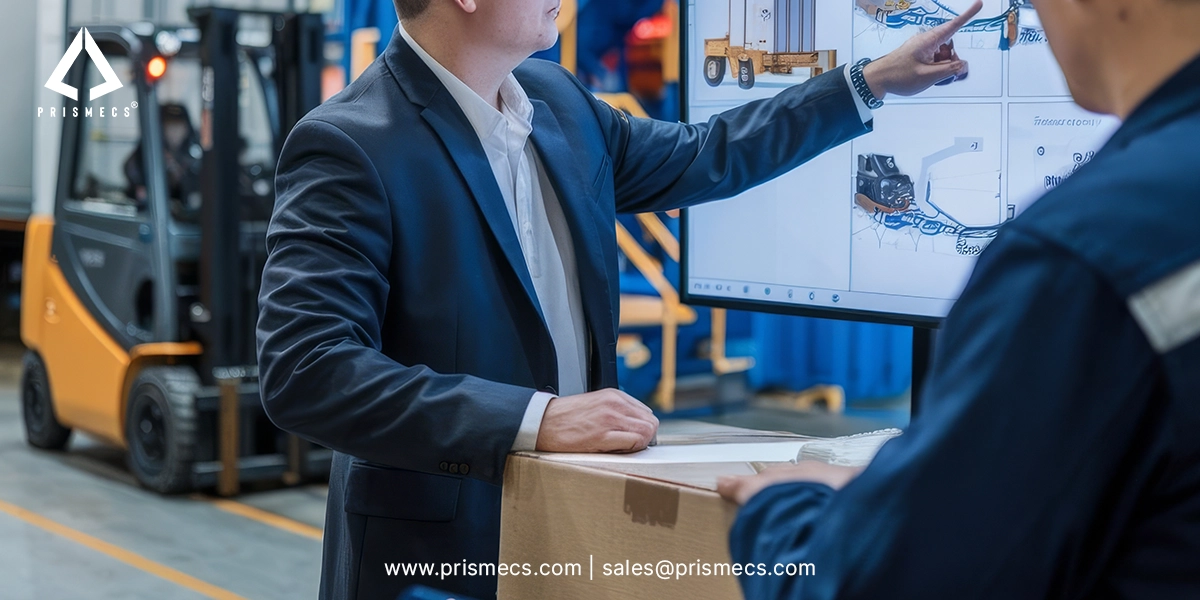
Industrial procurement services combine sourcing, supplier management, logistics, and quality control to get equipment and materials to a plant, facility, or project site on time, on budget, and to specification. For operators in power, oil and gas, and heavy industry, procurement is not an administrative task, it is a function that determines whether a project stays on schedule.
Prismecs delivers managed industrial procurement through its own EPCM teams and through eINDUSTRIFY, its dedicated Procurement-as-a-Service and digital marketplace platform, giving operators both project-embedded sourcing and standalone procurement support.
What Are Industrial Procurement Services?
Industrial procurement services involve sourcing, purchasing, managing suppliers, and delivering the equipment and materials an industrial operation needs, while controlling cost, verifying quality, and confirming compliance. This differs from simple purchasing, which is just placing an order, procurement is the full strategic process behind that order.
The category covers heavy equipment, raw materials, specialized tools, replacement parts, electrical components, and safety gear. It also includes MRO procurement, maintenance, repair, and operations items such as spare parts and consumables that keep existing equipment running rather than materials used in new construction.
These services apply across power generation, oil and gas, data centers, petrochemicals, and other capital-intensive sectors where a single missing part can hold up an entire project.
Why Industrial Procurement Services Matter
Outsourced procurement reduces costs through analytics-led sourcing improvements, with industry data showing savings in the 5% to 10% range from better supplier negotiation and spend visibility. Automation and digital procurement tools are cutting bid cycle times by as much as 50% compared to manual sourcing processes.
Visibility is a real gap most operators face without a managed process: only 6% of businesses report having full supply chain visibility, while 94% report a direct revenue impact when supply chain disruptions hit. For an industrial operator, procurement is not about shaving a few dollars off a purchase order, it is about keeping operational flow intact when a single missing component can stall an entire project. In 2026 that exposure is driven by equipment availability, with lead times on transformers and switchgear now quoted in years rather than months.
What Do Industrial Procurement Services Include?
Industrial procurement covers a full cycle, not just placing purchase orders. Requirements gathering starts the process by defining specifications, quantities, delivery timelines, and compliance requirements before any vendor is contacted.
Supplier sourcing identifies qualified vendors by checking certifications, pricing, lead times, and production capacity. Price negotiation then secures terms and contracts, while order management issues purchase orders and tracks them through to delivery.
Logistics and delivery handle shipping, customs clearance, and last-mile delivery so materials arrive where and when needed. Quality control runs pre-shipment inspections and post-delivery checks, and reporting and spend analysis give full visibility into cost, supplier performance, and improvement opportunities across the entire cycle.
Types of Industrial Procurement
Every operation needs a different mix of procurement types depending on project phase and item category.
How to Choose the Right Procurement Partner
Selecting a procurement partner in energy and heavy industry goes far beyond comparing vendors or pricing models. For operators managing power plants, refineries, grid infrastructure, or large-scale industrial assets, the right partner must integrate seamlessly into complex project environments and support long-term operational reliability.
Industry-Specific Engineering Expertise
Look for procurement teams that understand turbine systems, balance-of-plant equipment, electrical infrastructure, and critical spares. A partner experienced in power generation, oil and gas, or petrochemical operations will anticipate technical specifications, compliance requirements, and commissioning timelines without slowing down project execution.
Supply Network Built for Critical Infrastructure
In industrial environments, supplier depth matters more than supplier quantity. Strong procurement partners maintain qualified global vendor networks capable of supporting outages, fast-track EPC schedules, and emergency replacement needs, reducing exposure to downtime and logistical disruption.
Digital Visibility Across the Supply Chain
Modern procurement should provide real-time insight into order status, lead times, documentation, and logistics milestones. Platforms that integrate tracking, reporting, and performance analytics help engineering and operations teams maintain schedule certainty and manage risk across distributed projects.
Operational Reliability and Lifecycle Support
Reliability is measured by more than on-time delivery. Evaluate how a procurement partner supports inspection processes, quality assurance, installation readiness, and long-term asset performance, since providers that align procurement with O&M strategies create stronger operational continuity.
Scalable, Project-Driven Execution
Industrial procurement needs change across project phases, from early engineering through commissioning and ongoing operations. Choose a partner capable of scaling support across EPC execution, distributed energy deployments, and long-term plant optimization rather than offering a one-size-fits-all sourcing model.
Governing Standards and Compliance in Industrial Procurement
Industrial procurement in energy and heavy industry runs on three frameworks a buyer should confirm before signing a supplier agreement.
ISO 9001 is the certification to require from any supplier providing critical equipment or components. Incoterms 2020 sets 11 standardized trade terms, specifying the correct one, such as FCA or DDP, in a purchase contract prevents disputes over who pays for freight, insurance, and customs clearance. Foreign entity of concern (FEOC) sourcing rules apply specifically to components tied to federally tax-credit-eligible energy projects, making supplier documentation a compliance requirement, not just a quality one, on those projects. A procurement partner should verify all three before a purchase order is issued.
What Are the Benefits of Industrial Procurement Services?
A managed procurement partnership delivers measurable, not just qualitative, advantages. Lower total cost of ownership (TCO), the full cost of an asset including purchase price, shipping, installation, and lifecycle maintenance, comes from bulk pricing and optimized sourcing rather than unit price alone.
Faster lead times follow from real-time tracking and logistics support, while vendor-managed inventory (VMI) arrangements, where a supplier monitors and replenishes stock at the buyer's site, and just-in-time (JIT) sourcing reduce the need to carry excess inventory. Better quality follows from proper inspections and supplier audits, and reduced risk comes from diversified, vetted supplier networks that absorb disruption instead of passing it downstream.
Improved compliance with ISO 9001 and Incoterms requirements, centralized spend reporting, and freed-up internal teams round out the case. Instead of scrambling to fix sourcing problems, operations teams stay focused on building, scaling, and delivering.
Common Industrial Procurement Challenges and How to Fix Them
How to Get Started with Industrial Procurement Services
Audit Your Current Procurement
Review cost, delivery reliability, and supplier performance to find where inefficiency is actually costing money.
Set Clear Goals
Define specific objectives, cost reduction, faster lead times, or better quality control, since a procurement partner needs a defined target to design around.
Identify Key Categories
Prioritize the categories with the highest operational impact first, typically direct materials and critical spares.
Evaluate Service Providers
Assess partners on engineering expertise, supply network depth, digital visibility, and lifecycle support, not price alone.
Start Small, Then Scale
Pilot with one high-impact category before expanding scope across the operation.
Measure and Optimize
Track cost savings, on-time delivery rate, and order accuracy to give a procurement partner room to prove performance.
The Future of Industrial Procurement Services
Procurement-as-a-Service (PaaS), where sourcing, vendor management, and logistics are delivered as an outsourced platform rather than an in-house function, is one of the fastest-growing procurement models heading into 2026. North America held a 44.7% share of the global PaaS market in 2025, and the U.S. segment is projected to grow at a 10.8% compound annual growth rate through 2033, driven by demand for supplier risk management across complex, multi-tier supply chains.
AI-powered sourcing is already reducing costs rather than remaining a future concept: AI adoption in procurement can cut logistics costs by roughly 15% and improve service efficiency by up to 65%, alongside the bid-cycle-time reductions already covered above. Sustainable procurement, blockchain traceability, and closer supplier co-development are all gaining adoption, but the near-term financial case for outsourcing rests on the visibility and cost data already cited in this guide.
Managed Procurement and eINDUSTRIFY
eINDUSTRIFY is Prismecs's dedicated Procurement-as-a-Service and digital marketplace platform, built specifically for industrial buyers who need RFQ management, sourcing, and vendor coordination without embedding a full procurement team on-site. It functions as the standalone procurement layer for operators who want managed sourcing without a full EPCM engagement.
Where Prismecs's own EPCM and owner's engineering teams handle procurement as part of a larger project scope, eINDUSTRIFY serves buyers who need dedicated Procurement-as-a-Service and marketplace access on its own, backed by Prismecs for logistics, installation, and operations support once materials arrive. You can request a quote or explore available inventory directly through eINDUSTRIFY.
How Prismecs Supports Industrial Procurement and Supply Chain Excellence
Prismecs delivers industrial procurement embedded within EPCM, owner's engineering, and O&M engagements for operators managing power plants, refineries, and large-scale industrial assets. Our Supply Chain Solutions team sources components with ISO 9001 and Incoterms compliance built into vendor qualification.
For available ready-to-ship equipment, our Equipment Inventory lists turbines, transformers, and related assets, and once materials arrive, our Operations and Maintenance Services keep procured equipment performing to design specification across its operating life.
Frequently Asked Questions
What are industrial procurement services?
Industrial procurement services involve sourcing, purchasing, managing suppliers, and delivering equipment and materials for industrial operations while controlling cost, verifying quality, and confirming compliance. This differs from simple purchasing, which is just placing an order without the surrounding strategy, negotiation, and logistics management.
What is the difference between managed procurement and Procurement-as-a-Service?
Managed procurement means outsourcing the full procurement function to a provider embedded in a larger project, such as an EPCM engagement. Procurement-as-a-Service, like eINDUSTRIFY, is a standalone platform for RFQ management, sourcing, and vendor coordination without requiring a full project engagement.
How much can industrial procurement outsourcing save a company?
Analytics-led sourcing improvements typically deliver 5% to 10% in cost savings, while automation can cut procurement bid cycle times by up to 50% compared to manual processes. These figures come from better supplier negotiation, spend visibility, and reduced administrative overhead.
What standards should a procurement partner verify before sourcing industrial equipment?
A procurement partner should confirm ISO 9001 quality management certification for the supplier, the correct Incoterms 2020 designation for shipping risk and cost allocation, and foreign entity of concern (FEOC) compliance for any components tied to federally tax-credit-eligible energy projects.
What is the biggest visibility gap in industrial procurement today?
Only 6% of businesses report having full supply chain visibility, while 94% report a direct revenue impact when disruptions occur. A procurement platform with real-time tracking and spend analysis closes this gap by surfacing delays and cost variance before they affect a project schedule.
How do I choose between direct, indirect, and project-based procurement support?
Direct procurement covers materials used in production, indirect covers support items like MRO and safety gear, and project-based procurement handles sourcing for a specific capital project with its own budget and timeline. Most industrial operators need a partner capable of supporting all three rather than choosing one exclusively.
Is Procurement-as-a-Service growing, and is it worth adopting now?
North America held 44.7% of the global Procurement-as-a-Service market in 2025, with the U.S. segment projected to grow at a 10.8% compound annual growth rate through 2033. That growth is driven by demand for supplier risk management, making PaaS adoption a near-term rather than speculative decision for operators managing complex supply chains.
Partner with Prismecs and eINDUSTRIFY for Procurement and Supply Chain Excellence
Procurement isn't just about securing the lowest price, it's about creating a resilient, scalable operation that keeps critical materials flowing on schedule. Whether you need procurement embedded in a full EPCM engagement or standalone Procurement-as-a-Service through eINDUSTRIFY, Prismecs supports both paths.
Call us at +1 (888) 774-7632 or email sales@prismecs.com to discuss your procurement strategy, or visit eINDUSTRIFY to explore sourcing and marketplace options directly.
Tags: Procurement-as-a-Service Industrial Supply Chain Management ISO 9001 Supplier Compliance Managed Sourcing Solutions EPC Procurement Strategy
recent posts
O&M Services
15 minutes read
Writing a Power Plant O&M RFP That Gets Comparable Bids
Write a power plant O&M RFP every bidder must price the same way. Get the pricing template, data room checklist and weighted scorecard that expose eve...
EPCM Services
19 minutes read
25 Questions to Ask a Power Plant EPC Contractor Before You Sign
Most lists of questions to ask an EPC contractor stop at the question. Get why each matters, the strong answer, the red-flag reply and a weighted bid...
Gas Turbines
19 minutes read
Dual-Fuel Gas Turbines: How Gas-and-Liquid Fuel Flexibility Works
A dual-fuel gas turbine switches from natural gas to diesel at load, but most failures start in idle oil lines. Get transfer steps and coking fixes be...
Power Utilities
18 minutes read
Temporary and Bridge Power for Industrial Facilities: When and How to Use It
Planning bridge power past 12 months? Under EPA rules your generators may be stationary from day one. Check Tier 4, NSPS KKKKa and SPCC triggers befor...