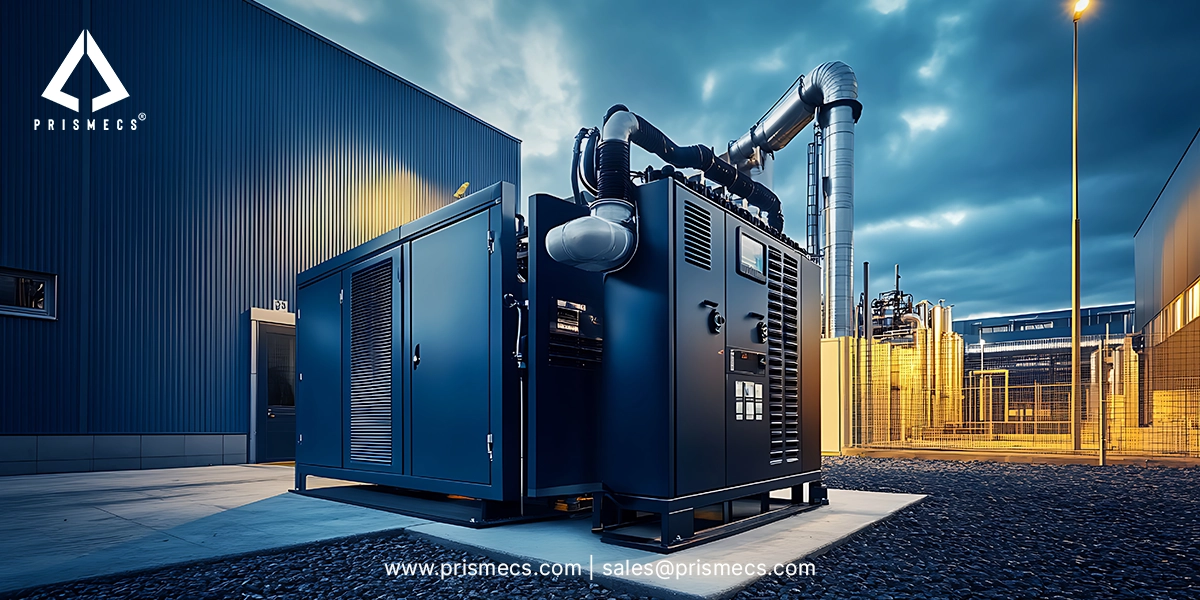
A utility feeder trips during a peak-load window, the UPS absorbs the first seconds, the generators receive the start command, and one automatic transfer switch refuses to close because its source-available logic was never tested under real sequence timing. The facility still has generators. It still has batteries. It still has a nameplate capacity. What it does not have is a backup architecture that behaves correctly when every component has to act in order, under load, without manual intervention.
That is where backup power systems succeed or fail. Failure rarely starts with a missing generator. It starts with an incomplete load hierarchy, a weak fuel plan, untested transfer logic, poor breaker coordination, or an O&M model that treats weekly no-load starts as proof of readiness.
For data centers, industrial plants, healthcare infrastructure, telecom hubs, petrochemical facilities, and power generation sites, emergency power systems must be designed as operating systems, not equipment packages. NFPA 110 frames this discipline around emergency power supply systems and their installation, testing, and maintenance requirements; IEEE 446 addresses the uses, power sources, design, and maintenance of emergency and standby power systems for industrial and commercial applications.
Size the System for Real Load Behavior
Nameplate kW is a starting point, not a performance guarantee. Data centers and industrial plants apply load in steps, not smoothly. UPS rectifiers, VFDs, compressors, chillers, motor-control centers, and transformer inrush create simultaneous demand spikes that stress governor and voltage regulator response.
Your generator specification must include:
- Steady-state kW and kVA
- Largest single block-load transfer
- Allowable voltage dip (%) and recovery time
- Allowable frequency dip (%) and recovery time
- Nonlinear load harmonic profile
- Motor starting method (DOL, soft-start, VFD)
- UPS walk-in ramp settings
- Load sequencing order and inter-step delay
ISO 8528-1 governs generating set ratings and performance classifications. A unit that holds 80% resistive load cleanly can still fail if the first black-start block combines transformer inrush with UPS rectifier demand. Load-bank testing must replicate site operating conditions, not just resistive equivalents.
Treat Transfer Logic as a Control System

Transfer equipment connects Source A or Source B, but transfer logic decides whether the power architecture survives the first 60 seconds of an outage. The control narrative should be written and approved before ATS equipment submittals are finalized.
The transfer sequence narrative must define:
- Normal-source failure thresholds (voltage, frequency, phase)
- Start delay and confirm-on-delay to prevent nuisance transfers
- Transfer permissive and bus dead-band windows
- Load priority, inhibit conditions, and retransfer delay
- Closed-transition limits and synchronizing parameters
- Failure response: what happens when the standby source does not appear
- Manual bypass operation sequence
Applicable standards: IEC 60947-6-1 (transfer switching equipment) and UL 1008 (ATS up to 1000 V, including automatic, closed-transition, bypass/isolation, and fire-pump types).
The most valuable commissioning tests are not successful ones; they are the forced-failure scenarios. Force the ATS to see a failed standby source. Confirm load shedding before voltage collapses. Verify bypass/isolation permits maintenance without critical bus exposure.
Design Redundancy for Maintenance, Not Just Outage Survival
Redundancy has no value if scheduled maintenance forces the facility into a single point of failure. Four questions must be answered before the one-line diagram is frozen:
- Which component can be removed from service without load loss?
- Which component failure keeps the facility within thermal and electrical limits?
- Which maintenance activity creates temporary single-point exposure?
- Which breaker, ATS, UPS, fuel, cooling, or control element remains unmitigated?
Topology | Redundancy Type | Maintainability | Typical Use Case |
N+1 | Capacity redundancy | Single path exposure during maintenance | Industrial plants, mid-tier data centers |
2N | Full path redundancy | Concurrent maintainable | Tier III/IV data centers, hospitals |
2N+1 | Fault tolerant + extra capacity | Fully concurrent maintainable | Hyperscale, mission-critical campuses |
Distributed Redundant | Shared load across multiple paths | Partial concurrent maintainability | Large campus power distribution |
Validate Mechanical Support Systems First
Electrical engineers focus on breakers and transfer timing. Field failures often originate in mechanical support systems, and a generator cannot accept load if any of the following are deficient:
- Starting batteries: weak cells or inadequate float charge
- Jacket-water heaters: undersized for ambient temperature
- Day tanks: contaminated fuel or insufficient return-line sizing
- Louvers and dampers: fail-to-open on power loss
- Radiator airflow: recirculation from inadequate discharge clearance
- Exhaust backpressure exceeds OEM limit under full load
NFPA 110 Class specifies the minimum runtime without refueling (Class 2, 6, 48, X). At coastal and desert sites, support systems degrade faster than nameplate suggests salt air attacks radiator fins and terminations; fine dust loads filters; stored fuel accumulates water and microbial growth. Every support system needs an inspection point, alarm threshold, maintenance interval, and commissioning test.
Specify Power Quality at the Load Terminals
Power availability is not the same as power usability. IT equipment, VFDs, rectifiers, and process controls care about voltage sags, frequency deviation, harmonics, transient events, and transfer duration, not just generator kW.
Acceptance criteria must be measured at the load, not just at the generator terminals. Define limits for:
- Voltage and frequency deviation at steady state and during block-load transfer
- Total harmonic distortion (THD-V) at the critical bus, per IEEE 519
- Neutral current under nonlinear load
- Transfer interruption duration at the UPS input
- Surge transient exposure near switchgear, transformers, and service entrances, per IEC 61000-4-5
Generator alternator reactance, transformer impedance, UPS input filtering, and grounding configuration all affect the waveform seen by the load. A system that holds kW can still overheat transformers or drop control power supplies if voltage distortion is uncontrolled.
Commission for Failure Sequences, Not Just Successful Operation

A commissioning plan that only proves normal operation leaves the owner exposed. Integrated systems testing must begin from credible failure events; NFPA 110 requires installation of acceptance testing and AHJ involvement for Level 1 systems.
Test Scenario | What to Validate | Pass Criteria |
Utility loss (black start) | Generators start, ATS transfer, load pickup sequence | Full load on bus within Type classification time |
Generator failure to start | Redundant unit assumes load; alarms fire | No loss of critical bus; alarm annunciated within 30 sec |
ATS failure to transfer | Bypass/isolation path available; manual override works | Critical load maintained; operator intervention documented |
Breaker trip under load | Upstream protection holds; load shed as designed | No cascading trip; priority loads remain energized |
UPS battery discharge | Generator sustains load before UPS depletion | Seamless handoff; no voltage sag below tolerance |
Fuel pump failure | Day tank level alarm; transfer to alternate pump | Runtime maintained; alarm response within spec |
Test reports must capture timestamps, waveform captures, alarm logs, breaker state records, operator actions, and exceptions. Commissioning also reveals installation details that design drawings miss; a mislanded control cable, a factory-default ATS delay, or an unheated generator room can each defeat an otherwise sound design.
Build O&M Into the Design From Day One
Reliability declines when operations inherit a system designed without maintainability. O&M requires space, isolation, access, trained operators, spare parts, test points, safe switching procedures, and documentation.
A minimum O&M specification for backup power systems includes:
- Battery impedance testing and charger alarm verification
- Fuel sampling, polishing, and water/microbial analysis
- Coolant and oil analysis on scheduled intervals
- Thermal imaging of switchgear, ATS, and UPS under full load
- Relay setting records and ATS timing verification
- Periodic black-start and full-load exercises with AHJ witness where required
- Firmware and controls version management
Every asset, generator, ATS, breaker, relay, UPS module, battery string, fuel pump, day tank, louver, heater, and sensor need a tag, maintenance interval, spare part reference, and failure code in a CMMS-ready asset hierarchy. Without that structure, maintenance becomes reactive, and tribal knowledge fills the gaps.
Procurement Decisions Protect Lifecycle Reliability
Equipment selection determines reliability before a single cable is pulled. The failure mode is rarely a bad generator. It is a bid package that never forced the vendor to disclose how the unit behaves under your load profile, at your site temperature, against your runtime class. Procurement is a reliability engineering activity, not a purchasing formality.
Bid packages must require vendors to disclose:
- Generator rating basis: standby, prime, or continuous application
- Alternator capability under the specified nonlinear load profile
- Transfer switch listing standard (UL 1008, IEC 60947-6-1)
- Paralleling system load-shed logic and closed-transition limits
- Battery sizing for required starting attempts at minimum site temperature
- Fuel system sizing for runtime and return flow
- Controls protocol compatibility and cybersecurity posture
- OEM documentation, factory test reports, and spare-parts lead times
This is where sourcing discipline either protects the design or quietly undermines it. Prismecs runs procurement as an engineered workflow rather than a catalog transaction, through its Supply Chain Solutions and the eINDUSTRIFY procurement platform, which handles RFQs, vendor qualification, factory test-report verification, and logistics under one accountable chain. When a transformer or generator package has to match a commissioning window, the difference between a 6-week and a 20-week lead time is a sourcing network, not a spec sheet. Prismecs has sourced critical energy equipment under tight deadlines and strict compliance requirements for partners including GE Vernova, using a global vendor network and QA workflows to keep delivery on the project's critical path.
Design for the Next Load Increase
AI clusters, liquid cooling, and higher rack densities compress the time between design capacity and operating capacity. Modularity must be planned, not retrofitted.
Reserve and document provisions for:
- Spare generator positions and paralleling bus sections
- Switchgear expansion sections with protection-setting study updates
- Additional fuel storage and fill connection capacity
- UPS module growth paths and static bypass headroom
- Busway and cable tray expansion
- Controls I/O capacity for new loads and monitoring points
Partner With Prismecs for Backup Power Systems That Perform Under Load
A backup power system is only proven the day it survives a real failure sequence, not the day it passes a no-load start. Prismecs designs, sources, commissions, and maintains emergency and standby power as an operating system across data centers, power utilities, oil and gas, petrochemicals, and healthcare facilities.
That lifecycle model is backed by delivery, not just design: 1,500+ MW delivered across 15 countries without a single commissioning failure, including multi-unit TM2500 mobile gas turbine programs in Oman, Taiwan, and Switzerland sustained by Prismecs O&M crews and CMMS-driven maintenance.
Prismecs brings the full stack to your architecture:
- EPCM and Owner's Engineering for load classification, sizing, and redundancy design
- Installation & Commissioning built around forced-failure test sequences, not just successful starts
- O&M Services with battery impedance testing, fuel polishing, thermal imaging, and CMMS asset hierarchies
- Supply Chain Solutions and ready-to-ship turbines, transformers, and generators with 24/7 emergency response
Speak with Prismecs' Data Center and O&M specialists to stress-test your backup power architecture, commissioning plan, and maintenance readiness before the next outage does it for you.
Backup Power System Design: Key Questions
What is the first step in designing a backup power system?
Classify every load before sizing any equipment. Under NFPA 70 (Articles 700, 701, 702) and NFPA 110, each load is assigned a restoration time and priority tier: emergency, legally required standby, mission-critical IT, or optional standby, before the one-line diagram is drawn. Generator kW is the last decision, not the first.
Why do backup power systems fail even when the generator works?
Most failures are sequence and logic failures, not equipment failures. A facility can have generators, batteries, and nameplate capacity and still go dark because an automatic transfer switch's source-available logic was never tested under real timing, breaker coordination was weak, or the load hierarchy was incomplete.
What does NFPA 110 require for backup power?
NFPA 110 defines emergency power supply systems by Level (1 or 2), Class (runtime hours: 2, 6, 48, or X), and Type (transfer time: 10, 60, or 120 seconds). These three parameters drive equipment quality, fuel storage sizing, ATS delay, and the rigor of acceptance testing, including AHJ-witnessed testing for Level 1 systems.
What is the difference between N+1, 2N, and 2N+1 redundancy?
N+1 adds one spare unit but exposes a single path during maintenance. 2N provides fully independent dual paths and is concurrently maintainable, typical for Tier III/IV data centers and hospitals. 2N+1 adds fault tolerance plus extra capacity for hyperscale and mission-critical campuses.
How should backup power systems be commissioned?
Commission from failure scenarios, not successful ones. Force the ATS to see a failed standby source, confirm load shedding before voltage collapses, and verify bypass/isolation. Test reports must capture timestamps, waveform captures, alarm logs, and breaker states, not just a passing black-start.
Does Prismecs design, install, and maintain backup power systems?
Yes. Prismecs delivers backup and standby power as a full lifecycle: EPCM and Owner's Engineering, Installation & Commissioning around forced-failure testing, and OEM-agnostic O&M, across data centers, power utilities, oil and gas, petrochemicals, and healthcare, backed by 1,500+ MW delivered across 15 countries.
Tags: NFPA 110 emergency power data center power redundancy UPS and ATS commissioning mission-critical power design standby generator systems
recent posts

O&M Services
15 minutes read
Writing a Power Plant O&M RFP That Gets Comparable Bids
Write a power plant O&M RFP every bidder must price the same way. Get the pricing template, data room checklist and weighted scorecard that expose eve...

EPCM Services
19 minutes read
25 Questions to Ask a Power Plant EPC Contractor Before You Sign
Most lists of questions to ask an EPC contractor stop at the question. Get why each matters, the strong answer, the red-flag reply and a weighted bid...
Gas Turbines
19 minutes read
Dual-Fuel Gas Turbines: How Gas-and-Liquid Fuel Flexibility Works
A dual-fuel gas turbine switches from natural gas to diesel at load, but most failures start in idle oil lines. Get transfer steps and coking fixes be...

Power Utilities
18 minutes read
Temporary and Bridge Power for Industrial Facilities: When and How to Use It
Planning bridge power past 12 months? Under EPA rules your generators may be stationary from day one. Check Tier 4, NSPS KKKKa and SPCC triggers befor...