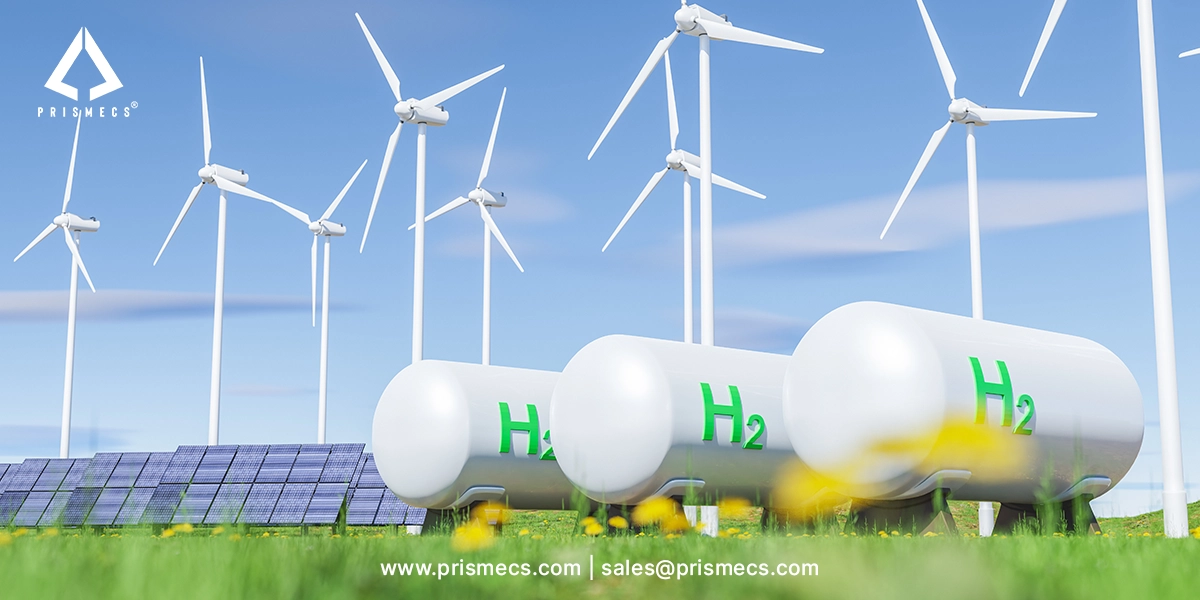
A green hydrogen plant converts renewable electricity and purified water into hydrogen through electrolysis, but the electrolyzer is only one subsystem among several that determine whether the plant performs. Water treatment, power supply, compression, and storage together consume a substantial share of plant energy and capital.
This guide covers how a plant operates, how the four commercial electrolyzer technologies compare, why water treatment is the most underestimated subsystem, where balance of plant decides efficiency, the standards that govern hydrogen facilities, and how to plan a project.
It is written for project developers, EPC and engineering teams, and industrial and utility operators evaluating hydrogen production facilities.
Prismecs delivers the power, electrical, and infrastructure scope that hydrogen plants depend on. It does not manufacture electrolyzers or produce hydrogen.
How a Green Hydrogen Plant Works
A green hydrogen plant splits purified water into hydrogen and oxygen using electricity from renewable sources, emitting no carbon dioxide in the process. The plant is an integrated system in which generation, treatment, electrolysis, and gas handling must be sized against one another.
Renewable power supply
Dedicated renewable generation supplies the electricity, and its capacity typically exceeds the electrolyzer rating because renewable output is variable. The relationship between generation capacity and electrolyzer capacity determines the plant's utilization and therefore its hydrogen cost.
Grid connection, transmission, and battery storage frequently form a separate contract package from the electrolysis plant itself, because they are power infrastructure disciplines rather than process ones.
Water treatment and electrolysis
Feed water passes through a treatment train to reach the purity the electrolyzer requires, then enters the stack where direct current splits it into hydrogen and oxygen. Water quality is not a detail; membrane and electrode degradation follow directly from impurities.
Gas processing, compression, and storage
Hydrogen leaves the stack requiring drying, purification, and compression before storage or delivery. Compression is energy-intensive and represents a significant parasitic load, which is why electrolyzers that output at elevated pressure reduce downstream compression duty.
Electrolyzer Technologies Compared
Four electrolyzer technologies exist commercially or near-commercially, and only two are used at industrial scale today. Selection is driven by whether the power supply is steady or variable, by capital budget, and by required response.
According to a peer-reviewed techno-economic assessment drawing on more than 40 studies, alkaline electrolyzers are the most cost-effective option in baseload power contexts, while PEM offers superior dynamic response and gas purity at higher cost, and SOEC remains limited by thermal cycling despite high theoretical efficiency.
Matching technology to power profile
The decisive question is whether the plant runs on firm power or on variable renewable output. PEM can follow variable generation down to low minimum loads, while alkaline systems prefer steady operation and respond more slowly, which makes the power supply architecture and the electrolyzer choice a single coupled decision rather than two separate ones.
Efficiency is expressed in kilowatt-hours per kilogram of hydrogen, which is the metric that connects electrolyzer performance directly to production cost, since electricity dominates the levelized cost of hydrogen.
Water Treatment: The Underestimated Subsystem
Water treatment is routinely underestimated during early design, because the stoichiometric water requirement for electrolysis is far lower than the plant's actual consumption. System blowdown, cooling, and treatment losses all add to the theoretical figure.
Purity requirements
Electrolyzers require ultra-pure water, and the treatment train exists to produce it. Typical designs target resistivity above 18 megaohm-centimeters through a multi-stage process of pre-treatment and filtration, reverse osmosis to remove dissolved salts, and ion exchange polishing to reach final purity.
ASTM D1193, the standard specification for reagent water, provides the benchmark, though electrolyzer manufacturers frequently specify tighter requirements than the standard grades. Purity tolerance differs by technology: PEM requires extremely high purity to protect thin polymer membranes, alkaline systems tolerate more but circulate larger volumes for electrolyte and cooling duty, and SOEC requires steam, which adds a dedicated generation stage to the treatment train.
Wastewater and water-stressed locations
Treatment produces a waste stream, and its disposal is a genuine constraint in arid regions where many high-irradiance hydrogen projects are sited. Reverse osmosis brine carries high salinity that may exceed local discharge limits, along with antiscalants and biocides from pre-treatment.
Zero liquid discharge systems resolve the disposal problem but add substantial capital and operating cost. In coastal locations, desalination can supply feed water, though it adds another energy load to the plant's balance.
Balance of Plant: Where Efficiency Is Won or Lost
Balance of plant, meaning everything outside the Electrolyzer stack, determines a large share of overall plant efficiency and is the responsibility of the EPC rather than the stack manufacturer. This is the least discussed and most consequential aspect of hydrogen plant design.
The components involved are unglamorous and collectively decisive: pumps circulating water and electrolyte, cooling systems rejecting process heat, rectifiers converting AC to the direct current the stack requires, compressors raising hydrogen to storage pressure, control systems, and the electrical distribution feeding all of it.
Industry analysis indicates that balance of plant loads account for roughly 10 to 20% of plant efficiency losses, and that plant-wide efficiency depends on how well the EPC integrates and optimizes them. Two plants using identical stacks can deliver materially different kWh/kg depending on this integration.
The practical implication for developers is that stack efficiency quoted on a datasheet is not plant efficiency. Evaluating a project on stack performance alone omits the portion of the energy balance that the project team actually controls.
Hydrogen Storage and Delivery
Stored hydrogen is what converts intermittent production into a dispatchable energy resource, and the storage method should follow from duration and scale rather than from convention. Each option carries a different cost and footprint profile.
- Compressed gas in pressurized tanks suits on-site buffering, backup, and peak-load supply at modest volumes.
- Underground caverns in suitable geology provide large-scale, long-duration storage at the lowest cost per unit stored.
- Pipeline delivery supplies power plants, industrial users, and hydrogen-ready turbines directly, removing on-site storage duty.
- Liquefaction enables dense storage and long-distance transport, at the cost of significant energy for the liquefaction process itself.
- Conversion to ammonia provides a transportable carrier for export, which is the route chosen by most large export-oriented projects.
Storage integration is an engineering scope in its own right, requiring pressure system design, materials selection for hydrogen service, safety systems, and integration with the plant's control and electrical systems.
Standards Governing Green Hydrogen Plants
Hydrogen facilities are governed by a specific family of safety, equipment, and quality standards, distinct from general industrial codes. Citing them correctly is how a design demonstrates compliance to authorities and insurers.
Electrical and power infrastructure carries its own requirements alongside these. Rectifiers, switchgear, transformers, and distribution serving the plant fall under the applicable electrical codes and standards, which is why hydrogen plant projects require both process and power engineering competence.
Green Hydrogen Projects at Scale
Large projects demonstrate how renewable generation, electrolysis, and industrial infrastructure combine at scale, and they reveal how the work is actually contracted.
NEOM illustrates the contracting structure clearly. According to Air Products, which serves as primary EPC contractor and system integrator, the complex includes 257 wind turbines generating 1.6 GW, a 2.2 GW solar farm, and a dedicated transmission grid carrying 4 GW across the site, and is expected to avoid roughly five million tonnes of CO2 annually.
The division of scope is instructive for anyone planning a project. Electrolysis and system integration sat with one contractor, while the renewable generation, transmission, and battery storage packages were contracted separately, alongside further specialist scopes for compression and inverters. A hydrogen plant is assembled from distinct engineering disciplines rather than delivered as a single product.
How to Plan a Green Hydrogen Plant
Planning a hydrogen project runs from resource assessment through offtake definition to technology selection, and the sequence matters because early decisions constrain later ones.
Assess the renewable resource.
Evaluate solar, wind, or hydro potential and site the plant close to generation to limit transmission losses. Resource quality sets capacity factor, which drives hydrogen cost more than almost any other variable.
Define the offtake.
Power generation, industrial feedstock, mobility, or export each imply different purity, pressure, storage, and delivery requirements. Designing before the use case is fixed produces a plant that fits nothing well.
Select the electrolyzer against the power profile.
Match technology to whether supply is firm or variable, weighing capital cost against response capability and purity requirements.
Secure and engineer the water supply.
Confirm availability, design the treatment train to the electrolyzer's specification, and resolve wastewater disposal before site selection is finalized, particularly in water-stressed regions.
Engineer the balance of plant deliberately.
Rectification, cooling, compression, and electrical distribution determine plant efficiency and should be optimized rather than assembled.
Plan storage and delivery.
Choose storage mode by required duration and scale, and design to the applicable hydrogen safety codes from the outset.
How Prismecs Supports Green Hydrogen Plant Projects
Prismecs delivers the power, electrical, and infrastructure scope that hydrogen plants depend on, covering renewable generation integration, electrical systems, storage, and EPC coordination. Prismecs does not manufacture electrolyzers or produce hydrogen; it engineers and builds the infrastructure around them.
The Prismecs capability set for hydrogen plant projects:
- Renewable generation and grid integration: solar, wind, and storage integration engineered to supply electrolysis load, including transmission and interconnection.
- Electrical infrastructure: transformers, switchgear, and distribution sized for plant load, the scope that feeds rectification and balance of plant.
- Battery energy storage: BESS smoothing variable renewable output to improve electrolyzer utilization.
- EPC and owner's engineering: project coordination across specialist packages, plus feasibility and site assessment for the power and infrastructure scope.
- O&M: lifecycle maintenance of power generation and electrical assets serving the facility.
The differentiator is the scope that large projects contract separately. Electrolyzer manufacturers supply stacks and process integrators handle electrolysis, but the renewable generation, transmission, storage, and electrical infrastructure form their own package, and that is the work Prismecs performs.
Frequently Asked Questions
How does a green hydrogen plant work?
A green hydrogen plant uses renewable electricity to split purified water into hydrogen and oxygen through electrolysis, emitting no carbon dioxide. Feed water passes through a treatment train to reach ultra-pure quality, direct current drives the electrolyzer stack, and the hydrogen produced is dried, purified, and compressed before storage or delivery. Renewable generation capacity typically exceeds electrolyzer capacity because renewable output varies.
Which electrolyzer technology should a project use?
Four technologies exist commercially or near-commercially. Alkaline is the most mature and cost-effective for steady baseload operation. PEM offers faster response and higher gas purity, suiting variable renewable input, at higher capital cost. SOEC achieves high efficiency where waste heat is available but is limited by thermal cycling durability. AEM is emerging. Selection follows the power profile more than any other factor.
How much water does a green hydrogen plant need?
Actual consumption is significantly higher than the stoichiometric requirement, because system blowdown, cooling, and treatment losses all add to the theoretical figure. Water must also be ultra-pure, typically above 18 megaohm-centimeters resistivity, achieved through pre-treatment, reverse osmosis, and ion exchange polishing. ASTM D1193 provides the benchmark, though manufacturers often specify tighter requirements than the standard grades.
What is balance of plant in a hydrogen facility?
Balance of plant covers everything outside the electrolyzer stack: pumps, cooling, rectifiers, compressors, controls, and electrical distribution. It accounts for roughly 10 to 20% of plant efficiency losses, and plant-wide efficiency depends on how well the EPC integrates and optimizes those loads. Two plants using identical stacks can deliver materially different efficiency depending on this integration.
Which standards govern green hydrogen plants?
ISO 22734 covers hydrogen generators using water electrolysis. NFPA 2, the Hydrogen Technologies Code, governs safety for generation, storage, and use. ASME B31.12 covers hydrogen piping and pipelines, ISO 19880 covers gaseous hydrogen components, and ISO 14687 specifies fuel quality. ASTM D1193 benchmarks feed water purity. Electrical infrastructure additionally falls under the applicable electrical codes.
What is the largest green hydrogen plant in the world?
The NEOM Green Hydrogen Project in Saudi Arabia is the largest by electrolyzer capacity, with approximately 2.2 GW of electrolysis supported by 4 GW of dedicated renewable generation from 2.2 GW solar and 1.6 GW wind across 257 turbines. It is designed to produce up to 600 tonnes of hydrogen per day, converted into 1.2 million tonnes of ammonia annually, with product availability targeted for 2027.
Why Hydrogen Plants Are Integration Projects
A green hydrogen plant is an integration project rather than an equipment purchase. The electrolyzer determines a portion of performance, while water treatment, power supply, compression, and electrical infrastructure determine the rest, and those systems are contracted, engineered, and optimized separately.
Developers planning hydrogen facilities need partners across each discipline, including the renewable generation, electrical infrastructure, and storage scope that large projects package independently. That is where Prismecs works: the power and infrastructure layer that hydrogen production depends on.
To discuss renewable generation, electrical infrastructure, or storage integration for a hydrogen project, call +1 (888) 774-7632 or email sales@prismecs.com.
Tags: green hydrogen plant electrolyzer technology comparison hydrogen plant water treatment balance of plant ISO 22734 hydrogen
recent posts
EPCM Services
19 minutes read
25 Questions to Ask a Power Plant EPC Contractor Before You Sign
Most lists of questions to ask an EPC contractor stop at the question. Get why each matters, the strong answer, the red-flag reply and a weighted bid...
Gas Turbines
19 minutes read
Dual-Fuel Gas Turbines: How Gas-and-Liquid Fuel Flexibility Works
A dual-fuel gas turbine switches from natural gas to diesel at load, but most failures start in idle oil lines. Get transfer steps and coking fixes be...
Power Utilities
18 minutes read
Temporary and Bridge Power for Industrial Facilities: When and How to Use It
Planning bridge power past 12 months? Under EPA rules your generators may be stationary from day one. Check Tier 4, NSPS KKKKa and SPCC triggers befor...
Gas Turbines
16 minutes read
What Is a Mobile Gas Turbine Power Plant? TM2500-Class Units Explained
A mobile gas turbine power plant is a transportable power generation system designed to add electrical capacity faster than a conventional permanent p...