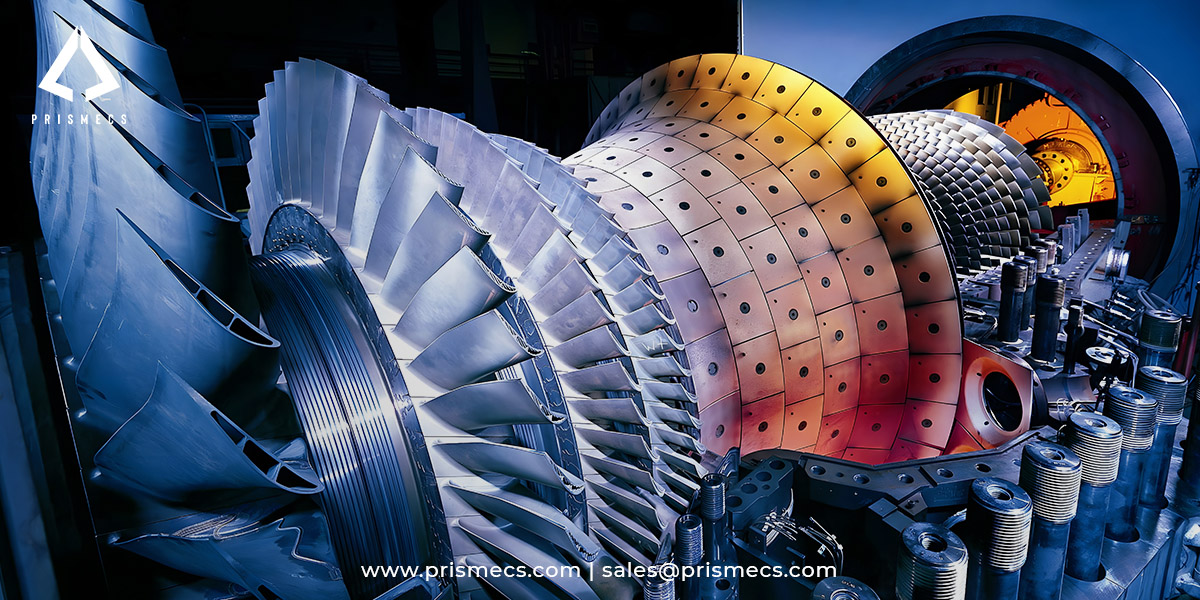
Gas turbine engines have revolutionized electricity generation by delivering high-efficiency, reliable power from a variety of fuels. Since their first commercial deployment in 1939, these engines have become central to industrial and utility-scale power plants worldwide.
This guide explores the technical operation of gas turbines, compares them to reciprocating engines used in industrial power applications, and highlights the operational advantages that support EPC, O&M, and distributed energy projects.
What Is a Gas Turbine Engine?
A gas turbine engine is a continuous-combustion system that converts fuel energy into mechanical and electrical power. By compressing air, mixing it with fuel, and igniting it at high pressure, gas turbines produce rotational energy that drives generators or mechanical systems.
Key benefits of gas turbines include:
- High power density in compact designs
- Operational reliability with fewer moving components than reciprocating engines
- Fuel flexibility, including natural gas, diesel, or synthetic alternatives
- Integration into combined cycle systems for enhanced energy efficiency
This makes them essential for power plants, oil & gas facilities, industrial manufacturing, and distributed energy systems.
How Gas Turbines Wor
A typical turbine engine consists of three key parts:
Compressor
The compressor draws in large volumes of air and compresses it into compressed air. This air acts as the base for combustion and energy generation. In engineering designs, advanced control systems regulate airflow and maintain efficiency at higher temperature ranges. Similar to a steam engine, the compressor converts kinetic energy into thermal energy. This energy moves to the next stage.
Combustion Chamber
Inside the chamber, someone injects fossil fuel, such as natural gas, into compressed air. They ignite this mixture to produce exhaust gas at an extremely high temperature. These gases serve as a power source, flowing into the turbine. In advanced systems, heat exchanger technology boosts thermal efficiency by recycling heat. Heat exchangers work like those in nuclear reactors or combined cycle power plants.
Turbine
The turbine rapidly expands the hot gases, spinning blades at high speed. This rotation helps drive the compressor and powers an electric generator to create electricity. Depending on the type of internal design, engineers may add an electric motor for hybrid systems. The process follows the Brayton Cycle, where efficiency depends on pressure ratio and firing temperature. Engineers include monitoring to keep operations stable.
Read More: Gas Turbine Power Station for Industries
Role of Reciprocating Engines in Industrial Power Generation
Reciprocating internal combustion engines are widely deployed in industrial and utility-scale power applications where operational flexibility and fast response are critical. Unlike gas turbines, which operate on continuous combustion, reciprocating engines use cyclic combustion within individual cylinders to generate mechanical power.
In power generation environments, these engines are commonly used for:
- Distributed energy systems
- Grid stabilization and peak-shaving applications
- Emergency and standby power supply
- Remote industrial operations
One of the key advantages of reciprocating engines is their ability to achieve full load rapidly, making them highly effective for backup power and load-following duties. Their modular design also allows operators to scale capacity incrementally based on site demand.
However, reciprocating engines typically require more frequent maintenance due to the higher number of moving components and mechanical wear points compared to gas turbines.
For large-scale, continuous power generation, gas turbines often provide superior lifecycle efficiency, reliability, and operational stability.
Aero-Derivative vs. Heavy-Duty Gas Turbines
Two main types of turbine engines exist:
Heavy Duty Gas Turbines | Aero-Derivative Gas Turbines |
Designed for stationary applications
| Derived from aircraft engines. Compact, lightweight, and portable
|
Pressure ratios up to 18:1
| Higher pressure ratios (up to 30:1)
|
Known for long operational life and robust construction
| Better thermal efficiency, lower emissions, and quicker startups
|
Both are used in power generation but differ in design and operational flexibility.
Thermal Efficiency & Combined Cycle Operations
While a simple cycle gas turbine engine has an average efficiency of 30-40%, combined cycle systems improve this dramatically.
How?
Combined cycle power plants capture exhaust gas from the gas turbine, usually around 600°C. They use this heat to power a steam engine. These plants achieve thermal efficiency of 55–60%.
However, operating in combined mode requires:
- Longer startup times
- Complex purging procedures
- Gradual ramp-up to full power output
Gas Turbines vs. Combustion Engines: A Technical Comparison
Here’s how a gas turbine operates compared to a combustion engine across several operational metrics:
| Specification | Gas Turbine | Reciprocating Engine |
|---|---|---|
| Start-up Time | Combined cycle: ~20 min | <10 min |
| Load Flexibility | Less efficient for short-duration load balancing | Excellent for pulse loads and emergency operations |
| Modularity | Designed for large-scale installations | Highly modular; ideal for distributed or small-scale applications |
| Ambient Temperature Sensitivity | Can experience performance drops in extreme environments | More stable output under varying ambient conditions |
| Ramp Speed | Slower ramp-up/down | Fast ramping suitable for grid stabilization |
| Water Requirements | Often requires water for cooling or emissions control | Lower water usage |
| Fuel Flexibility | Efficient primarily with gaseous fuels | Can switch between liquid and gaseous fuels mid-operation |
Key Benefits of Gas Turbine Engines
- High power output in a compact design
- Ability to produce electricity efficiently in combined cycle setups
- Reliable operation with fewer moving parts compared to reciprocating engines
- Operates at high pressure and higher temperature with reduced emissions
- Can be integrated with steam engine systems for enhanced energy recovery
Gas Turbine Applications Across Industrial Power and Energy Sectors
Gas turbines play a central role in modern energy infrastructure due to their high power density, operational reliability, and fuel flexibility. They are widely deployed across industries where uninterrupted power supply and operational efficiency are mission-critical.
Key industrial applications include:
Utility-Scale Power Generation
Gas turbines are extensively used in simple cycle and combined cycle power plants, delivering reliable baseload and peaking power to national and regional grids.
Oil and Gas Operations
In upstream and downstream facilities, gas turbines provide mechanical drive and on-site electricity generation for compressors, pumping stations, and processing facilities.
Industrial Manufacturing Facilities
Energy-intensive industries such as petrochemicals, metals, and heavy manufacturing rely on gas turbines for captive power generation, ensuring operational continuity and energy cost optimization.
Distributed Energy and Microgrid Systems
Gas turbines are increasingly deployed in decentralized energy systems, supporting microgrids, industrial campuses, and mission-critical infrastructure such as data centers.
Their ability to operate on multiple fuel types and deliver consistent high-output power makes them a preferred solution for industrial operators worldwide.
Need Expert Gas Turbine Solutions?
At Prismecs, we offer cutting-edge services for gas turbine engines. We deliver equipment and control systems tailored to meet your industry's specific needs. Whether you're looking for parts, complete systems, or maintenance support, our expert team is here to help.
- Comprehensive gas turbine parts & systems
- Maintenance & repair solutions
- Custom solutions for power and industrial applications
Contact us today to learn how we can optimize your mechanical energy systems. To avail of our services, please call us at +1 (888) 774-7632 or email us at sales@prismecs.com. Visit our website or reach out to our Contact Us page to get started!
Tags: Gas Turbine Engine Reciprocating Engines High Speed Internal Combustion Engine Exhaust Gas Natural Gas Propulsion System Turbine Engine Gas Turbine Operates Power Plant Jets Engine
recent posts
Power Generation
10 minutes read
How to Maximize Uptime in Power Generation Plants
Discover how Prismecs power plant maintenance helps operators prevent outages, protect revenue, and keep turbines running at peak performance. Learn h...
Renewables
8 minutes read
Opportunities in Renewable Energy Development
Explore Renewable Energy Development strategies focused on grid stability, faster deployment, and resilient power systems with Prismecs. Plan your nex...

Press Release
2 minutes read
Altaaqa Global & Prismecs Form Strategic Cooperation to Accelerate Modular Power Deployment Across USA
Prismecs and Altaaqa Global Announce Strategic Cooperation to Accelerate Modular Power Deployment in the United States Houston, TX & Dubai, UAE – Febr...

Procurement
9 minutes read
Complete Guide to Industrial Procurement Services
Explore Industrial Procurement Services for power and oil & gas projects. Cut delays, secure critical equipment, and build resilient supply chains wit...